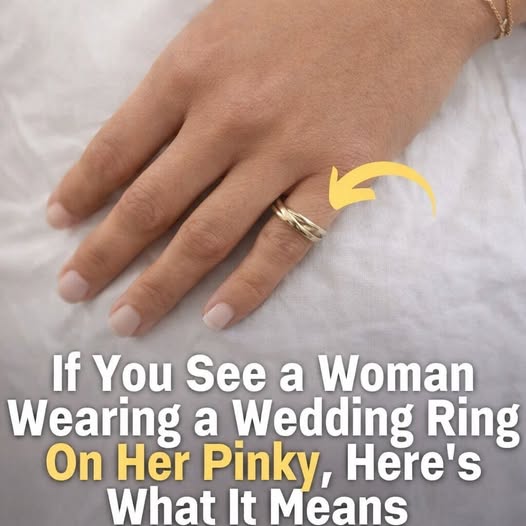
For centuries, rings have communicated meaning without words, signaling unions, promises, alliances, and social positions long before the wearer spoke. Traditionally, the ring finger carried symbolism tied to romance, marriage, and devotion, reinforced by myth and repetition. Against this backdrop, women choosing pinky rings represents a subtle yet potent disruption. At first glance, it may seem purely aesthetic, a choice of metal or style. Yet for many, the pinky ring is a personal declaration, a symbol of self-recognition and fulfillment that does not require external validation. Unlike engagement rings or wedding bands, it exists independently or alongside them, quietly asserting that love can be inward-facing, self-directed, and worthy of celebration on its own terms.
The pinky finger itself contributes to the symbolism. Historically associated with communication, intuition, and individuality—and linked to Mercury in ancient traditions—it is least tied to obligation or societal expectation. Choosing it for a ring emphasizes autonomy. For some women, a pinky ring marks a moment of personal reclamation after a breakup, divorce, or life challenge, transforming endings into beginnings. Others use it to honor milestones rarely acknowledged publicly: financial independence, survival of illness, emotional growth, or personal achievements. In these cases, the ring functions as a private ceremony, a tangible acknowledgment of experiences that may otherwise go unnoticed.
Psychologically, wearing a pinky ring redirects the concept of commitment inward. It becomes a daily reminder of boundaries, self-respect, and intentional living. In cultures that equate happiness with romantic partnership, this quiet gesture can feel revolutionary. It neither rejects love nor relationships, but it prioritizes self-knowledge and emotional health. Many women describe their pinky rings as grounding tools during moments of stress or self-doubt, reinforcing promises made to themselves rather than to others. Freely chosen rather than socially mandated, these rings serve as anchors, embodying agency and autonomy rather than decoration alone.
Fashion and history converge in this modern expression. Pinky rings have long symbolized power, wealth, and rebellion, typically through male associations. Today, women reclaim the pinky ring to signal sovereignty over self rather than dominance over others. Styles range from understated bands to bold stones or inherited pieces, reflecting personal narrative rather than public expectation. This flexibility allows each wearer to define the meaning herself, rewriting a historically male-coded symbol into one of personal empowerment and identity.
While social media has amplified visibility, the motivation behind pinky rings remains deeply personal. Unlike public markers of romantic milestones, the pinky ring resists performance, validation, or explanation. Its power lies in quietness; many women wear it without explanation, preserving its private significance. This contrasts sharply with societal rituals around engagement or wedding rings, highlighting that some commitments are sacred precisely because they are self-directed and unshared.
Ultimately, pinky rings today participate in a broader cultural redefinition of success, fulfillment, and love. They do not reject tradition or partnership, but they challenge the assumption that these must define identity. By choosing the pinky ring, women affirm that a life can be meaningful, whole, and celebratory at any stage, with or without a partner. Small in size but rich in significance, the ring reflects self-authorship, honoring inner growth with the same seriousness society typically reserves for romantic commitment. It is a quiet but powerful symbol: a choice to mark, remember, and cherish oneself without apology.