The night everything truly began to unravel arrived without spectacle or warning, slipping quietly into existence the way emotional exhaustion often does after months of living on borrowed strength. There were no slammed doors, no raised voices announcing collapse, only the faint glow of the kitchen clock after midnight and the heavy stillness of a house that no longer felt like shelter. By then, Caleb had already filed for divorce, presenting a narrative so neatly assembled it almost felt merciful in its restraint. He spoke of emotional distance, of growing incompatibility, of arguments that had become unmanageable. He described me as overwhelmed, fragile, unable to regulate stress, and therefore ill-equipped to provide stability. He described himself as calm, rational, dependable—the steady parent holding everything together. On paper, it all looked reasonable, even compassionate. And in my fatigue, in the fog created by years of quietly enduring tension I could never quite explain, I initially lacked the clarity to challenge how deliberately those words were arranged. I did not yet recognize that what he was building was not simply a legal case, but a version of reality where my presence slowly dissolved while his authority solidified unquestioned.
Our daughter Harper was ten years old, suspended in that fragile space between childhood innocence and emerging awareness. She understood more than I realized, felt more than she could articulate, and absorbed far more than any child should ever be asked to carry. She sensed the undercurrent of unease in our home, the unpredictable shifts in atmosphere, the way silence could become heavy and watchful. Still, she trusted, as children often do, that adults ultimately knew what they were doing, or at least that they were supposed to. What I didn’t know then was that while I lay awake worrying about court dates, financial instability, and the quiet terror of losing my child, Harper was learning a different kind of survival. She was learning how to stay quiet, how to minimize her presence, how to anticipate moods before they erupted. The divorce proceedings moved forward with startling speed, propelled by Caleb’s confidence and the polish of his legal team. His attorney spoke with practiced assurance, describing a household strained by my emotional volatility and instability. I was portrayed as reactive and unpredictable, while Caleb was framed as the grounding force best suited to maintain routine and order. Sitting in that courtroom, listening to my life summarized through his voice alone, I felt as though I were watching someone carefully erase me in real time, replacing lived truth with a more convenient fiction.
I wanted to speak about the things that never left bruises. The way my body learned to tense when his footsteps sounded heavier than usual. The way conversations could turn sharp without warning, how warmth could evaporate from a room in seconds. I wanted to explain how fear does not always scream, how it often whispers and teaches you to listen closely for danger. But none of that translated into evidence. The court wanted documentation, not intuition. Facts, not feelings. Harper sat beside me, her small legs swinging slightly above the floor, her hands folded too neatly in her lap. She was unusually quiet, her gaze fixed on the wood grain of the bench ahead of her as though it held answers she wasn’t ready to share. When the judge asked if there was anything further before adjourning, I shook my head, already bracing myself for the slow dismantling of everything I believed justice was meant to protect. I had no idea that the most powerful testimony in the room had not yet been spoken, or that it would come from the smallest voice present.
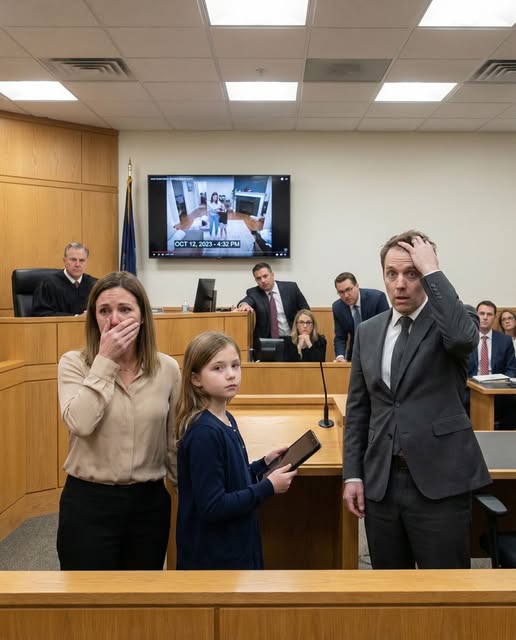
That voice emerged when Harper stood. The scrape of her chair against the courtroom floor sounded impossibly loud in the sudden silence as she asked, in a trembling but determined tone, “Your Honor, can I show you something Mommy doesn’t know?” The air shifted instantly. The judge leaned forward, his expression careful and measured, and asked her gently whether she felt safe speaking. Harper nodded, though her hands shook at her sides. Every instinct in my body screamed to protect her, to pull her back into the safety of silence, to shield her from the weight of adult consequences. But I stayed still, understanding in that moment what I had learned too late for myself: silence had never protected us. Harper reached into her jacket pocket and pulled out a small tablet, worn at the corners, its screen smudged with fingerprints. She explained that it held a video she had recorded because she was afraid she might forget what happened. When the device was connected to the courtroom monitor, confusion and dread washed over me in equal measure, emotions I couldn’t yet fully name or prepare myself for.
The video opened with a timestamp glowing in the corner, showing a late hour deep into the night. Our kitchen appeared on the screen, ordinary and painfully familiar. Then Caleb’s voice filled the courtroom, stripped of the calm, measured tone he wore in public. He was shouting—not at me, but at our child. His words were sharp, relentless, laced with blame and warning. He told her to stop crying, accused her of causing stress, instructed her not to tell me what was happening. Harper’s small voice could be heard, shaking as she asked for me. At one point, the sound of something breaking echoed through the speakers, causing several people in the courtroom to flinch. I felt myself detach, as though watching a truth I had always sensed but never fully confronted. When the screen finally went dark, silence fell heavily over the room. The judge’s expression had changed, professional distance giving way to something unmistakably human. Harper explained that she recorded the video because she worried that if she forgot, it might stop being real. She said she didn’t want anyone to tell her she was imagining things. The narrative that had been so carefully constructed unraveled in seconds, undone not by argument or persuasion, but by unfiltered truth captured by a child who needed proof to survive.
The court did not issue an immediate ruling that day, but everything had shifted. In the weeks that followed, the language surrounding the case changed dramatically. Psychological evaluations were ordered. Visitations became supervised. Therapy and protective measures were mandated. Where Caleb had once been described as stabilizing, official documents now spoke of concern, volatility, and risk. I was granted primary custody, not as a victory, but as a necessary intervention to ensure safety. Outside the courthouse, Harper clutched my hand tightly, her body finally releasing tension it had carried far too long. She apologized for not telling me sooner, her voice barely above a whisper. I knelt in front of her and told her what mattered most: that fear does not cancel bravery, that silence is not consent, and that she protected herself in the only way she knew how. Healing did not arrive all at once. It came slowly, through therapy sessions, difficult conversations, and learning to let go of guilt hindsight tries to impose. Harper began sleeping through the night again. Her laughter returned, tentative at first, then freer. I learned that safety is not built through appearances or convincing arguments, but through listening when a child finally finds the courage to speak. That day in court changed more than custody arrangements. It reshaped my understanding of strength. Sometimes it looks like authority. Sometimes it looks like control. And sometimes, it looks like a small girl standing in a room full of adults and saying, quietly and bravely, “I have something to show you.”