Travel has always promised a temporary escape: rest, novelty, and the comfort of stepping outside the routines of home. Over time, for frequent travelers, that promise becomes second nature. You learn the platforms, scan reviews, trust polished listings, and rely on familiar host profiles. Confidence builds quickly because modern systems encourage it: verification badges, glowing ratings, and professional photography create an illusion of safety. Yet beneath this surface, the ecosystem of vacation rentals operates inside a complex web of digital networks, hidden cameras, and invisible monitoring tools. What once felt like a simple exchange of hospitality can be quietly transformed into surveillance, exploitation, or manipulation. The story is not one of paranoia—it is a stark reminder of how swiftly trust can be shattered when hidden assumptions collapse.
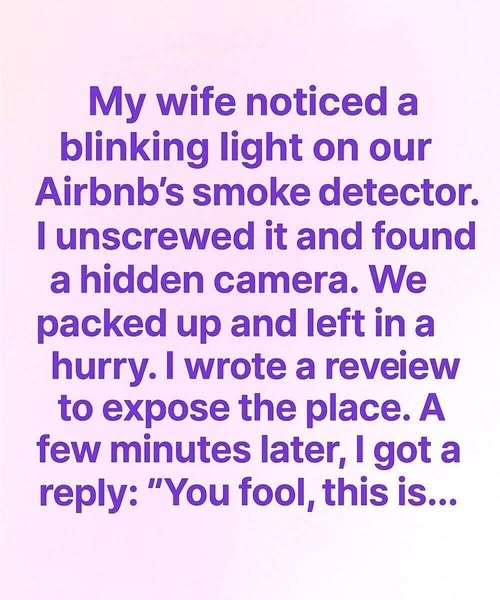
The moment everything changed was subtle, almost mundane. A faint blinking light on a smoke detector—a detail easy to overlook—drew attention. After a long journey, fatigue made us eager to relax, and the home looked exactly as advertised. But instinct noticed what reason might have dismissed. Closer inspection revealed a hidden camera lens tucked behind the smoke detector, disguised as an innocuous safety device. That instant reframed the entire space: a haven became invasive. Walls, furniture, and silence—all ordinary—suddenly felt hostile. There was no time for debate; leaving became imperative. Control, safety, and autonomy had been compromised, and walking away was the only way to reclaim them.
What followed was a tense mix of relief and lingering unease. At a nearby diner, adrenaline gave way to reflection, and the experience was shared online to warn others. The host’s response was immediate and unsettling: dismissive, threatening, and intentionally vague, implying knowledge of “others” who would be “looking for it.” Fear shifted from mere privacy violation to an unspoken, orchestrated intent. The rental was no longer a single lapse of judgment; it now seemed part of a carefully monitored environment. Even when reviewing photos for reassurance, subtle reflections suggested another hidden device, confirming that surveillance was deliberate, layered, and strategic. The space we had trusted was never neutral—it had been curated to observe and manipulate without detection.
The incident exposed how digital trust can be fragile, especially in travel. Platforms, reviews, and verification systems can create convincing narratives, but narratives can be fabricated or manipulated. Convenience—instant booking, professional photography, glowing ratings—does not guarantee safety. Awareness and vigilance became tools of survival, not paranoia. Actions that might have seemed excessive before—careful inspection, photographing details, documenting interactions, immediate departure—were now necessary, acts of self-preservation in an environment where assumptions no longer held.
Reflection revealed a broader truth about travel in the digital age. Safety cannot be outsourced entirely to platforms, hosts, or policies. It begins with attentiveness: noticing subtle signs, questioning the ordinary, trusting instincts over appearances. Older travelers or those less familiar with modern technology are particularly vulnerable, as established routines and trust in systems can be exploited. True safety requires awareness, decisiveness, and a willingness to act when comfort feels disrupted. In short, it is a personal responsibility as much as a systemic one.
The lesson of the hidden camera extends beyond any single Airbnb. Travel today intersects with surveillance, technology, and the illusion of control. Convenience, ease, and trust are often accompanied by unseen risks. Being vigilant does not diminish enjoyment or adventure; it ensures that autonomy and privacy remain intact. Digital trust, like physical safety, is fragile. Protecting oneself requires awareness, observation, and the courage to walk away when instincts warn of danger. In an era where appearances can deceive and systems can fail, the most important safeguard remains the traveler’s own attention and judgment.
This experience serves as a reminder that safety in modern travel is both digital and personal, and that vigilance, awareness, and decisiveness are the best tools travelers can carry—far more reliable than stars, reviews, or glossy photos.