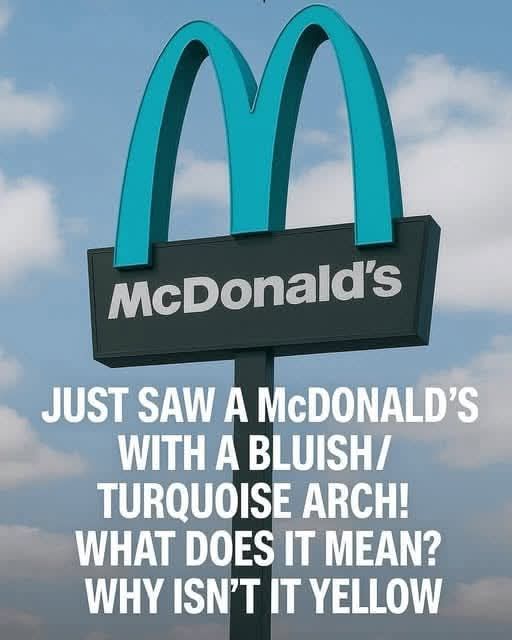
Long before turquoise arches became a viral curiosity, Sedona was already living inside a carefully protected identity shaped by stone, sky, and silence. Rising from the Arizona desert, the town’s red rock formations dominate the horizon with a presence so powerful that architecture, commerce, and daily life seem secondary to the land itself. Sedona has never been just a place people pass through; it is a place people feel. The color of the rocks shifts with the sun, glowing rust at dawn, deep crimson at dusk, and almost purple under storm clouds. By the late twentieth century, residents had grown deeply aware that this visual harmony was fragile. They had seen other towns lose themselves to generic development, where strip malls and standardized signage flattened local character into something interchangeable. When McDonald’s approached Sedona in 1993 with plans to open a restaurant, the proposal was not viewed as a simple business opportunity. It was a test of values. The golden arches, designed to command attention from highways and city streets alike, represented more than fast food; they symbolized the creeping sameness reshaping much of the American landscape. Sedona’s leaders and residents understood that once the visual language of the place was compromised, it could not easily be reclaimed. Their resistance was not rooted in elitism or hostility toward commerce, but in stewardship. They believed that the land itself was the town’s most important citizen, and any structure introduced into that space would need to respect its authority.
What followed was an unusual negotiation between local governance and global power. Sedona’s building codes were already strict, requiring earth-toned colors and architectural designs that blended into the environment rather than competing with it. Yellow, especially the bright, unmistakable yellow of McDonald’s arches, was deemed too disruptive against the red rock backdrop. For McDonald’s, a brand built on uniformity and instant recognition, this presented a rare challenge. The company faced a choice: insist on its standard design and walk away, or adapt in a way few other corporations ever had. The decision to compromise revealed something quietly profound. Turquoise was selected not arbitrarily, but with cultural and environmental sensitivity. In the American Southwest, turquoise holds deep symbolic meaning, long associated with Native American traditions as a stone of protection, healing, and connection to the sky. Its muted blue-green tones echoed the desert’s subtle palette rather than clashing with it. By accepting turquoise arches, McDonald’s acknowledged that its visual dominance was not universal, that local identity could carry equal weight to global branding. The arches remained recognizable, but they spoke softly instead of shouting. In that shift, the company demonstrated that adaptation does not necessarily weaken a brand; sometimes it deepens it by embedding it within a story larger than itself.
When the restaurant opened, reactions reflected the tension inherent in the decision. Some visitors laughed, snapped photos, and treated the turquoise arches as a novelty, an oddity worthy of postcards and road trip anecdotes. Others saw something far more significant. For residents, the building represented a quiet victory, proof that a small community could negotiate with a multinational corporation and emerge with its values intact. Over time, what began as curiosity transformed into civic pride. The restaurant stopped being “the McDonald’s that shouldn’t be here” and became “the McDonald’s that listened.” Travelers who stopped for a meal often left with a deeper impression of Sedona itself, carrying the story of turquoise arches as evidence that the town refused to surrender its visual soul. The building did not detract from the landscape; it deferred to it. In doing so, it became an unlikely landmark, not because it was loud or rebellious, but because it was restrained. Its fame grew precisely because it broke expectations about how power usually operates, showing that even the most standardized symbols can bend when confronted with strong local will.
The broader significance of Sedona’s decision extends far beyond one fast-food restaurant. Across the United States, towns struggle with the balance between economic development and cultural preservation. Chain stores bring convenience, jobs, and tax revenue, but they often arrive with aesthetics that ignore regional history and local context. Highways begin to look the same, exits blur together, and the sense of arrival disappears. Sedona’s turquoise arches became a case study in resistance to that flattening effect. They demonstrated that participation in the modern economy does not require visual surrender. The town did not reject McDonald’s outright; it simply insisted that the corporation become a guest rather than a conqueror. This distinction matters. It reframed the conversation from anti-business sentiment to pro-place advocacy. In doing so, Sedona offered a model for how communities can protect what makes them distinct without isolating themselves from the wider world. The lesson was subtle but powerful: uniqueness is not a barrier to progress, but a form of value that, when protected, enhances both community and commerce.
There is also a psychological dimension to the enduring fascination with Sedona’s turquoise arches. People are drawn to moments when immense power yields to principle. Watching a global brand adjust its most iconic symbol to accommodate a small town disrupts a familiar narrative in which corporations always dominate. It feels fair in a way that is increasingly rare. For residents, the arches affirm that collective standards matter, that local voices can shape outcomes even when facing enormous influence. For visitors, the building becomes a lesson rendered in architecture rather than words. It invites reflection on how often places sacrifice identity for convenience, and how different the world might feel if more communities insisted on visual and cultural coherence. The arches do not dominate the skyline; they sit quietly beneath it, reinforcing the idea that restraint can be a form of strength. In choosing to blend rather than blaze, the brand did not lose visibility; it gained meaning.
Decades later, the Sedona McDonald’s remains more than a roadside curiosity. It stands as a living reminder that place still matters in an age of replication. The red rocks continue to command attention, unchanged and immovable, while the turquoise arches exist in respectful dialogue with the land. The story endures because it challenges assumptions about inevitability. It suggests that homogenization is not the natural cost of modern life, but a choice that can be resisted. Sedona chose to protect its visual integrity, and in doing so, transformed an ordinary fast-food restaurant into a symbol of thoughtful coexistence. The turquoise arches are not just a design compromise; they are a declaration that identity, once defended, has the power to reshape even the most familiar symbols. In a landscape increasingly defined by sameness, Sedona offers a quiet but enduring truth: when communities honor where they are, even the most global brands can learn to belong.