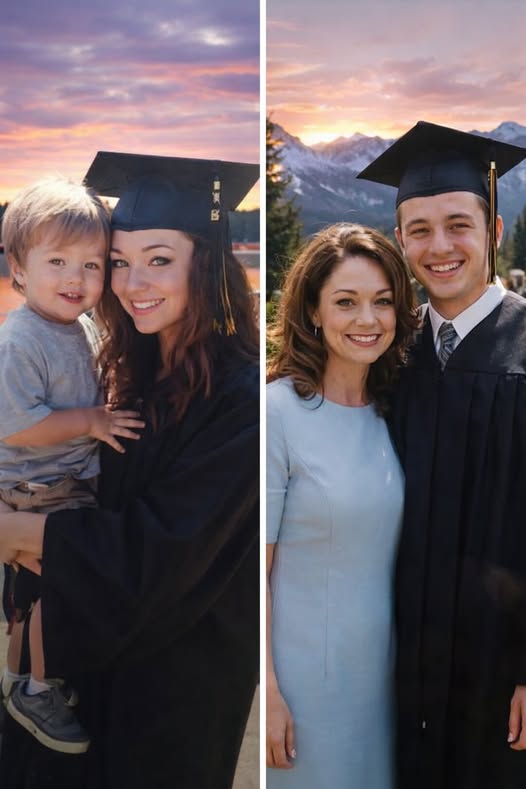
For most of my life, my understanding of family was simple and contained. My mother was my constant, my protector, and my proof that love could be both fierce and sufficient. She raised me alone with a kind of quiet determination that never asked for sympathy and never allowed absence to feel like deficiency. She worked long hours, showed up to every school event, celebrated my milestones with unfiltered pride, and built a life where stability came not from abundance but from consistency. When I was younger, I occasionally asked about my father, more out of curiosity than longing. Her answers were always brief and carefully neutral: he wasn’t ready, it didn’t work out, he left. There was no bitterness in her voice, no drama, no invitation to dig deeper. Over time, I learned not to ask. I accepted that some stories simply ended before they began, and I grew up believing that if someone wasn’t present, it was because they chose not to be. That belief shaped me in subtle ways, teaching me independence early and convincing me that whatever I achieved in life would be something I built with my mother alone.
Graduation day felt like the natural culmination of that shared journey. My mom hovered as she always did, adjusting my cap, smoothing imaginary wrinkles in my gown, insisting on just one more photo even as my name was about to be called. The air buzzed with celebration, families clustered together, laughter echoing across the campus lawn. It was in that moment of collective joy that something unexpected pierced the familiar rhythm of my life. A man I had never seen before approached me hesitantly, his expression caught somewhere between fear and resolve. He looked out of place, like someone who had wandered into a moment he didn’t quite belong to. When he spoke, his voice shook as he told me he was my biological father. I laughed reflexively, not because it was funny, but because my mind rejected the possibility outright. This was not part of my story. But when I looked at my mother, the color drained from her face, and in that instant, denial became impossible. The celebration around us faded into noise as the truth pressed forward, demanding attention.
We stepped away from the crowd, and what followed felt less like a conversation and more like a confession long overdue. He explained that he hadn’t walked away from me, hadn’t chosen absence or abandonment. He had been told, years ago, that my mother had miscarried. He believed it completely. He mourned a child he never met and carried that grief quietly, assuming the story had ended before it ever truly began. As he spoke, pieces of a hidden past surfaced. My parents had dated briefly in college, young and unprepared for the permanence that pregnancy implied. When my mom found out she was pregnant, his wealthy parents intervened. They pressured her, questioned her intentions, threatened legal action, and tried to control the narrative of what should happen next. She was young, scared, and suddenly aware of how little power she had in the face of their influence. In her fear, she made a choice she believed would protect me from a future defined by manipulation and conflict. She told him the baby was gone and disappeared from his life entirely.
Hearing that truth fractured something inside me, but it also rearranged it. The man standing in front of me wasn’t a villain from an unfinished story; he was a stranger who had been robbed of knowledge, just as I had been. He didn’t ask for forgiveness or demand a place in my life. He simply said he wanted me to know the truth, that he had only learned about me recently and felt I deserved honesty. He handed me his phone number with a kind of restraint that surprised me, as if he understood that this moment was already heavy enough. Then he left, blending back into the crowd, leaving behind a silence thicker than anything I had known. That night, my mother and I talked longer than we ever had before. She admitted she should have told me sooner, that fear had guided her decisions more than malice ever did. For the first time, I saw her not just as my parent, but as a young woman who had once been overwhelmed and alone.
In the weeks that followed, I wrestled with emotions I didn’t have names for yet. Anger surfaced, but it didn’t settle comfortably on either of them. My mother had lied, yes, but not out of cruelty. She believed she was protecting me from a world that had already tried to exert control before I was even born. The man who claimed to be my father hadn’t fought for me because he hadn’t known I existed. The absence I had carried my entire life suddenly felt less like rejection and more like an unanswered question. Eventually, I reached out to him. Our conversations were cautious at first, shaped by years of distance and the awareness that we were learning each other out of sequence. He asked about my childhood, my interests, my dreams. I learned about his life, the family dynamics he had grown up with, and the regret he carried for a loss he thought was inevitable. There was no instant bond, no cinematic reunion, just a slow unfolding of connection grounded in honesty.
What surprised me most was how much lighter I felt once the silence was broken. The emptiness I had occasionally sensed growing up wasn’t rooted in being unwanted, as I had quietly assumed; it came from not knowing the full truth of my own origin. Understanding that changed the way I saw myself. I was not the result of abandonment, but of fear, youth, and choices made under pressure. My mother’s strength took on new dimensions, layered with vulnerability and sacrifice. My father became real, not as a replacement for what I had, but as an addition to my understanding of where I came from. Knowing the truth didn’t erase the past or instantly heal every confusion, but it gave me something I didn’t realize I had been missing: clarity. And with it came the possibility of redefining my story on my own terms, no longer shaped by silence, but by honesty, complexity, and the knowledge that love can exist even when it arrives late.