Climbing onto a roof is rarely an emotional experience. It is usually practical, even mundane—a task driven by necessity rather than curiosity. A homeowner might go up to check for leaks, repair rusted panels, or clear away debris. Expectations are simple: dust, leaves, maybe signs of wear. But occasionally, something disrupts that expectation so completely that the ordinary setting transforms into something unsettling.
That disruption often begins with a single glance.
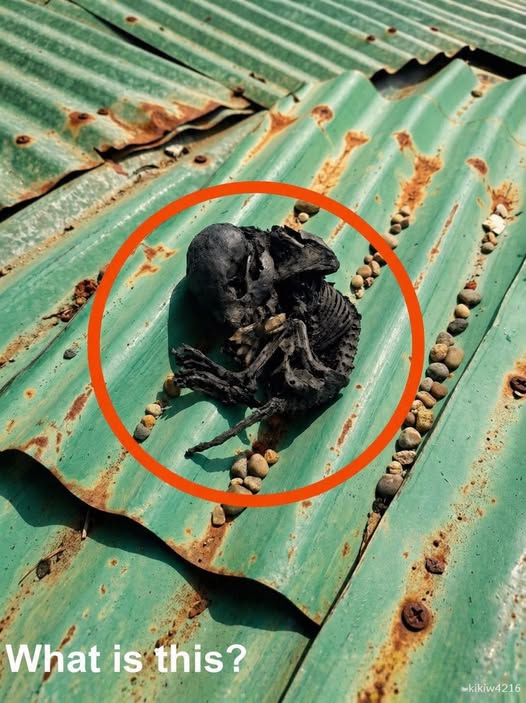
In this case, it was a small, dark figure resting on a rusted metal surface. At first, it did not immediately register as anything familiar. Its shape was curled, its surface shriveled and hardened, and its overall appearance sat somewhere between recognizable and alien. It was clearly not alive—but it did not look like anything the mind could quickly categorize either.
That ambiguity is powerful.
When the brain encounters something it cannot easily identify, it does not remain neutral. Instead, it begins searching for patterns. This is tied to a psychological tendency known as pareidolia, where the mind tries to interpret vague or random shapes as something meaningful—often faces or human-like forms. In this situation, the partially preserved structure of the object can appear disturbingly lifelike, even when it is not.
The result is a mix of fear and fascination.
At a distance, the figure may seem almost humanoid. Up close, details begin to emerge—thin, fragile limbs, a small skull-like structure, and what appears to be dried skin clinging tightly to bone. But even with closer inspection, certainty does not come immediately. Instead, the mind cycles through possibilities, many of them unlikely, simply because the object exists outside of everyday experience.
This is where emotion takes over.
Fear, in moments like these, is not necessarily about danger—it is about uncertainty. The unknown triggers a heightened state of awareness. The body becomes alert. The mind races. Time stretches, and even a small object can hold attention for far longer than expected.
Yet curiosity follows closely behind.
As the initial shock fades, the need to understand begins to take over. The object is examined from different angles. Observations become more detailed. Questions become more specific: What is it? How did it get here? Why does it look like this?
This shift—from reaction to investigation—is a crucial turning point.
What once seemed mysterious begins to reveal patterns that can be explained. The skeletal structure becomes more recognizable. The proportions begin to align with known forms. The texture, once disturbing, starts to make sense in a biological context.
One of the most important explanations in cases like this is the process of natural mummification.
Unlike the intentional preservation seen in ancient cultures, natural mummification occurs without human intervention. It happens when environmental conditions prevent the usual decomposition process. Normally, after death, bacteria and moisture break down organic material relatively quickly. But when those elements are removed or limited, decomposition slows—or even stops.
A metal rooftop creates surprisingly ideal conditions for this.
During the day, especially in direct sunlight, the surface can become extremely hot. This heat accelerates dehydration, drawing moisture out of organic tissue. At the same time, the exposed environment allows for constant airflow, which further aids in drying. Without moisture, bacteria cannot function effectively, and the body does not decay in the usual way.
Instead, it dries.
Skin tightens. Tissue hardens. The body shrinks. What remains is a preserved form—lightweight, fragile, and often visually striking. Over time, this can create a figure that looks almost sculptural, as if frozen in its final position.
This explains the texture and appearance—but what about the identity?
Looking more closely at the structure, certain features begin to stand out. A narrow skull. A beak-like formation. Thin, delicate bones. These details point toward a likely conclusion: the remains of a small bird.
Birds frequently land on rooftops. They rest, search for food, or navigate their surroundings from elevated positions. Occasionally, due to injury, illness, or exhaustion, they may die in these locations. Because of their small size and light weight, their bodies are less likely to be disturbed by predators or environmental forces.
This allows the mummification process to occur undisturbed.
Over time, feathers may detach or decay, leaving behind a more skeletal appearance. Without the familiar outer features, the remaining structure can look unusual—especially to someone unfamiliar with avian anatomy. What was once clearly identifiable becomes ambiguous, and that ambiguity fuels the initial reaction.
This entire experience highlights how strongly perception influences interpretation.
The object itself does not change. What changes is the understanding of it.
At first, it is unknown—and therefore unsettling. Then it becomes a puzzle. Finally, it becomes an example of natural processes at work. The emotional journey follows this progression closely: fear, curiosity, resolution.
But even after the explanation is clear, the feeling often lingers.
There is something inherently powerful about encountering death in an unexpected form. Not in a dramatic or violent way, but in a quiet, almost accidental moment. It forces a pause. It disrupts routine. It reminds us that natural processes are constantly unfolding, often unnoticed.
From a broader perspective, this connects to fields like forensic science, where understanding how bodies change over time and under different conditions is essential. Investigators and scientists study exactly these kinds of processes—how environment, temperature, and exposure affect decomposition or preservation.
What seems unusual in everyday life is often well understood in scientific contexts.
The difference lies in familiarity.
Most people do not encounter naturally mummified remains regularly. So when they do, the reaction is immediate and emotional. But with knowledge, that reaction can shift. Fear becomes understanding. Confusion becomes clarity.
There is also a subtle philosophical layer to this experience.
The rooftop, a place associated with maintenance and routine, becomes the setting for something unexpected. The boundary between the ordinary and the extraordinary blurs. A simple inspection turns into a moment of reflection—not just on what was found, but on how easily perception can be influenced.
It raises an important question: how often do we misinterpret what we see simply because it falls outside our expectations?
In everyday life, the brain relies heavily on patterns. It predicts, simplifies, and fills in gaps. This allows for efficiency—but it also creates blind spots. When something does not fit the pattern, the reaction is often exaggerated, not because the object is inherently alarming, but because it is unfamiliar.
This is why context matters so much.
A small, dried object in a natural environment might go unnoticed. The same object on a rooftop, in a place where it is not expected, becomes significant. Location transforms perception.
Over time, experiences like this tend to become stories.
They are retold not because of what was found, but because of how it felt. The initial shock, the confusion, the investigation, and the final realization. Each stage adds to the narrative, turning a brief moment into something memorable.
And that memory carries a lesson.
Not every mystery is complex. Not every strange discovery is extraordinary. Sometimes, the explanation is simple—but the experience is still meaningful.
It reminds us to pause before jumping to conclusions. To observe more carefully. To question initial assumptions. And perhaps most importantly, to remain curious even in moments of discomfort.
Because curiosity is what transforms fear into understanding.
In the end, the mummified figure on the rooftop is not just an object. It is a convergence of biology, environment, and perception. It tells a quiet story—of a small creature, of heat and time, and of the human tendency to seek meaning in the unfamiliar.
What began as a moment of unease becomes something else entirely.
Not a mystery without explanation, but a reminder that the world is full of processes happening just beyond our awareness—waiting to be noticed, questioned, and understood.