Travel has long carried an almost sacred promise, one that feels especially powerful in an age defined by speed, stress, and constant connection. To travel is to step outside routine, to exchange the familiar for the restorative belief that distance itself can heal exhaustion. For many modern travelers, that promise is reinforced by systems designed to make the unfamiliar feel safe: verified profiles, polished listings, star ratings, and thousands of reassuring reviews. Over time, these signals blend into a kind of background comfort. You stop actively evaluating risk and instead trust the structure built around you. Platforms become proxies for judgment, and convenience replaces caution. Yet beneath this surface lies a reality shaped by surveillance technology, data-driven reputation systems, and an imbalance of accountability. The relationship between guest and host, once grounded in direct human interaction, now exists inside a digital marketplace where appearances can be curated and trust can be simulated. This story is not about rare bad luck or exaggerated fear. It is about how easily confidence can be engineered—and how devastating it feels when that confidence collapses all at once.
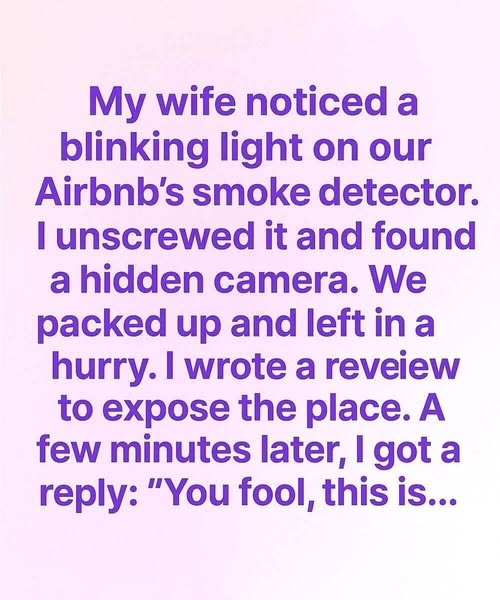
The unraveling rarely announces itself dramatically. There is no alarm, no confrontation, no obvious threat. It begins quietly, almost politely, with a detail small enough to be ignored. In our case, it was a faint blinking light on what appeared to be a standard smoke detector in an otherwise welcoming rental. We had arrived tired from a long drive, grateful that the space looked exactly like the photos promised. The furniture was tasteful, the lighting warm, the atmosphere deliberately calming. Everything about the setting encouraged relaxation. Yet discomfort has a way of bypassing logic, and my wife felt it before I did. What followed was not panic, but curiosity sharpened by unease. A closer inspection revealed a hidden lens embedded behind plastic designed to signal safety rather than scrutiny. In that moment, the room changed. The walls no longer felt protective. Silence felt heavy instead of peaceful. A space meant to offer rest suddenly felt like an intrusion. We did not argue, debate, or rationalize. We packed instinctively, understanding that the decision to leave was not about evidence or procedure, but about reclaiming agency in a situation where it had already been violated.
Leaving should have brought relief, and for a brief moment it did. Distance can create the illusion of safety, especially when adrenaline fades. We stopped at a brightly lit diner, hoping the familiarity of public space would ground us. It was there, fueled by anger and disbelief, that I posted a detailed warning online. The act felt protective, almost necessary, as though documenting the experience could restore some balance. I expected silence, denial, or a generic response. What arrived instead was swift and disturbing. The host’s reply was not apologetic or confused. It was dismissive, vaguely threatening, and unsettlingly confident. References to unnamed individuals who would be “looking for it” shifted the experience into darker territory. The message carried an implication of awareness rather than surprise, of control rather than concern. It raised questions far more troubling than the camera itself. Who installs such devices without fear of consequence? Why respond with intimidation instead of explanation? The tone suggested this was not an accident or misunderstanding, but part of a pattern sustained by the belief that accountability would never truly arrive.
As we revisited the photos we had taken, searching for reassurance, we instead uncovered another layer of unease. A faint reflection, easy to miss at first glance, hinted at a second device positioned elsewhere in the room. That detail changed the narrative completely. One hidden camera might be explained away by incompetence or misguided intent. Multiple vantage points suggested planning, coverage, and familiarity with surveillance. The rental no longer felt like a space misused, but a space designed. The realization was deeply sobering. Digital trust had replaced direct oversight, and the systems meant to protect users had become tools that could be exploited. Reviews, verification badges, and professional photography had worked exactly as intended, creating a convincing illusion of safety. But illusions are powerful precisely because they feel real. Once that truth settled in, it became impossible to ignore how easily manipulation can hide inside normalcy, and how little recourse exists when that manipulation is revealed.
Distance eventually brought calm, but peace remained elusive. We drove for hours, choosing anonymity over convenience, avoiding predictable stops until exhaustion forced us to rest. Even then, sleep came slowly. The idea that devices could record, track, or identify us lingered in the background, transforming ordinary actions into calculated choices. Disconnecting from accounts, reporting the listing, documenting every detail—these steps felt less like overreaction and more like self-defense. Yet alongside the fear sat a quieter frustration: would any of this matter? Technology evolves faster than oversight, and responsibility often dissolves into gray areas between platforms, hosts, and authorities. Each entity points elsewhere, creating gaps where accountability should exist. That uncertainty proved as draining as the fear itself, highlighting how exposed travelers can feel once trust is broken and systems fail to respond decisively.
With time, reflection replaced panic, and a larger lesson began to take shape. Modern travel safety is no longer limited to physical considerations like locks, lighting, or location. It now includes an understanding of how digital tools can be misused and how convenience often carries hidden costs. Older travelers, in particular, may rely heavily on established routines and reputations, assuming familiarity equals safety. Yet familiarity can be engineered, and trust can be manufactured. Awareness does not require paranoia, but it does demand attentiveness. Simple habits—checking devices, questioning discomfort, and being willing to leave without hesitation—can make a critical difference. Ultimately, the most important realization is that safety cannot be fully outsourced to platforms, ratings, or promises. In a world where trust can be simulated with precision, protecting oneself begins with personal vigilance and the courage to listen when something feels wrong. The illusion of safety is powerful, but awareness is stronger, and learning to look beyond appearances may be the most essential travel skill of all.