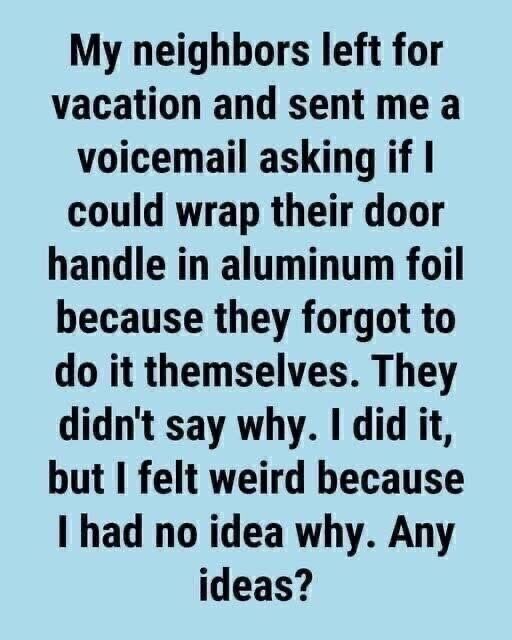
Home security is often framed as a choice between vulnerability and costly investment. Alarms, cameras, smart locks, and monitoring services dominate conversations about protection, creating the impression that safety requires technical expertise or significant expense. Yet many people overlook how small, thoughtful actions can meaningfully improve awareness and deterrence. One such example is the aluminum foil door handle trick, a simple method that has circulated widely through social media and home safety discussions. At its core, the idea is not about turning foil into a lock or barrier, but about using its physical properties to create immediate feedback. By wrapping aluminum foil around a door handle before sleeping or leaving home, homeowners introduce a visible, audible, and tactile signal that can reveal tampering, draw attention to unexpected movement, and subtly change how an entry point is perceived.
The effectiveness of this method lies in how aluminum foil behaves. Lightweight and highly responsive, foil does not return to its original shape once disturbed. When wrapped snugly around a door handle, even slight contact causes creases, tears, or loosening that are easy to notice. This makes it a crude but effective tamper indicator. Additionally, foil produces a sharp, unmistakable sound when handled. In a quiet home at night, that crinkling noise can travel farther than expected, alerting occupants to movement at the door before an intruder gains access. The reflective surface of foil adds another subtle advantage, as it can catch light from street lamps, passing cars, or porch lights, drawing attention to the handle and making the door feel less discreet to anyone approaching it with ill intent.
Beyond its physical properties, the aluminum foil trick works on a psychological level that is central to crime prevention. Many opportunistic intruders rely on speed, familiarity, and invisibility. They look for doors that appear untouched, routine, and unmonitored. A door handle wrapped in foil breaks that expectation. It signals awareness and suggests the homeowner is attentive enough to notice small changes. Even if the foil itself provides no real barrier, it introduces uncertainty, and uncertainty is often enough to make a target less appealing. Criminal behavior frequently depends on minimizing risk, and anything that increases the chance of detection, noise, or delay can act as a deterrent. In this sense, the foil becomes less about protection and more about perception, subtly shifting the balance away from easy access.
It is important, however, to understand the limits of this approach. Aluminum foil is not a substitute for locks, reinforced doors, or proper security systems. It cannot prevent forced entry or replace structural defenses. Its value lies in complementing existing measures and increasing situational awareness. When used alongside solid locks, motion-activated lighting, and basic noise deterrents, the foil can act as an early warning sign rather than a primary line of defense. For example, if foil is disturbed overnight, it may prompt a homeowner to check camera footage, inspect the property more carefully, or adjust routines. In this way, it becomes part of a layered security mindset, where multiple small precautions work together to reduce vulnerability rather than relying on a single solution.
There are also secondary benefits that explain why the trick resonates with so many people. From a hygiene perspective, foil can act as a temporary barrier on handles in shared spaces, reducing direct contact and reminding occupants to wash hands more frequently. During times of illness or heightened concern about germs, this visual cue can reinforce cautious behavior. The trick also appeals to a sense of resourcefulness. Using a common household item to solve multiple problems taps into a broader desire for practical, low-cost solutions that do not depend on constant upgrades or subscriptions. It empowers people to take action immediately, without waiting for professional installation or specialized equipment.
Ultimately, the aluminum foil door handle hack is best understood as a symbol of practical awareness rather than a miracle security solution. It demonstrates how attention to detail and creative thinking can enhance peace of mind in everyday life. By offering visible signs of tampering, producing noise when disturbed, and subtly discouraging unwanted attention, it supports a proactive approach to home safety. In a world increasingly focused on complex technology, this simple method serves as a reminder that security often begins with observation, intention, and the willingness to use what is already within reach.