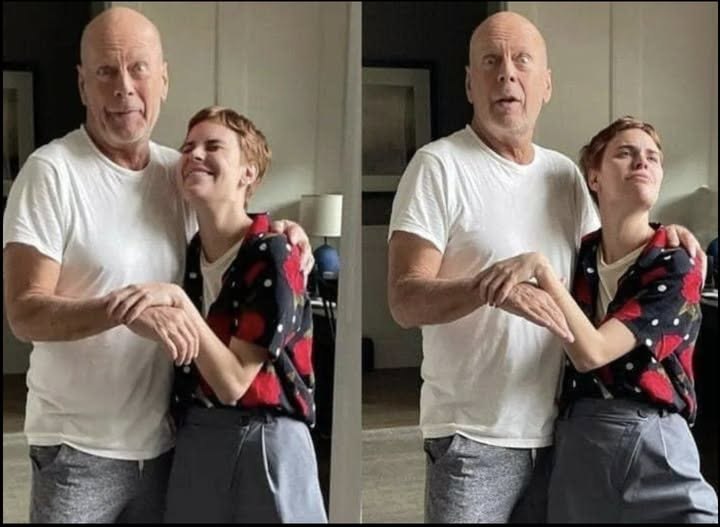
For much of modern film history, Bruce Willis was not simply an actor but a constant presence, a figure whose voice, posture, and understated confidence became instantly recognizable across generations. From explosive action franchises to quieter dramatic performances, his career unfolded in public view, shaped by charisma and an ability to make toughness feel human. When his family announced in 2022 that he would be stepping away from acting following a diagnosis of aphasia, and later frontotemporal dementia, the news marked a profound shift. The transition was not framed with spectacle or grand statements, but with restraint. Rather than inviting commentary or speculation, those closest to him emphasized care, privacy, and understanding. It was a rare moment in celebrity culture, one where the absence of performance spoke louder than any appearance ever could, signaling a deliberate move away from public consumption toward personal preservation.
Since that announcement, Bruce Willis has largely retreated from the rhythms of public life that once defined him. The change has been noticeable not because of dramatic updates, but because of their scarcity. In an era where constant visibility is often mistaken for relevance, his family has chosen silence over exposure. When glimpses do appear, they are gentle and understated: a photograph shared without explanation, a brief caption focused on gratitude or togetherness, a moment frozen in time without narrative framing. These small windows offer no medical detail, no emotional commentary designed to invite sympathy. Instead, they reflect presence rather than performance, reminding observers that a life does not lose its meaning when it becomes quieter. The restraint itself feels intentional, as though the family is carefully protecting something sacred from the noise that once surrounded him.
At the center of this chapter is a family that has closed ranks with remarkable consistency. Bruce Willis’s blended family includes his three adult daughters with Demi Moore and his two younger daughters with Emma Heming Willis. What might have been a complicated dynamic under strain has instead become a source of stability. Public statements from family members consistently emphasize unity, shared routines, and emotional connection rather than struggle or loss. Demi Moore has spoken openly about acceptance, framing the situation not as a tragedy to be resisted, but as a reality to be met with honesty and love. Emma Heming Willis, now also a vocal advocate for caregivers, uses her platform to highlight compassion, patience, and the unseen labor of supporting a loved one through cognitive illness. Their approach suggests a collective understanding that care is not only medical but emotional, relational, and deeply human.
This emphasis on presence over explanation has reshaped how many people view Bruce Willis today. He is no longer defined by premieres, interviews, or box office numbers, but by moments of quiet connection. Photographs show him surrounded by family, engaged in simple activities, grounded in routine. These images do not attempt to reassure the public or deny reality. Instead, they reflect an acceptance that life’s value is not measured by productivity or visibility. In choosing not to narrate every development, the family resists the urge to turn illness into a storyline. What remains visible is affection, continuity, and the dignity of living fully within new limits. For fans accustomed to seeing Willis as invincible, this reframing can feel unsettling, yet it also invites a deeper understanding of strength as something that evolves rather than disappears.
Bruce Willis’s legacy, once anchored almost exclusively in film, now extends into this quieter space. His work remains intact, preserved in characters that continue to circulate across screens and generations. Yet alongside those performances exists another legacy, one shaped by how his life beyond the screen is being handled. There is no attempt to mythologize suffering or to use vulnerability as a form of spectacle. Instead, there is consistency, respect, and an insistence on humanity. In a culture that often equates worth with output, the way his family speaks about him reinforces a different message: that a person’s value is not diminished by illness, change, or withdrawal from public life. This perspective resonates far beyond Hollywood, touching families who recognize similar journeys in their own lives.
As time moves forward, Bruce Willis remains present in a way that defies conventional expectations of celebrity. He is present in memories, in the films that still bring joy and familiarity, and in the ongoing devotion of those closest to him. He is also present in a broader cultural conversation about aging, illness, and care, even if he does not speak within it himself. The family’s approach offers a model of how to navigate public attention without surrendering intimacy, how to acknowledge reality without allowing it to eclipse love. In stepping back from the spotlight, Bruce Willis has not faded; he has simply moved into a different kind of visibility, one defined not by fame, but by connection, dignity, and the enduring power of being surrounded by people who choose to show up, quietly and consistently, every day.