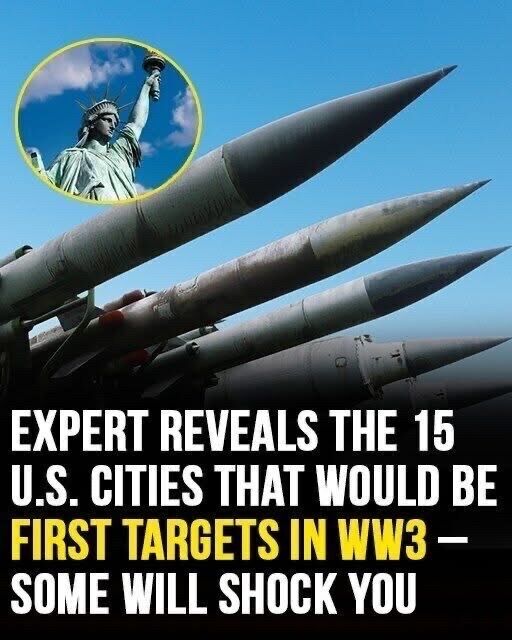
When public discussion turns to the possibility of a global conflict, imagination almost instinctively gravitates toward iconic skylines, capital cities, and places heavy with symbolism. Towering buildings, financial districts, and seats of government dominate popular thinking because they feel like the obvious centers of power. Yet modern military analysis presents a far more unsettling picture, one that challenges assumptions shaped by earlier wars and cinematic portrayals. Contemporary conflict planning, particularly in scenarios involving nuclear weapons, is far less concerned with visibility than with function. What matters most is not how recognizable a place is to the public, but how deeply it is embedded in the systems that allow a nation to detect threats, make decisions, communicate orders, and respond. This logic reflects decades of deterrence theory, technological evolution, and sobering historical near-misses. In a world where destructive capacity is immense, early moves in any major conflict would likely focus on limiting escalation by targeting the ability to retaliate. As a result, quiet locations tied to command centers, missile fields, air bases, and communication hubs carry strategic weight regardless of their size or cultural prominence, forcing a reassessment of what vulnerability truly means in the modern age.
Renewed interest in these questions does not arise in isolation. Shifting alliances, confrontational rhetoric, and global uncertainty have contributed to a sense that long-standing stability cannot be assumed. Even messages emphasizing restraint or disengagement can coexist with aggressive language, unpredictable policy shifts, and escalating diplomatic tensions. Analysts study this mix carefully because history shows that wars often begin not with clear intent, but through miscalculation, fear, pride, or cascading reactions to perceived threats. In such an environment, people naturally ask not only whether a catastrophic conflict is likely, but how it might unfold if deterrence were to fail. This curiosity reflects collective anxiety about systems that demand flawless judgment under pressure. Nuclear strategy intensifies that concern by compressing decision-making timelines and magnifying the consequences of every signal sent or misread. Examining where risks might concentrate helps demystify these systems and reveals that danger does not always align with fame, population size, or economic visibility.
At the core of modern nuclear strategy lies counterforce targeting, an approach that prioritizes disabling an opponent’s military capabilities rather than immediately striking population centers. This logic stems from deterrence theory, which assumes rational actors seek to avoid total annihilation by preserving the ability to respond. If that ability appears threatened, incentives can shift rapidly. In a hypothetical scenario where leaders believe conflict is unavoidable, early objectives would likely include degrading command-and-control systems, missile silos, bomber bases, and communication networks that enable retaliation. Scholars and nuclear policy experts have long emphasized that this logic is deeply unsettling because it treats geography as a functional grid rather than a human landscape. Under this framework, a location’s importance is defined by what it controls or supports, not by how many people recognize its name. A small town near a missile field can be strategically more significant than a global metropolis if it anchors critical response infrastructure. This reality reshapes public perceptions of risk and highlights how deterrence strategies, designed to prevent war, also define its most likely pathways.
Geography plays a decisive role in how this strategic logic unfolds. Missile silos, air bases, and command facilities are not placed randomly; they are located according to terrain, distance from borders, logistical access, and long-standing planning assumptions. Over time, civilian communities have grown around many of these installations, drawn by employment opportunities and the stability of life far from major urban centers. These towns rarely see themselves as central to global affairs, yet their proximity to strategic assets places them within calculations that feel abstract until examined closely. Locations tied to intercontinental ballistic missile fields, strategic bomber wings, or early-warning systems gain importance because they anchor the physical backbone of deterrence. In these areas, the boundary between military and civilian space becomes blurred. Homes, schools, hospitals, and businesses coexist alongside systems designed for worst-case scenarios, revealing a paradox of modern security: the very structures intended to prevent war also embed risk within everyday landscapes.
Command-and-control centers occupy a particularly critical position within this strategic network. These facilities are responsible for detecting threats, validating information, transmitting orders, and coordinating responses across vast distances. In nuclear strategy, their reliability is essential, as confusion or delay can be as dangerous as deliberate aggression. Disrupting these nodes could theoretically impair decision-making and increase uncertainty during a crisis. For this reason, locations associated with early warning, strategic communications, and centralized planning receive significant attention in analytical models. Many of these sites are not widely known and are often located inland, chosen because they were once considered less vulnerable. Advances in missile technology and surveillance have reduced the protective value of distance alone, but their strategic relevance remains unchanged. As a result, surrounding regions carry significance that defies popular assumptions about safety and obscurity.
This shift in focus does not mean that major metropolitan areas lose their importance in modern war planning. Political capitals, economic hubs, and cultural centers remain vital due to their symbolic power, population density, and influence on global systems. Strikes against such cities would have profound psychological, economic, and political consequences. The difference lies in sequencing and intent. In many strategic models, infrastructure directly tied to military response is prioritized early to shape the balance of power, while population centers represent a different form of pressure or escalation. This distinction is difficult to accept because it challenges intuitive beliefs that anonymity or modest scale equates to safety. It reveals that risk is distributed unevenly, shaped by invisible networks rather than visible prominence.
Ultimately, the value of examining these scenarios lies not in predicting catastrophe, but in reinforcing the importance of restraint, communication, and human judgment. Deterrence systems are often described as mechanical or automatic, yet they depend fundamentally on people interpreting data, assessing intent, and making decisions under extreme stress. History contains numerous examples in which accidents, misunderstandings, or technical failures brought the world dangerously close to disaster, only to be averted by individual choices made in moments of uncertainty. Understanding how strategic logic operates grounds public anxiety in reality rather than speculation, highlighting both the fragility and resilience of the systems that have so far prevented the worst outcomes. It also underscores a sobering truth: in the modern world, civilian life cannot be fully separated from military planning, because the infrastructure of deterrence is embedded within the fabric of everyday existence. Geography and strategy may set the stage, but it is human decision-making that ultimately determines whether societies step back from the edge or move closer to it.