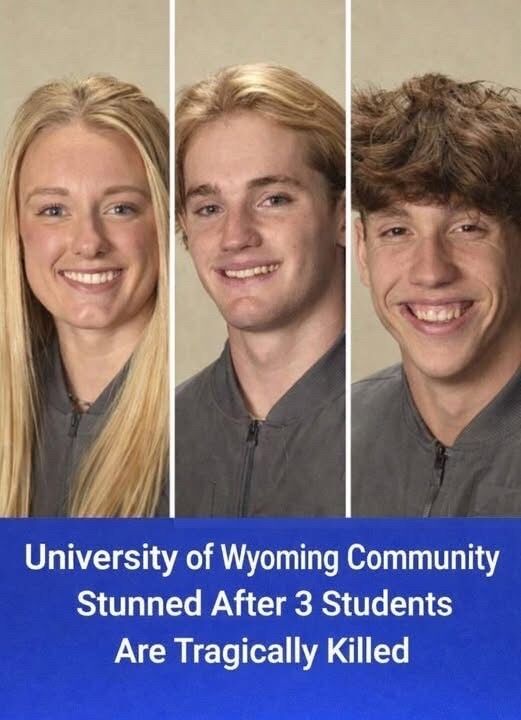
The University of Wyoming was shaken by profound tragedy when news emerged that three members of its men’s swimming and diving team had died in a traffic accident near the Wyoming–Colorado border. Charlie Clark, 19, Luke Slabber, 21, and Carson Muir, 18, were traveling with teammates when their Toyota RAV4 left the roadway at the intersection of U.S. Highway 287 and Red Mountain Road and rolled multiple times. The suddenness of the loss sent waves of disbelief through the campus and beyond, as students, coaches, classmates, and families struggled to comprehend how lives defined by promise, discipline, and youthful ambition could end so abruptly. What began as an ordinary day was transformed into one marked by shock, silence, and shared sorrow, as the names of the students spread through dormitories, classrooms, and athletic facilities.
The Colorado State Patrol confirmed that the crash remains under investigation, noting that no potential contributing factor has been ruled out, including speed, impairment, or distraction. What is known is that the vehicle, carrying five occupants, left the southbound lane before rolling several times, a sequence that underscores how quickly routine travel can become catastrophic. For many within the university community, the uncertainty surrounding the cause adds another layer of anguish, leaving painful questions unanswered. The stretch of highway where the crash occurred, familiar to countless students and residents, has taken on new meaning, serving as a stark reminder of life’s fragility and the unpredictable risks woven into everyday moments. Investigators continue their work not only to determine what happened but to provide clarity that may help loved ones begin the difficult process of healing.
Two other teammates who were in the vehicle survived and were treated for injuries described as non-life-threatening before being released from the hospital. Their survival brings relief, yet it is inseparable from grief, as they face physical recovery alongside the emotional weight of losing close friends. Within the swimming and diving program and the broader campus community, attention has turned to the bonds forged through shared practices, competitions, travel, and daily life. These young men were more than athletes; they were classmates, roommates, training partners, and friends whose presence shaped routines and relationships. Their absence is felt in quiet, deeply personal ways, in empty lanes at the pool, unoccupied seats in lecture halls, and moments where familiar faces are suddenly missing.
University leaders responded swiftly, acknowledging the depth of the loss and emphasizing that while the students were not traveling on official university business, they were integral members of the university family. President Ed Seidel spoke of a grief that extends far beyond athletics, touching every corner of the campus and the surrounding community. Counseling and support services were made available, recognizing that tragedies of this magnitude affect individuals differently. Some experience shock, others fear or overwhelming sadness, and many confront a heightened awareness of mortality that can be particularly jarring for young adults still envisioning their futures. Vigils, messages of condolence, and spontaneous acts of remembrance emerged as the community sought ways to honor the lives lost and support one another through collective mourning.
Beyond the immediate sorrow, the tragedy has prompted broader reflection on road safety, youth, and the pressures faced by student-athletes balancing demanding schedules with academic and personal commitments. Long drives between competitions, social obligations, and home are often a routine part of college life, undertaken with little thought until tragedy strikes. In the aftermath, conversations have shifted toward awareness and care, not rooted in blame, but in recognition of shared vulnerability. For parents and guardians watching from afar, the loss is a painful reminder of the trust placed in institutions and in young adults themselves, trust that can never fully shield against loss but can inspire renewed attention to safety, communication, and mutual responsibility.
As the University of Wyoming mourns Charlie Clark, Luke Slabber, and Carson Muir, their legacy lives on in the memories of those who knew them and in the values they embodied as students and teammates. They are remembered not only for the tragedy that ended their lives, but for their dedication, camaraderie, and the futures they were actively building. In time, the sharpness of grief may soften, but the impact of their absence will remain part of the university’s story. Through remembrance, compassion, and a shared commitment to care for one another, the community seeks a way forward that honors three young lives while holding close the reminder that connection and empathy matter most when words feel painfully insufficient.