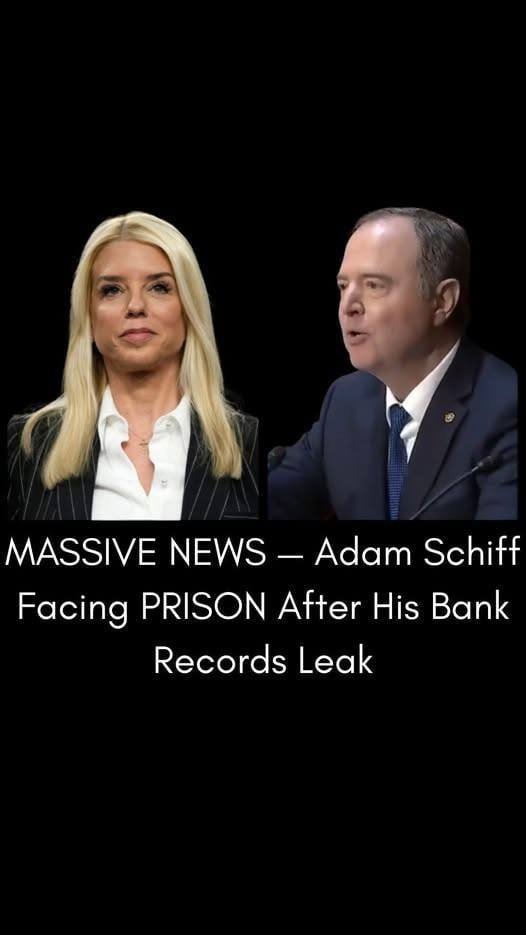
Donald Trump once again propelled himself into the center of America’s political storm by accusing Senator Adam Schiff of mortgage fraud, reviving a rivalry that has simmered for years and now threatens to spill into yet another cycle of accusation, denial, and public confusion. The claim, delivered with Trump’s characteristic certainty, framed Schiff not merely as a political adversary but as a potential criminal actor, a shift that instantly elevated the rhetoric from partisan hostility to alleged legal misconduct. Mortgage fraud, while technical and often opaque to the public, carries a particular sting because it suggests deceit hidden within everyday financial paperwork, a betrayal of trust that resonates with voters who navigate similar systems themselves. Schiff responded swiftly, rejecting the accusation outright and calling it a deliberate political attack untethered from fact. Almost immediately, the nation divided along familiar lines, with Trump supporters embracing the claim as long-awaited proof of elite wrongdoing, while critics warned that unproven allegations framed as crimes undermine democratic norms. The episode illustrates how personal vendettas, legal language, and media amplification now intertwine, creating spectacles where accountability and accusation are increasingly difficult to separate.
Schiff’s response emphasized the absence of evidence and the importance of legal standards, underscoring that no charges have been filed and no wrongdoing established. Trump, however, hinted at hidden documentation and undisclosed findings, a rhetorical strategy that thrives on implication rather than verification. This gap between assertion and proof has become emblematic of modern political conflict, where suggestion alone can shape public belief. Sympathetic media outlets and online commentators amplified the allegation, often presenting repetition as validation, while opponents stressed that criminal accusations demand substantiation, not innuendo. In this environment, the burden of proof appears inverted; denial is treated as suspect, while accusation is granted immediate attention. The resulting dynamic shifts public discourse away from evidence-based evaluation toward narrative momentum, where loyalty and outrage often eclipse careful judgment. The controversy reveals how easily legal terminology can be weaponized, transforming complex financial concepts into blunt tools for political warfare.
The accusation fits seamlessly into the long-standing animosity between Trump and Schiff, forged during impeachment proceedings and years of mutual antagonism. Schiff has long been a central figure in Trump’s portrayal of institutional betrayal, while Trump represents to Schiff a profound threat to constitutional norms. By alleging mortgage fraud, Trump escalated the conflict from ideological disagreement to claims of criminality, signaling to his supporters that political opposition is not merely misguided but corrupt. This framing recasts political rivalry as moral combat, encouraging voters to interpret governance through a lens of suspicion. When opponents are portrayed as criminals rather than adversaries, compromise becomes betrayal and debate becomes impossible. Such escalation deepens polarization, reinforcing the belief that political victory must come through exposure and punishment rather than persuasion. Over time, this logic corrodes the foundations of democratic engagement, replacing civic disagreement with perpetual conflict.
At the heart of the allegation lies Schiff’s ownership of multiple homes, a circumstance common among members of Congress who divide their lives between Washington, D.C., and their home states. Mortgage law surrounding “primary residence” designation is nuanced, hinging on intent, usage, and disclosure rather than simplistic geography. Establishing fraud requires clear evidence of deliberate misrepresentation for financial gain, a standard far higher than political suggestion. Legal experts have repeatedly noted that without documentation demonstrating knowing deception, accusations remain speculative. Yet nuance rarely survives in partisan arenas, where complexity is often stripped away to fit emotionally charged narratives. As a result, a legally intricate issue becomes simplified into a symbol of alleged corruption, its details overshadowed by the power of accusation. The public, confronted with conflicting claims and limited clarity, is left to navigate a landscape where perception often outweighs fact.
Despite the absence of publicly confirmed evidence, the allegation spread rapidly across modern media ecosystems, highlighting how speed and alignment frequently trump verification. Algorithms reward controversy, and repetition across platforms can create an illusion of credibility even when original sourcing is thin or nonexistent. In such conditions, denial struggles to compete with accusation, particularly when the claim reinforces existing beliefs. Schiff’s emphasis on legality and due process resonates with audiences committed to institutional norms, but others interpret complexity as evasion rather than explanation. This inversion reflects a troubling shift in public discourse, where the mere act of being accused can function as a form of punishment. Reputational damage occurs regardless of legal outcome, and the eventual resolution, if one arrives, often receives far less attention than the initial charge.
Beyond the individuals involved, the episode exposes deeper fractures in American political culture. Accusations have become tools of mobilization, and legal language is increasingly wielded as a weapon rather than a pathway to justice. As claims and counterclaims collide, shared factual ground continues to erode, replaced by parallel realities sustained by anger, suspicion, and allegiance. The enduring casualty is public trust, not only in political figures but in the institutions designed to adjudicate truth and accountability. When legal processes are preempted by public verdicts and partisan narratives, confidence in democratic systems weakens. This latest clash between Trump and Schiff is therefore more than another headline; it is a reflection of a political environment where conflict is constant, resolution is elusive, and the promise of reasoned debate is overshadowed by spectacle. In such an atmosphere, the challenge facing American democracy is not merely to determine who is right or wrong, but to restore a culture where truth is pursued through evidence rather than accusation, and trust is rebuilt through consistency rather than outrage.