The killing of Renee Nicole Good sent shockwaves through Minneapolis and far beyond, igniting grief, fury, and a deep national conversation about law enforcement, protest, and accountability. Renee, a thirty-seven-year-old mother of three, was shot and killed during an ICE operation just blocks from her home, in an incident that unfolded within seconds but left a lifetime of consequences behind. Witnesses described chaos, shouting, and fear as officers moved through the neighborhood, while video footage circulating online appeared to capture the final moments before her death. Almost immediately, conflicting narratives emerged. Authorities claimed Renee used her vehicle as a weapon and posed a direct threat to the ICE agent involved, while legal observers and bystanders insisted she was unarmed, acting in a monitoring role, and posed no imminent danger. As investigations began, protests erupted, fueled not only by the loss of Renee’s life but by the broader frustration of communities who feel repeatedly unheard when force is used against civilians.
Public outrage intensified when political leaders quickly weighed in, often before all facts were established. Former President Donald Trump defended the ICE agent, framing the shooting as self-defense and labeling Renee and others present as agitators. Vice President JD Vance echoed similar sentiments, stating that laws were violated and the shooting was justified. These comments, broadcast across social media platforms, were met with fierce backlash. For many, they felt like a dismissal of Renee’s humanity and a rush to absolve authority without due process. At the same time, supporters of law enforcement argued that officers operate under extreme pressure and deserve protection until investigations are complete. This clash of perspectives highlighted a growing divide in how Americans interpret justice, protest, and the role of federal enforcement agencies, especially in communities already strained by aggressive immigration policies and historical mistrust.
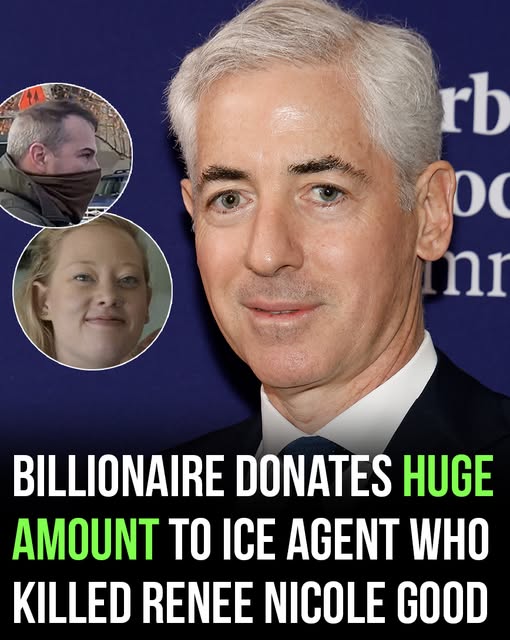
The controversy deepened further when billionaire hedge fund manager Bill Ackman confirmed he had donated $10,000 to a GoFundMe campaign supporting ICE agent Jonathan Ross, the man who fired the fatal shot. Ackman’s involvement instantly drew national attention, not only because of his wealth and influence, but because of what the donation symbolized to many people. Critics viewed it as an endorsement of lethal force and a dismissal of Renee’s life, while supporters argued it reflected a commitment to the legal principle of presumed innocence. Ackman defended his decision publicly, stating that he intended to support both parties involved and that Renee’s family fundraiser had already been closed when he attempted to donate. He described the situation as a tragedy, emphasizing that split-second decisions can lead to irreversible outcomes. Despite his explanation, the gesture reignited anger, with many questioning how power and money shape public narratives in moments of crisis.
As Ackman’s donation circulated online, attention also turned to the overwhelming public response in support of Renee’s family. Her GoFundMe campaign quickly surpassed $1.5 million, reflecting a wave of compassion from people across the country who felt connected to her story. Vigils filled the streets of Minneapolis, where thousands marched not only to honor Renee’s life but to demand transparency and accountability. Protesters carried signs bearing her name, lit candles, and shared stories of loss, emphasizing that Renee was more than a headline—she was a parent, a partner, a friend, and a person deeply rooted in kindness. For many participants, the demonstrations were not solely about this single incident but about a broader pattern of deaths that seem to follow the same script of disputed facts, official justifications, and delayed justice.
The most powerful voice amid the noise belonged to Renee’s widow, Becca, whose words cut through political arguments and online outrage with quiet clarity. In a heartfelt statement, she described Renee as someone who radiated kindness, joy, and compassion in every space she entered. She spoke not of anger, but of love, faith, and the belief that humanity is meant to care for one another. Her description of Renee as “made of sunshine” resonated deeply, reminding many that behind every political debate lies a family grappling with irreversible loss. Becca’s message reframed the tragedy, shifting focus away from ideology and back to the human cost—the children growing up without their mother, the empty spaces left behind, and the grief that no donation or statement can undo.
The case of Renee Nicole Good now stands at the intersection of wealth, power, protest, and grief, exposing uncomfortable truths about how society responds to tragedy depending on who holds authority and resources. Bill Ackman’s donation, regardless of intent, became a symbol of how quickly narratives can be influenced by money and status, while Renee’s death became a rallying cry for those demanding systemic change. As investigations continue and protests persist, the nation is left wrestling with difficult questions: whose lives are protected, whose stories are believed, and how justice is defined in moments of irreversible loss. Beyond the headlines and debates, one truth remains unshakable—Renee Nicole Good’s life mattered, and the conversation her death has sparked will continue to challenge a deeply divided society to confront its values, its systems, and its humanity.