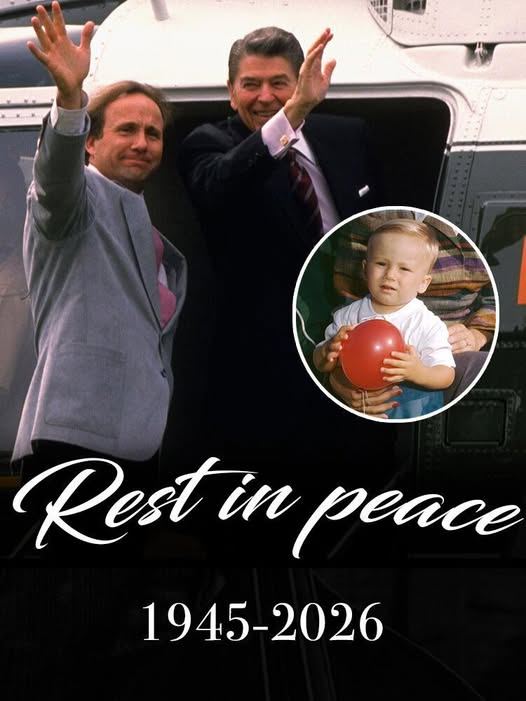
Michael Reagan’s life unfolded in the space between profound public visibility and deeply personal uncertainty, shaped by the tension between a famous legacy and the necessity of forging his own path. Born John Charles Flaugher in Los Angeles in 1945 and adopted just hours after birth by Ronald Reagan and Jane Wyman, he entered a household and a world that carried high expectations and unspoken pressures. From the earliest days, identity was less inherited than negotiated; the Reagan name offered recognition, yet belonging was something Michael had to cultivate in parallel to his father’s escalating public career. He grew up under a shadow that was both protective and demanding, as the life of a future Hollywood star and politician cast long lines over personal relationships, requiring a delicate balance between familial loyalty and self-definition. In those formative years, moments that might have been shared intimately were often mediated through absence, public appearances, or the attention demanded by others, creating a nuanced sense of identity that would define much of his adult life.
Learning of his adoption from his sister rather than from his parents produced an early fracture, one that marked his understanding of family and trust. It was not a narrative of rejection but of delayed revelation, a detail that would echo in his reflections on belonging, history, and memory. As Ronald Reagan transitioned from Hollywood to political prominence, Michael often perceived family through gaps—weekends interrupted by work, holidays compressed by schedules, and formative events attended from the periphery rather than the center. These experiences were not intentionally cruel, but they embedded in him a quiet resilience, the ability to navigate absence without losing the capacity for empathy and connection. Over time, he recognized that family was not only defined by proximity or shared experiences but also by the cultivation of understanding, forgiveness, and attentiveness, even when life’s pace made these qualities difficult to sustain. This insight would inform his personal, spiritual, and professional endeavors for decades to come.
Unlike children of powerful figures who often oscillate between rebellion and blind veneration, Michael embraced a more nuanced approach. He respected his father’s legacy while maintaining honesty about emotional distance and personal disappointment. This balance was neither easy nor universally accepted, yet it allowed him to inhabit a space in which grief, admiration, and self-determination coexisted. His willingness to speak openly about complex emotions, including the isolation he experienced, distinguished him from both mythologizing narratives and purely critical accounts. These qualities extended into his public voice, where he discussed politics, faith, and society with a combination of reverence for history and clarity about lived realities. By acknowledging the tension between public image and private truth, Michael provided a model of integrity that respected both the symbolic weight of his family and the necessity of personal agency.
One of the most defining moments of his public journey involved his disclosure of childhood sexual abuse, an act that required both courage and vulnerability. In an era when male survivors—particularly those connected to conservative political legacies—rarely spoke, he chose transparency as a form of testimony and advocacy. By sharing his story without sensationalism, he challenged cultural assumptions about power, silence, and protection. His decision was not intended to indict or provoke scandal but to illuminate the quiet suffering that often accompanies public life, offering guidance to others navigating trauma. In his writings and commentary, including memoirs like Twice Adopted and On the Outside Looking In, he explored the intersection of personal hardship and societal expectation, illustrating how acknowledgment, reflection, and resilience can transform pain into meaningful contribution and public discourse.
Faith became a central pillar of Michael’s life and recovery. Describing himself as “twice adopted,” he framed identity not solely as biological or social, but as spiritual and moral. Forgiveness, in his conception, did not erase harm or absolve accountability but allowed survival without bitterness. This perspective influenced his conservative commentary, blending adherence to political principles with reflection on human vulnerability, responsibility, and morality. As a radio host and commentator, he defended his father’s administration while providing nuanced critiques, emphasizing that public accomplishment often comes with private cost. His empathy, shaped by personal experience, informed his engagement with audiences, demonstrating that political loyalty can coexist with honesty, and that critique can be compassionate without diminishing achievement. In this balance, he modeled the integration of personal truth with public responsibility.
Michael Reagan’s death on January 4, 2026, at the age of 80 in Los Angeles marked the conclusion of a life defined by both familial legacy and independent agency. Surrounded by loved ones, he left behind a family, a body of work in commentary and advocacy, and a lasting example of resilience, honesty, and integrity. His contributions extended beyond media and politics into charitable engagement, including support for health causes and youth programs, illustrating a commitment to service alongside personal reflection. Remembered not merely as the son of a president but as an individual who insisted on authorship of his own narrative, Michael Reagan’s life bridged public expectation and private authenticity, demonstrating that even in the shadow of immense power, a person can claim clarity, voice, and moral vision, leaving a legacy rooted in both love and truth.