Why a Jar of Pickles Became an Unforgettable Symbol of Love, Kindness, and Human Connection
Some of the most meaningful memories in life begin with situations so ordinary they barely seem important at the time. They are not dramatic milestones or carefully planned celebrations. They do not involve luxury vacations, expensive gifts, or life-changing announcements. Instead, they emerge quietly from everyday moments—late-night conversations, small acts of effort, or simple gestures that unexpectedly reveal how deeply people care for one another.
Years later, those are often the moments people remember most clearly.
Not because they changed the world, but because they changed the way someone felt.
One such story began with something remarkably simple: a pregnancy craving and a jar of pickles.
At first glance, it sounds almost humorous. Pregnancy cravings have long been treated as lighthearted stories shared between couples, families, and friends. Popular culture has turned them into jokes involving strange food combinations, midnight snack runs, and desperate searches for oddly specific flavors. Yet anyone who has experienced pregnancy firsthand—or loved someone going through it—understands that cravings are often about far more than food.
They can feel emotionally urgent.
Comforting.
Overwhelmingly specific.
And strangely important.
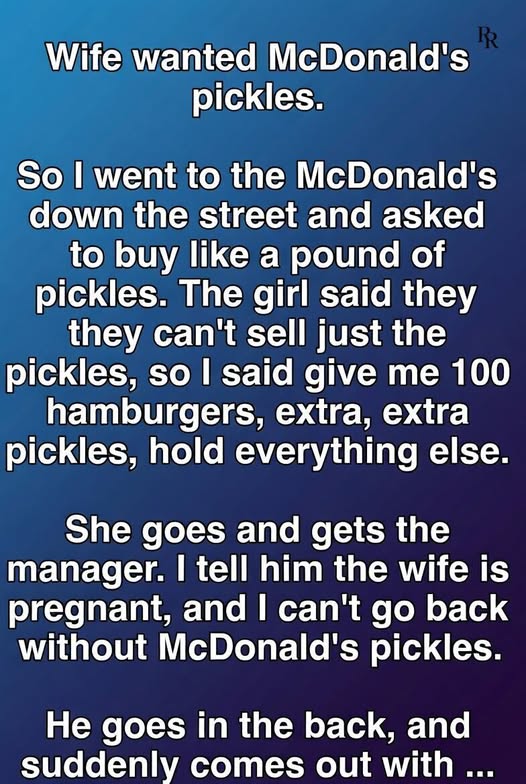
Late one quiet night, a pregnant woman asked her partner for pickles from McDonald’s. Not grocery store pickles. Not homemade pickles. Not “any kind” of pickles.
McDonald’s pickles.
Cold, salty, familiar, and somehow exactly right in a way only cravings can explain.
To someone outside the moment, the request might have sounded trivial. But inside the relationship, it mattered. The craving represented comfort, reassurance, and care. It became one of those small opportunities where love expresses itself not through grand speeches, but through willingness.
So her partner did what many caring people would do.
He grabbed his keys and went out into the night to find pickles.
The Emotional Weight of Small Requests
One reason stories like this resonate with so many people is because they reflect a universal truth about relationships:
Love often appears in inconvenient moments.
Not when things are easy.
Not when gestures are convenient or impressive.
But when someone chooses effort over indifference for something that may seem small from the outside.
Driving somewhere late at night for food is rarely about the food itself. It is about saying:
“I heard you.”
“I care about what matters to you.”
“I’m willing to go out of my way for your comfort.”
That emotional meaning transforms ordinary errands into acts of intimacy.
The man likely expected the trip to be quick and uneventful. He would order the pickles, drive home, and hand them over with a smile. Problem solved.
But life has a way of turning simple plans into memorable stories.
The Problem Nobody Expected
When he arrived at the McDonald’s counter, he encountered something completely unexpected:
The restaurant would not sell pickles by themselves.
From the perspective of the business, the rule made sense. Fast-food systems are built around efficiency, consistency, and predefined menu structures. Items exist within combinations, meal setups, and ordering protocols designed to keep operations running smoothly.
Pickles were considered ingredients.
Not standalone products.
In theory, the explanation was logical.
In practice, it created an oddly emotional obstacle.
Suddenly, a request that seemed incredibly simple became impossible because of policy limitations.
This is one of the strange tensions modern life creates. Human needs and institutional systems do not always align smoothly. Policies exist for order and efficiency, but emotional situations rarely fit neatly inside structured rules.
The employee behind the counter likely was not trying to be difficult. They were simply following procedure.
Yet to the man standing there, the problem felt frustratingly absurd.
He did not need an entire meal.
He did not want burgers.
He only wanted the pickles.
And somewhere at home, someone he loved was waiting for them.
When Humor Becomes Problem-Solving
What happened next is part of what makes the story memorable.
Instead of becoming angry or leaving defeated, he turned to humor.
Humor is often underestimated as a social tool, but psychologically, it serves an important purpose. It relieves tension, softens conflict, and creates emotional flexibility in uncomfortable situations. When rules create dead ends, humor sometimes opens human connection again.
Rather than arguing aggressively about policy, he made an exaggerated suggestion.
If pickles could only exist inside burgers, perhaps he should order an absurd number of burgers with nothing but pickles on them.
The suggestion was ridiculous.
And intentionally so.
It was less about literal food and more about communicating:
“There has to be some reasonable way to solve this.”
In customer service situations, these moments can go in very different directions. Some employees become defensive. Others shut down emotionally. Occasionally, someone recognizes the humanity underneath the awkwardness.
That is exactly what happened here.
The Manager Who Chose Empathy
Eventually, the manager became involved.
Unlike rigid systems, humans can interpret situations emotionally rather than mechanically. The manager immediately understood what was really happening.
This was not a complicated customer dispute.
It was not manipulation.
It was not someone trying to exploit policy loopholes.
It was simply a tired man trying to bring home pickles to his pregnant partner.
The request was not really about food anymore.
It was about care.
And in that moment, the manager made a choice that transformed the entire experience.
Instead of hiding behind policy, they chose compassion.
A container of pickles was quietly prepared.
No argument.
No lecture.
No embarrassment.
No unnecessary difficulty.
Just a simple human decision to help.
The actual value of the pickles was insignificant. But emotionally, the gesture carried enormous weight because it restored humanity to an interaction that could easily have become cold and transactional.
Why Small Kindnesses Matter So Much
Many people underestimate how deeply small acts of kindness affect memory.
Grand events are often exciting in the moment, but tiny moments of empathy frequently become more emotionally durable over time. Psychologists suggest this happens because unexpected kindness activates emotional safety and social trust in powerful ways.
When someone helps without obligation, the brain remembers it differently.
Especially during stressful or emotional periods of life.
Pregnancy itself can already feel emotionally intense, physically exhausting, and psychologically overwhelming. Small comforts become magnified because they provide grounding and reassurance during a major life transition.
The pickles were never just pickles.
They represented effort.
Attention.
Patience.
Love.
And unexpectedly, they also represented kindness from a stranger.
Why People Remember These Stories Forever
Years later, couples rarely remember every routine day of their relationship. The brain naturally filters repetitive experiences over time.
But emotionally unusual moments stay vivid.
People remember:
- Driving through storms for comfort food
- Laughing during stressful situations
- Late-night conversations
- Unexpected acts of generosity
- Moments where someone went out of their way for them
These memories become emotional anchors in relationships.
Interestingly, the stories couples tell repeatedly are often not about perfection. They are about effort. The moments become meaningful precisely because something went wrong, became complicated, or required patience to solve.
If the man had simply bought pickles without difficulty, the moment probably would have been forgotten within weeks.
But the obstacle gave the story emotional texture.
Now it had humor.
Frustration.
Persistence.
Compassion.
And ultimately resolution.
That combination turned a routine errand into a lasting family memory.
The Hidden Power of Everyday Love
Modern culture often portrays love through dramatic gestures:
- Expensive gifts
- Lavish vacations
- Public surprises
- Perfect anniversaries
- Cinematic declarations
But long-term relationships are usually sustained by something much quieter.
Consistency.
Attention.
Small acts repeated over time.
A person willing to leave the house late at night because someone they love wants pickles may not look romantic in a movie scene. Yet in real life, those moments often carry more emotional truth than grand performances ever could.
Real love frequently looks ordinary.
It looks like effort without complaint.
It looks like patience during inconvenience.
It looks like someone saying, “I’ll go get them,” even when tired.
Fast-Food Workers and Invisible Emotional Labor
Another reason this story resonates is because it highlights the emotional role customer service workers sometimes play in people’s lives.
Most fast-food interactions are brief and transactional. Employees follow systems designed for speed and consistency. Yet workers often encounter deeply human situations hidden beneath ordinary orders.
Someone ordering comfort food after a difficult day.
A parent buying dinner after working late.
A teenager nervously on a first date.
A grieving person seeking familiarity.
Or in this case:
A man trying to fulfill a pregnancy craving.
The manager’s decision mattered because they recognized the emotional context behind the request. They understood that flexibility sometimes matters more than procedure.
These moments rarely receive recognition, yet they shape how people experience the world.
A small act of understanding can completely transform someone’s night.
Why Humor Helps During Stress
The humorous aspect of the story also explains why people connect with it emotionally.
Humor often appears during stressful moments because it creates emotional relief. The absurdity of trying to buy “just pickles” from a fast-food restaurant reflects the strange tension between modern systems and human spontaneity.
People laugh because they recognize the situation.
Who has not experienced a moment where a simple request became unnecessarily complicated?
Humor softens frustration and creates connection. Instead of escalating conflict, the man’s exaggerated response opened the possibility for empathy.
That emotional flexibility helped the situation end positively rather than negatively.
The Pregnancy Craving Phenomenon
Pregnancy cravings themselves remain psychologically fascinating.
Scientists still debate exactly why cravings happen, but they likely involve combinations of:
- Hormonal changes
- Sensory shifts
- Emotional associations
- Nutritional needs
- Comfort-seeking behavior
Certain foods become emotionally charged in surprising ways. Texture, smell, temperature, and familiarity all influence cravings intensely.
Pickles, in particular, are one of the most famously associated pregnancy foods because their sharp salty flavor creates strong sensory stimulation.
But cravings are rarely only biological.
They are often emotional too.
The desired food becomes associated with relief, calmness, and comfort.
That is why denying or dismissing cravings can feel emotionally disproportionate compared to the food itself.
Why the Story Endures
What makes the pickle story memorable is not the food.
It is what the food represented.
The story contains multiple layers of humanity:
- A pregnant woman seeking comfort
- A partner willing to help immediately
- Institutional rules creating frustration
- Humor diffusing tension
- A stranger choosing empathy over rigidity
- A small act becoming emotionally meaningful
These layers reflect something deeply recognizable about human relationships.
Most meaningful memories are built from ordinary ingredients.
Not perfection.
Not wealth.
Not spectacle.
Just people trying to care for one another in imperfect situations.
The Difference Between Rules and Understanding
The story also highlights an important truth about modern life:
Rules are necessary, but they are not always sufficient.
Systems create order, but empathy creates humanity.
The manager did not dismantle policy or create chaos. They simply recognized that compassion sometimes matters more than rigid interpretation.
That flexibility transformed an awkward transaction into a lifelong memory.
People rarely remember rules being enforced.
They remember being understood.
Why These Moments Become Family Lore
Over time, stories like this evolve into family legends.
Parents tell children.
Couples laugh about them years later.
Friends hear the story repeatedly at gatherings.
The emotional meaning grows stronger because it becomes attached to identity and shared history.
One day, the child connected to that pregnancy craving may hear the story and laugh at the idea that a jar of McDonald’s pickles once became a midnight mission full of obstacles and negotiations.
But underneath the humor, the deeper message remains:
“You were loved before you even arrived.”
That emotional truth is what gives the story lasting power.
The Beauty of Small Human Moments
In the end, the jar of pickles mattered because it revealed something essential about people.
Love often hides inside inconvenience.
Kindness often appears quietly.
And the moments that stay with us forever are rarely the ones we expect while they are happening.
A late-night craving.
A fast-food counter.
A small policy problem.
A manager choosing compassion.
A partner making the effort anyway.
None of it looked extraordinary at the time.
Yet together, those tiny pieces formed the kind of memory that lasts for decades.
Because sometimes the stories families treasure most are not about huge accomplishments or dramatic events.
Sometimes they are simply about someone going out into the night for pickles—and another person choosing to help them bring those pickles home.