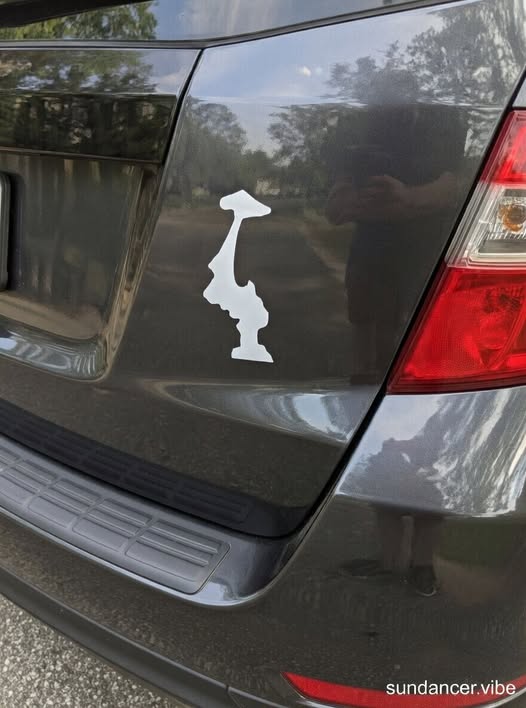
If you spend enough time traveling through Washington State, something subtle begins to stand out in the most ordinary places. It shows up on the backs of weathered Subarus parked outside trailheads, on water bottles clipped to hiking packs, and on laptops resting in quiet coffee shops filled with the soft hum of espresso machines and rainfall outside the window.
At first glance, it looks like a simple outline of Washington State.
But something feels slightly off.
The shape is upside down.
To someone seeing it for the first time, it might look like a printing mistake or a careless design error. Yet the more you notice it, the clearer it becomes: this is intentional. Repeated. Recognized. And quietly meaningful in a way that reflects the culture of the Pacific Northwest itself.
What makes this symbol so interesting is not just its design, but the way it spreads without explanation. There are no official campaigns behind it, no corporate branding strategy, and no single agreed-upon origin story. Instead, it moves organically—through observation, imitation, and shared understanding.
Someone sees it, wonders about it, and eventually adopts it.
And just like that, they become part of a quiet cultural signal that doesn’t need to be explained out loud.
This kind of understated communication fits perfectly within Pacific Northwest culture, where identity is often expressed in subtle gestures rather than bold declarations.
The origin of the upside-down Washington outline is commonly traced back to the early 2010s, when state-shaped decals became popular across the United States. People began placing their home states on cars, laptops, and gear as a simple expression of pride and belonging.
But in Washington, something slightly different happened.
Instead of following the trend exactly as it was, people began to flip the shape.
It was a small change—almost insignificant at first glance—but it carried a distinct personality. Washington’s outline is unique enough that even when inverted, it remains recognizable, which made the variation feel intentional rather than accidental.
From there, it spread quietly.
One of the most popular interpretations links the upside-down design to Washington’s famously rainy climate. The joke suggests that it rains so much in the state that everything might as well be upside down. It is a simple, self-aware kind of humor—one that doesn’t complain about the weather so much as accept it as part of life.
In that sense, the sticker becomes more than decoration. It becomes attitude.
A quiet way of saying: yes, it rains here—and we’re fine with that.
Another interpretation connects the flipped shape to the landscape itself. When turned upside down, the outline can resemble a mountain range, evoking the silhouette of peaks like Mount Rainier. For those who spend their time hiking, camping, or simply living close to nature, this reading feels especially meaningful.
What begins as a simple outline becomes something closer to a landscape memory—a reminder of snow-covered peaks, evergreen forests, and vast stretches of wilderness that define the region.
But beyond humor and geography, the upside-down sticker also reflects something deeper about Pacific Northwest identity: subtlety.
In many places, state pride is loud and unmistakable—flags, slogans, and bold colors designed to be seen from a distance. Washington’s version is quieter. More understated. Almost private.
The flipped outline isn’t immediately obvious to everyone, and that is part of its appeal.
It creates a small moment of recognition between those who understand it.
Not a declaration—but a signal.
A shared nod between people who notice the same details.
Over time, this small design has evolved into more than just a sticker. For many, it has become a marker of experience. It calls back to misty mornings, ferry rides across gray water, long drives through dense evergreen forests, and the quiet rhythm of life shaped by rain and mountains.
Even for those who move away, the symbol often remains—a small reminder of where they came from and the environment that shaped their sense of place.
In the end, the upside-down outline of Washington works because it doesn’t try to explain itself.
It spreads quietly, means slightly different things to different people, and still manages to feel universally understood by those who recognize it.
And maybe that is why it lasts.
Not because it is loud or official, but because it reflects something true about the region it represents: that meaning doesn’t always need to be stated directly to be shared.
Sometimes, the quietest symbols are the ones that stay with us the longest.