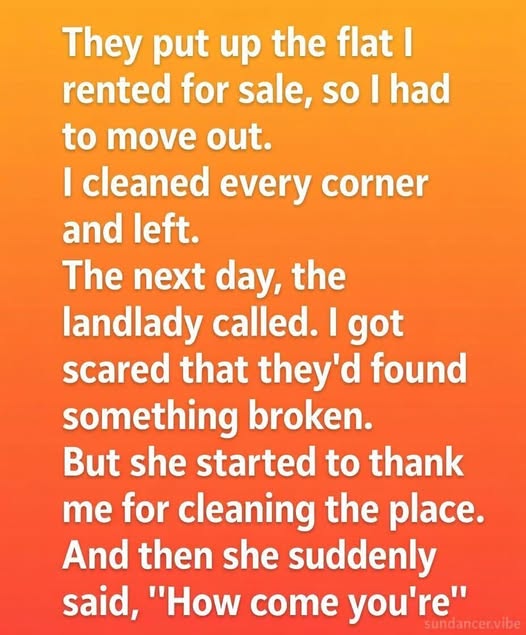
I didn’t think much of it at the time. Cleaning an apartment before moving out is what anyone is expected to do. At least, that’s how I saw it. You pack your boxes, wipe down the surfaces, sweep the floors, maybe scrub the bathroom a little more carefully than usual if you’re hoping to get your deposit back. It’s practical, routine, almost mechanical.
But something about that final day felt different.
After three years in the same apartment, I knew every sound the pipes made, every patch of sunlight that moved across the floor at different hours of the day, every small imperfection in the walls that I had stopped noticing long ago. It wasn’t just a place I lived in—it had become part of my rhythm, part of the background structure of my life.
And now I was leaving it.
The notice that the building was being sold came quietly, almost casually, like a sentence dropped into conversation that you don’t fully absorb until later. At first, I told myself it was fine. People move all the time. Life doesn’t stay in one place. But when I stood in the half-empty rooms surrounded by boxes, I felt something like emotional static—an awareness that something familiar was dissolving.
So I decided that if I was going to leave, I would leave properly.
Not rushed. Not careless. Not emotionally detached.
But clean. Respectful. Complete.
The Cleaning Became Something Else
At first, it was just practical work. I wiped down shelves, packed books, folded clothes, and labeled boxes with an almost obsessive sense of order. I wanted everything to make sense even in transition. There’s a strange comfort in structure when everything else feels uncertain.
Then it shifted.
As the rooms emptied, I started cleaning in a different way—not just to meet expectations, but to acknowledge the space itself. I scrubbed corners I had ignored for months. I polished surfaces that didn’t need polishing. I cleaned behind appliances I had never thought about in daily life.
It wasn’t about perfection. It was about closure.
By the time I finished, the apartment didn’t feel like mine anymore. It felt returned. Restored. As if I had briefly borrowed a space and was now giving it back in better condition than I found it.
The windows were the last thing I cleaned. Sunlight came through them in a way I hadn’t noticed in years—brighter, clearer, almost unfamiliar. The air smelled faintly of cleaning products and fresh openness. I remember standing in the middle of the empty living room thinking: That’s it. This chapter is done.
I didn’t expect anything to come from it.
I certainly didn’t expect a phone call.
The Call I Wasn’t Prepared For
The next morning, my phone rang.
It was my landlady.
We had never spoken much beyond the basics—rent reminders, maintenance checks, occasional updates about small repairs. Polite, brief, transactional. So seeing her name immediately made me tense.
My first thought was: Something went wrong.
Maybe I missed a stain. Maybe I damaged something without realizing it. Maybe there was a complaint from the inspection I wasn’t aware of yet.
I answered cautiously.
But instead of criticism, I heard warmth.
Genuine warmth.
“Thank you,” she said simply, “for leaving the apartment in such incredible condition.”
That alone surprised me. But what followed surprised me even more.
She paused, then added, “Can I ask you something? Why do you always take such care, even when no one is really watching?”
The question stopped me.
Because I had no prepared answer.
Not because I didn’t know—but because I had never been asked to explain it before.
The Habit I Never Thought About
I sat down without realizing it.
And after a moment, I told her the truth.
It wasn’t about cleanliness.
It wasn’t about rules.
It was about how I had learned, over time, that everything we leave behind carries a kind of memory.
Apartments. Jobs. Relationships. Conversations. Even temporary spaces.
I explained that I had moved several times over the years, and each time I had noticed something subtle: the way you leave a place tends to echo longer than the way you arrive. People forget how excited you were when you moved in, but they remember how you treated what you had when you left.
So I started paying attention.
Not because I expected recognition.
But because it felt like a form of respect.
Respect for spaces. Respect for people who come after. Respect for the idea that nothing we use is entirely ours—we are temporary occupants of everything.
There was a long silence on the other end of the line.
Not awkward. Just still.
Then she said something I didn’t expect:
“I think most people don’t do things like that anymore.”
The Meaning I Didn’t Realize I Was Creating
That moment stayed with me more than I expected.
Because until then, I had always assumed that what I did was invisible. Ordinary. Maybe even unnecessary.
But she saw it differently.
To her, it wasn’t just a clean apartment. It was consistency. Reliability. A kind of quiet respect that showed up even when there was no immediate reward.
And suddenly, I began to realize something uncomfortable but important:
We don’t always understand what our habits communicate to other people.
We think we are just “doing things.”
But other people are reading meaning into those actions all the time.
Not loudly. Not dramatically.
Quietly.
The Offer That Changed How I Saw Everything
Before ending the call, she said something that I didn’t fully process until later.
“If you ever need a place again,” she said, “you can contact me directly.”
It wasn’t transactional.
It wasn’t formal.
It was trust.
And it came from something as simple as how I had cleaned an apartment I no longer needed.
After the call ended, I just sat there for a while, thinking about how easily that could have never happened. I could have left in a rush. I could have done the bare minimum. I could have treated it like just another space I was done with.
Nothing would have forced me to care.
But I did.
Not for a reward.
Not for recognition.
Just because it felt right.
What I Realized Later
In the days that followed, the memory of that conversation kept resurfacing.
Not because it was dramatic—but because it was quiet.
And quiet things tend to stay with you longer.
I started noticing how often we underestimate small actions. How often we assume that only big achievements matter, when in reality, most of life is shaped in the margins—how we speak to strangers, how we handle responsibility, how we leave things behind.
Integrity, I realized, isn’t loud.
It doesn’t announce itself.
It accumulates.
Slowly.
Over time.
The Larger Lesson Hidden in a Simple Moment
That apartment was never just a place I lived in.
It became a reflection of something I didn’t have words for at the time: the idea that care doesn’t need an audience to matter.
And the phone call wasn’t really about cleaning.
It was about recognition—but not the kind I expected.
Not praise.
Not validation.
Something quieter.
Understanding.
Because someone, somewhere, noticed a pattern in how I moved through the world.
And responded to it.
Closing Reflection
We often assume that life-changing moments must be dramatic—big decisions, major events, obvious turning points.
But sometimes they are much smaller.
A wiped counter.
A clean floor.
A space left better than it was found.
And a phone call that quietly reminds you that even when no one says anything, the way you move through the world is still being read, still being remembered, and sometimes—when you least expect it—quietly returned to you in ways you never planned.
That day didn’t just end my time in an apartment.
It changed how I understood the weight of small actions.
And it stayed with me long after the boxes were unpacked.