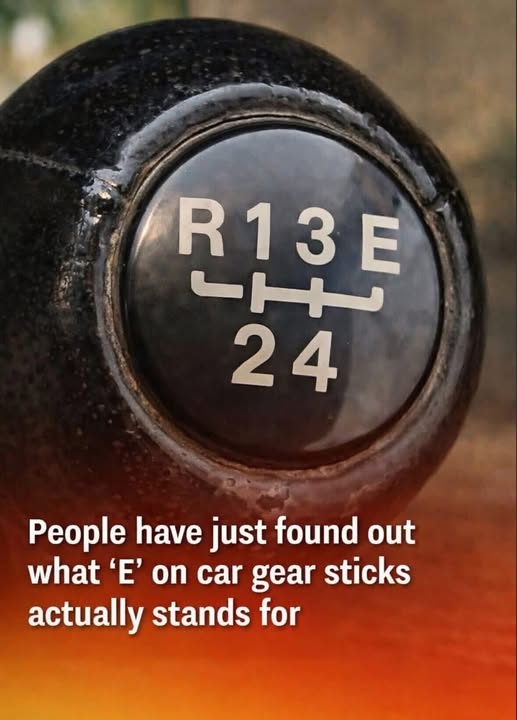
For many drivers, the layout of a gear stick feels almost universal. Whether it’s an automatic with the familiar “P–R–N–D” sequence or a manual gearbox with numbered gears, the system has remained consistent for decades. This familiarity is part of what makes driving transferable across different vehicles and countries.
But older cars sometimes carried an unusual and confusing addition: a letter “E” on the gear selector. To modern drivers, it looks strange—almost like a manufacturing error or an unfamiliar driving mode that no longer exists. Yet this small letter actually has a surprisingly practical history rooted in fuel efficiency, driving behavior, and early automotive engineering.
The Mystery of the “E” That Confused Drivers
As modern cars became more standardized, the appearance of an “E” on older vehicles sparked curiosity and confusion. Drivers encountering it today often assume it might mean “electric,” “emergency,” or even “extra gear.” Online discussions have only amplified the confusion, with many guessing its purpose incorrectly.
In reality, the answer is much simpler—and far more interesting. In many older automatic vehicles, especially European and Japanese models, the “E” stood for Economy.
This was not a decorative label. It represented a real driving mode designed to improve fuel efficiency at a time when engines were far less optimized than today’s systems.
What the “Economy” Mode Actually Did
The Economy (“E”) mode was created during an era when fuel consumption was a major concern for both manufacturers and drivers. Unlike modern vehicles that automatically adjust performance using onboard computers, older transmissions relied more on mechanical or basic electronic controls.
When the driver selected “E,” the car would adjust its shifting behavior to prioritize efficiency over performance. This usually meant:
- Earlier gear shifts at lower RPM
- Reduced engine strain during acceleration
- Smoother, less aggressive driving behavior
- Lower fuel consumption during steady cruising
In simple terms, the car intentionally avoided “revving hard” and instead kept the engine operating in a more relaxed and fuel-saving range.
On highways or long-distance drives, this could make a noticeable difference in fuel economy, especially during times when fuel prices were high or engine efficiency was limited by older technology.
Why It Was Useful at the Time
Unlike modern vehicles, older cars did not automatically optimize driving conditions in real time. Drivers had to be more involved in managing fuel efficiency through their driving habits.
The “E” mode provided a shortcut. Instead of constantly adjusting how you drove, you could select Economy mode and let the transmission handle fuel-saving behavior for you.
For many drivers in the 1970s, 1980s, and early 1990s, this feature was especially valuable during:
- Long highway trips
- Daily commuting in fuel-conscious households
- Times of fuel shortages or rising prices
It represented an early attempt at what we now call “smart efficiency.”
Why the “E” Gear Disappeared
As automotive technology evolved, the need for a dedicated Economy gear gradually disappeared. Several major advancements made it obsolete:
1. Computer-controlled transmissions
Modern vehicles can now adjust shifting patterns automatically based on driving style, speed, and road conditions.
2. Fuel injection systems
These replaced older carburetors and allowed engines to regulate fuel use far more precisely.
3. Drive modes became digital
Instead of a single “E” setting, cars now feature selectable modes like Eco, Sport, Comfort, or Normal.
4. Smarter engine management systems
Onboard computers continuously optimize performance without driver input.
As a result, the “E” gear was no longer necessary. Its function didn’t disappear—it was absorbed into more advanced systems that work continuously in the background.
The Modern Meaning of “E” in Cars
Interestingly, while the original “E” gear has faded into history, the letter itself has returned in a completely different form.
Today, “E” is most commonly associated with Electric vehicles (EVs) rather than Economy modes. This shift reflects a major transformation in automotive technology.
In electric cars:
- There are usually no traditional gearboxes
- Acceleration is controlled electronically
- Efficiency is managed by battery and motor systems
- Driving modes are software-based rather than mechanical
So while older drivers remember “E” as a fuel-saving gear, younger drivers are more likely to see it as part of the electric revolution.
A Symbol of Two Different Eras
The story of the “E” gear highlights an interesting contrast between past and present automotive design.
In older vehicles:
- “E” meant manual efficiency control
- Drivers actively engaged in saving fuel
- Mechanical systems required human input
In modern vehicles:
- Efficiency is fully automated
- Drivers rely on software optimization
- Electric systems redefine how energy is used
What once required a physical gear selection is now handled invisibly by computer systems.
Why This Small Detail Still Matters
Even though the “E” gear has largely disappeared, it represents an important stage in automotive evolution. It shows how manufacturers once tried to solve real-world problems with simple mechanical solutions before digital systems existed.
It also reflects a broader shift in driving culture—from hands-on control to intelligent automation.
For older drivers, the “E” gear is a reminder of a time when understanding your car was essential to saving fuel. For newer generations, it’s a small piece of history that explains how far automotive technology has advanced.
Conclusion
The forgotten “E” on gear sticks was never a mystery or mistake—it was an early fuel-saving innovation known as Economy mode. It helped drivers reduce fuel consumption at a time when efficiency depended heavily on manual control and mechanical design.
As technology advanced, it faded away, replaced by smarter systems that now manage efficiency automatically. And today, the same letter has returned with a new identity in electric vehicles, symbolizing a completely different era of driving.
In the end, the story of “E” is a quiet example of how automotive innovation evolves: what once required a simple switch now runs silently in the background—or has been reimagined entirely for a new generation of vehicles.