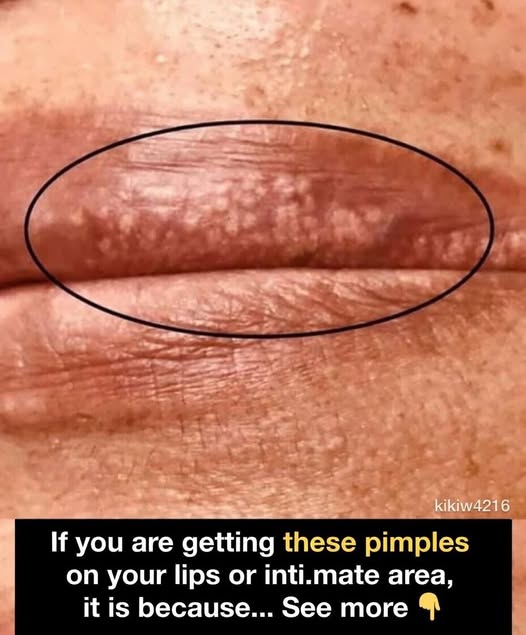
For nearly two years, thirty-four-year-old Melissa avoided looking closely at herself in the mirror. What started as a single tiny white bump near the corner of her upper lip slowly turned into several more, barely noticeable to anyone else yet impossible for her to ignore. At first she convinced herself it was acne. Then she wondered if it was an allergic reaction to lipstick. Eventually, after endless late-night internet searches and terrifying medical forums, her fear spiraled into something much darker. She became convinced she had contracted some kind of hidden infection that would permanently damage her relationships, her confidence, and possibly even her future.
The anxiety became overwhelming.
She stopped wearing bright lipstick because she feared it would attract attention to the tiny bumps. During conversations, she unconsciously covered her mouth with her hand. Intimate moments with her boyfriend became emotionally exhausting because she had also discovered similar bumps in private areas of her body and immediately feared the worst. Though the spots caused no pain, itching, or discomfort, the emotional burden they created was enormous. Melissa spent hundreds of dollars on creams, scrubs, acne treatments, and harsh online “miracle cures” that promised immediate removal. Nothing worked. Some products even irritated her skin badly enough to make the bumps appear more noticeable.
Finally, terrified and exhausted, she scheduled an appointment with a dermatologist expecting devastating news.
Instead, after less than five minutes of examination, the doctor smiled gently and delivered a sentence that instantly changed everything.
“They’re Fordyce spots,” he explained calmly. “They’re completely harmless.”
Melissa stared at him in confusion.
“Harmless?” she repeated.
The doctor nodded. “Incredibly common. Most adults have them to some degree. They aren’t contagious, they aren’t dangerous, and they aren’t caused by poor hygiene or sexual behavior.”
At that moment, nearly two years of fear collapsed inside her all at once.
What Melissa discovered that day is something millions of people worldwide desperately need to hear because these tiny bumps—often appearing on the lips, inside the mouth, or in intimate regions—cause enormous unnecessary anxiety despite being one of the most normal skin variations in existence.
Yet because people rarely discuss them openly, countless individuals suffer silently, convinced something must be terribly wrong.
The truth is far less frightening than most people imagine.
Fordyce spots are tiny visible sebaceous glands, also known as oil glands, that appear closer to the skin’s surface than usual. Normally, sebaceous glands exist beneath the skin and are associated with hair follicles, helping produce natural oils called sebum that keep the skin moisturized and protected. But in certain areas of the body—especially the lips and genital regions—some glands develop independently from hair follicles and become more visible through thinner skin.
This creates small pale bumps that can look alarming at first glance.
They may appear white, cream-colored, yellowish, or flesh-toned. Most range between one and three millimeters in size and often occur in clusters. Because they resemble pimples, many people mistakenly assume they are acne, infections, or sexually transmitted diseases. Others fear they are signs of cancer or poor hygiene.
But medically speaking, Fordyce spots are considered a completely benign anatomical variation.
In fact, dermatologists estimate that between seventy and eighty percent of adults worldwide have them to some degree.
That statistic shocks many people because despite how common the condition is, very few individuals openly talk about it. Social stigma surrounding visible skin changes—especially in intimate areas—creates silence and embarrassment. As a result, people often turn to internet searches filled with frightening misinformation rather than professional medical guidance.
The psychological impact can become surprisingly intense.
Some individuals become consumed by shame. Others avoid intimacy or social situations entirely. Young adults often panic because they fear judgment from romantic partners. Even married individuals sometimes secretly worry they have developed a hidden disease despite having no symptoms beyond the harmless bumps themselves.
Ironically, the fear surrounding Fordyce spots is often far more harmful than the spots themselves.
One reason these bumps create so much confusion is because they commonly appear in places associated with emotionally sensitive concerns. The lips and genital areas are regions people immediately connect with appearance, sexuality, attraction, and health. Any unfamiliar change in these locations can trigger immediate alarm.
But unlike many conditions people fear, Fordyce spots have several distinguishing characteristics.
They are painless.
They do not ooze or bleed.
They usually remain stable over time.
They do not form open sores.
They are not contagious.
And they are not linked to viruses or infections.
This is especially important because many people mistakenly confuse Fordyce spots with herpes. While both can appear around the lips or intimate areas, the two conditions are entirely different medically.
Herpes outbreaks usually involve painful blisters filled with fluid. They often burn, itch, or tingle before appearing and eventually rupture or crust over. Fordyce spots behave nothing like this. They remain stable, dry, and symptom-free.
Similarly, they differ from genital warts caused by HPV, which often have rough textures, irregular shapes, or cauliflower-like surfaces. Fordyce spots are typically smooth and uniform in appearance.
Understanding these differences can instantly relieve tremendous anxiety.
Doctors explain that Fordyce spots often become more noticeable during puberty because hormonal changes increase sebaceous gland activity throughout the body. This is why many people first notice them during adolescence or early adulthood. Hormones stimulate oil production, causing the glands to enlarge slightly and become easier to see beneath thin skin.
Genetics also appear to play a major role.
If parents or siblings have visible Fordyce spots, there is a greater chance other family members will develop them as well. Some people naturally have more visible sebaceous glands than others due to inherited skin characteristics.
Certain lifestyle factors may temporarily influence visibility too.
Heat, humidity, stretching of the skin, dehydration, or irritation from aggressive skincare products can make the bumps appear more prominent temporarily. Smoking has also been associated with increased visibility in some cases because it affects skin texture and oil gland behavior.
However, none of these factors actually “cause” Fordyce spots.
The glands already exist naturally within the skin.
This distinction matters because many people blame themselves unnecessarily. Some assume poor hygiene created the bumps. Others believe diet choices or sexual activity are responsible. In reality, Fordyce spots are simply part of normal human anatomy.
Unfortunately, misinformation online often makes things worse.
Countless websites advertise dangerous “cures” involving lemon juice, toothpaste, acids, essential oils, or harsh scrubbing methods. These approaches rarely help and frequently damage delicate skin instead. Dermatologists warn that aggressive home remedies can lead to burns, scarring, infections, or pigmentation changes far more problematic than the original spots themselves.
Yet desperation drives people toward these risky treatments because embarrassment clouds judgment.
The cosmetic industry also profits heavily from insecurity. Products promising “perfect skin everywhere” create unrealistic expectations that every inch of the human body should appear flawlessly smooth and poreless. This standard is biologically unrealistic. Human skin naturally contains variations, textures, glands, follicles, pigmentation differences, and small irregularities.
Fordyce spots are one of those normal variations.
Still, some individuals choose treatment for cosmetic reasons, particularly if the spots are highly visible or emotionally distressing. While no treatment is medically necessary in most cases, dermatologists do offer certain procedures that may reduce visibility.
Laser therapy is among the most effective.
Carbon dioxide lasers and pulsed-dye lasers can target sebaceous glands with precision, reducing their appearance while minimizing damage to surrounding tissue. Some patients also benefit from topical retinoids, which increase skin cell turnover and may make spots less noticeable over time.
Electrodessication and chemical treatments exist as well, though these procedures carry risks, especially in sensitive areas like the lips or genitals.
Doctors emphasize that treatment decisions should always involve realistic expectations.
Complete permanent removal is not always possible.
And because the condition itself is harmless, any cosmetic procedure must carefully balance potential benefits against risks like scarring or discoloration.
For many people, education alone becomes the most powerful treatment.
Once they understand the bumps are harmless, anxiety fades dramatically.
That emotional shift can be life-changing.
After Melissa learned the truth about her condition, she described feeling as though a massive invisible weight had finally lifted from her shoulders. She stopped obsessively checking mirrors. She threw away the expensive creams and internet remedies cluttering her bathroom cabinet. Most importantly, she stopped seeing her body as damaged or abnormal.
“I wasted two years being terrified of something completely harmless,” she later admitted.
Her experience is incredibly common.
Dermatologists regularly encounter patients who arrive convinced they have serious diseases only to discover they possess perfectly normal anatomical variations. Many patients cry with relief during appointments after learning the truth.
The silence surrounding Fordyce spots contributes heavily to this fear.
People openly discuss acne, wrinkles, eczema, and countless other skin conditions. But because Fordyce spots frequently involve intimate areas, embarrassment prevents conversation. As a result, millions quietly assume they are alone.
They are not.
Medical literature has documented Fordyce spots for well over a century. The condition was first described by dermatologist John Addison Fordyce in the late nineteenth century, and researchers have consistently emphasized its harmless nature ever since.
Yet despite decades of medical understanding, public awareness remains surprisingly low.
That gap between scientific knowledge and public understanding creates unnecessary suffering.
Experts believe better education could dramatically reduce anxiety surrounding the condition. When people recognize these bumps as common and benign, they are far less likely to spiral into catastrophic thinking or pursue harmful self-treatment methods.
Mental health professionals also note that body-image anxiety often magnifies normal physical variations into overwhelming emotional crises. In a culture dominated by filtered images, edited photographs, and unrealistic beauty standards, even tiny harmless skin features can feel emotionally devastating.
This pressure affects both men and women.
Men frequently panic after noticing bumps on the shaft of the penis or scrotum, fearing sexually transmitted infections despite negative test results. Women often experience similar anxiety regarding spots on the labia or lips. In both cases, embarrassment delays medical consultations, prolonging unnecessary fear.
Ironically, most doctors recognize Fordyce spots almost immediately.
Diagnosis typically requires only visual examination. In rare uncertain cases, dermatologists may use magnification tools or biopsy samples to rule out other conditions, but extensive testing is usually unnecessary.
The overwhelming majority of cases require nothing beyond reassurance.
Still, there are situations where medical evaluation remains important.
Any skin change involving pain, bleeding, rapid growth, ulceration, itching, or significant texture changes should always be examined professionally because not every bump is automatically a Fordyce spot. Conditions like infections, allergic reactions, cysts, or more serious dermatological disorders can occasionally resemble harmless spots initially.
This is why self-diagnosis through internet photos alone can be dangerous.
Professional medical guidance provides clarity far more effectively than endless online searching.
In recent years, social media platforms have begun slowly normalizing conversations about common skin conditions, including Fordyce spots. Dermatologists on educational channels now regularly share videos explaining the condition and reassuring viewers about its harmless nature.
This growing openness matters deeply.
Every honest conversation chips away at unnecessary shame.
Ultimately, Fordyce spots reveal something important about human health and self-perception. Bodies are naturally varied. Skin is not meant to resemble perfectly edited magazine images. Tiny glands, bumps, texture differences, freckles, scars, and irregularities are part of being human.
The real problem is often not the condition itself but the fear created by misunderstanding.
Knowledge changes everything.
Once people understand what Fordyce spots truly are, panic frequently transforms into relief almost instantly. The mysterious bumps that once triggered sleepless nights become little more than another normal feature of the human body.
And perhaps that is the most important lesson of all.
Sometimes the things we fear most are simply misunderstood parts of ourselves waiting to be explained with compassion instead of shame.
For millions of adults quietly worrying in mirrors every day, that understanding can feel nothing short of life-changing.