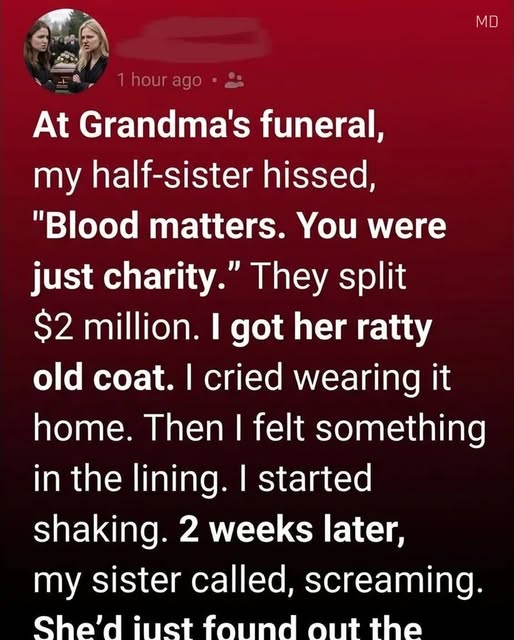
The day of my grandmother’s funeral smelled like rain, lilies, and bitterness.
Dark clouds pressed heavily over the cemetery while mourners dressed in expensive black coats gathered beneath umbrellas pretending grief had softened them into kinder people.
It hadn’t.
At least not Victoria.
I stood quietly near the back of the chapel, clutching the folded funeral program tightly enough to wrinkle the paper. My black dress was borrowed from a coworker because I couldn’t justify buying one for a single day, and my shoes pinched painfully against my heels.
None of that mattered.
The only thing I could focus on was the polished wooden casket resting beneath white flowers at the front of the room.
Grandma Evelyn was gone.
The woman who had raised me.
Protected me.
Loved me.
The only person who had ever made me feel like I belonged anywhere in this world.
Technically, she wasn’t my biological grandmother.
At least not according to the version of the story everyone else believed.
My mother, Isabel, worked as a housekeeper for the family for nearly fifteen years. She cleaned floors, folded laundry, polished silver, and quietly disappeared into the background while wealthy people carried on with their lives around her.
Then she got sick.
Very sick.
And when the rest of the family treated her like an unfortunate inconvenience, Grandma Evelyn stepped in.
She paid hospital bills.
Visited every evening.
Held my mother’s hand through endless treatments.
And when my mother finally passed away in a small hospital room with flickering fluorescent lights and peeling wallpaper, Grandma Evelyn took my tiny hand in hers and brought me home.
I was seven years old.
Terrified.
Grieving.
And suddenly living inside a mansion where nobody except Grandma truly wanted me there.
Especially Victoria.
Victoria was sixteen then—beautiful, elegant, wealthy, and cruel in the quietest ways possible.
She never openly insulted me in front of Grandma.
That would’ve risked consequences.
Instead, she specialized in subtle humiliation.
The kind hidden behind soft smiles and polished manners.
“You should feel lucky,” she whispered once while I helped clear dinner plates. “Most maids’ daughters don’t end up living in houses like this.”
I learned very young that cruelty doesn’t always shout.
Sometimes it speaks gently enough that nobody else notices.
Over the years, Victoria found endless ways to remind me I wasn’t truly family.
At birthdays, she introduced me as “Grandma’s little charity project.”
At holidays, she made jokes about whether I’d inherited my mother’s “cleaning instincts.”
At college graduation, when Grandma proudly cried during my ceremony, Victoria leaned over afterward and murmured:
“It’s amazing how far pity can take someone.”
Grandma always defended me whenever she heard those comments.
But she didn’t hear all of them.
No one did.
By adulthood, I had become skilled at pretending Victoria’s cruelty no longer hurt.
But grief weakens emotional armor.
And standing beside Grandma’s grave that gray afternoon, I felt stripped raw.
After the funeral service ended, people gathered beneath tents near the cemetery entrance sipping coffee and exchanging carefully rehearsed condolences.
Victoria approached me slowly, heels clicking sharply against wet pavement.
She wore a tailored black coat, diamond earrings, and an expression of delicate superiority.
“You look exhausted,” she said softly.
“I am.”
“I suppose this must all feel… uncertain for you now.”
I frowned slightly.
“What do you mean?”
She gave me a sympathetic smile so fake it almost impressed me.
“Well,” she sighed, “without Grandma, you don’t really have any connection to this family anymore.”
The words landed exactly as she intended.
Cold.
Precise.
Cruel.
I stared at her silently, too emotionally drained to fight.
But Victoria wasn’t finished.
“At least Grandma left you a few sentimental things,” she continued. “That was generous of her.”
Before I could respond, she leaned slightly closer.
“The rest of the inheritance is finally where it belongs.”
Then she smiled.
And walked away.
That evening, the family gathered at the estate for the reading of the will.
The house felt unbearably empty without Grandma’s presence.
No soft music drifting from the sitting room.
No smell of tea brewing in the kitchen.
No warm voice asking whether everyone had eaten.
Just tension.
The attorney sat stiffly near the fireplace while relatives arranged themselves across expensive furniture pretending not to anticipate money.
Victoria practically glowed.
And honestly, by the end of the meeting, she had every reason to.
She inherited nearly everything.
The estate.
The jewelry.
The investment accounts.
The antiques.
The art collection.
Even Grandma’s vintage car.
By comparison, my portion sounded painfully small.
A collection of books.
Several family photo albums.
And Grandma’s old wool coat.
That was it.
I nodded politely and thanked the attorney while Victoria barely concealed her satisfaction.
As everyone began leaving the room, she touched my arm lightly.
“Grandma always was sentimental,” she said gently. “I’m sure the coat means a lot to you.”
I went home shortly afterward carrying a cardboard box filled with photographs and books.
The wool coat rested folded carefully across my lap during the drive.
It still smelled faintly like Grandma’s perfume.
Lavender and cedarwood.
That scent nearly broke me.
Back at my apartment, I sat alone on the couch wearing the oversized coat while rain tapped softly against the windows.
Grief arrived in waves.
One moment I was numb.
The next I could barely breathe.
I buried my face against the collar and cried harder than I had all day.
That was when I noticed something strange.
Part of the lining near the inside seam felt unusually thick.
At first I assumed it was damaged padding.
But curiosity pushed through my exhaustion.
I turned on a lamp and examined the coat carefully.
Sure enough, a section inside had been stitched differently than the rest.
My pulse quickened.
Hands trembling slightly, I found a small sewing kit in my kitchen drawer and carefully loosened the seam.
Something crackled beneath the fabric.
Paper.
My heart started pounding.
I reached inside slowly and pulled out a sealed envelope yellowed slightly with age.
Across the front, in Grandma’s unmistakable handwriting, were four words:
For Clara Alone.
I froze.
Then carefully opened it.
Inside was a folded legal document.
At first the language blurred together because my brain struggled to process what I was seeing.
Then the meaning landed all at once.
It was a property deed.
To Grandma’s lakeside cabin.
Transferred legally into my name nearly eight years earlier.
I stared at the paper in total disbelief.
The cabin.
Grandma’s favorite place in the world.
A peaceful property tucked beside a quiet lake two hours outside the city.
She spent every summer there reading books on the porch, gardening near the shoreline, and drinking tea while watching sunsets reflect across the water.
She once told me the cabin was the only place she ever truly felt calm.
And somehow… she had secretly given it to me years ago.
Beneath the deed sat another folded piece of paper.
A handwritten letter.
My throat tightened as I unfolded it.
My dearest Clara,
If you are reading this, then I am gone, and Victoria has almost certainly made you feel small again.
Do not let her.
Tears blurred my vision immediately.
There are truths about this family that Victoria never understood because she spent too much of her life valuing status over character.
You were never charity to me.
You were never an obligation.
You were my joy.
I covered my mouth with shaking fingers.
Then I continued reading.
The cabin belongs to you because it was the place where I felt closest to peace, and I always hoped one day it would become your sanctuary too.
There is something else you deserve to know.
My breathing stopped.
Your mother was not merely my housekeeper.
She was my daughter.
The room tilted around me.
I read the sentence again.
And again.
My mother… was Grandma’s daughter.
Which meant—
Victoria wasn’t just my adoptive relative.
She was my half-sister.
Suddenly decades of tension rearranged themselves into horrifying clarity.
Grandma had hidden the truth.
Not from shame.
From protection.
My mother had been born from a brief relationship Grandma experienced years before marrying Victoria’s wealthy grandfather. The pregnancy was concealed to avoid scandal, and my mother was raised quietly by distant relatives before eventually returning years later as an employee rather than acknowledged family.
Grandma spent the rest of her life trying to stay close to her in whatever ways she could.
By the time I arrived, Grandma had already lost one daughter.
She refused to lose another piece of her family too.
At the bottom of the letter, Grandma wrote one final paragraph.
Blood alone does not create family, Clara. Love does. Loyalty does. Kindness does. Never forget that the people who try hardest to diminish you usually do so because they fear what your existence reveals about themselves.
I cried until sunrise.
Not only from grief anymore.
But from the overwhelming realization that Grandma had loved me far more deeply than I ever understood.
The following week, I drove to the lakeside cabin for the first time since her death.
The moment I arrived, memories hit me all at once.
The wooden porch swing.
The herb garden.
The wind chimes near the dock.
Inside, everything looked almost untouched.
Grandma’s favorite knitted blanket still rested across the couch.
Books remained stacked beside her reading chair.
A half-finished crossword puzzle sat near the kitchen table.
It felt less like entering an abandoned property and more like stepping into preserved love.
I spent hours wandering quietly from room to room.
At sunset, I sat alone on the dock wrapped in Grandma’s wool coat watching orange light ripple across the lake.
For the first time since the funeral, peace found me.
Then Victoria called.
I almost ignored it.
But curiosity won.
“What?” I answered flatly.
Her voice exploded through the phone immediately.
“You knew!”
“Knew what?”
“The antiques!” she snapped. “Half of them are replicas!”
I blinked slowly.
Apparently, after professional evaluations, many of the expensive decorative pieces Victoria inherited turned out to be reproductions Grandma had purchased years earlier simply because she liked how they looked.
Their sentimental value remained.
Their financial value did not.
Victoria sounded furious enough to shatter glass.
“You manipulated her against me!”
“No,” I replied calmly. “I didn’t.”
“You got something else, didn’t you?”
I looked out across the lake.
“Yes.”
Silence.
Then colder: “What?”
I considered lying.
Instead, I spoke carefully.
“Something Grandma actually wanted me to have.”
Victoria inhaled sharply.
“That cabin should’ve been mine.”
“But it wasn’t.”
“She owed me more!”
The bitterness in her voice startled even me.
After everything she inherited, it still wasn’t enough.
Because the issue had never really been money.
It was possession.
Control.
Validation.
She needed to believe she mattered more than I did.
And Grandma’s final choice shattered that illusion completely.
“You know what your problem is, Victoria?” I said quietly.
She scoffed. “Please enlighten me.”
“You spent your entire life believing love worked like inheritance. Like whoever received the most expensive things mattered most.”
“That’s ridiculous.”
“Is it?”
She said nothing.
“Grandma loved people based on how they treated others,” I continued. “Not on bloodlines or appearances or social standing.”
Her voice turned sharp again.
“You think you won something?”
“No,” I answered honestly. “I think Grandma already did.”
Then I hung up.
Victoria sent angry messages for weeks afterward.
I stopped responding.
Eventually the silence between us became permanent.
And honestly?
It felt peaceful.
Months later, I fully moved into the cabin.
I left my tiny apartment in the city and began working remotely instead.
Life became quieter there.
Simpler.
Healthier.
In the mornings, I drank coffee on the porch while mist rolled gently across the lake.
In the evenings, I read books beside the fireplace wrapped in Grandma’s old wool coat.
Sometimes grief still arrived unexpectedly.
A certain song.
A recipe.
The smell of lavender.
But alongside the grief now existed certainty.
I had been loved.
Completely.
Unconditionally.
Not as charity.
Not as obligation.
As family.
One autumn evening, while sorting through old kitchen drawers, I found another note tucked beneath a stack of recipe cards.
Only one sentence was written inside.
The wrong people will always measure your worth by what benefits them. The right people will simply love you.
I kept that note.
Framed it beside the fireplace.
Because after everything—after the funeral, the cruelty, the inheritance, and the buried truths—I finally understood something Grandma had been trying to teach me my entire life.
Family is not determined by who shares your last name.
It is determined by who protects your heart when the world tries to convince you that you are unworthy of love.
Victoria inherited wealth.
But Grandma left me something infinitely more valuable.
A home.
The truth.
And the certainty that I had belonged all along.
The day of my grandmother’s funeral smelled like rain, lilies, and bitterness.
Dark clouds pressed heavily over the cemetery while mourners dressed in expensive black coats gathered beneath umbrellas pretending grief had softened them into kinder people.
It hadn’t.
At least not Victoria.
I stood quietly near the back of the chapel, clutching the folded funeral program tightly enough to wrinkle the paper. My black dress was borrowed from a coworker because I couldn’t justify buying one for a single day, and my shoes pinched painfully against my heels.
None of that mattered.
The only thing I could focus on was the polished wooden casket resting beneath white flowers at the front of the room.
Grandma Evelyn was gone.
The woman who had raised me.
Protected me.
Loved me.
The only person who had ever made me feel like I belonged anywhere in this world.
Technically, she wasn’t my biological grandmother.
At least not according to the version of the story everyone else believed.
My mother, Isabel, worked as a housekeeper for the family for nearly fifteen years. She cleaned floors, folded laundry, polished silver, and quietly disappeared into the background while wealthy people carried on with their lives around her.
Then she got sick.
Very sick.
And when the rest of the family treated her like an unfortunate inconvenience, Grandma Evelyn stepped in.
She paid hospital bills.
Visited every evening.
Held my mother’s hand through endless treatments.
And when my mother finally passed away in a small hospital room with flickering fluorescent lights and peeling wallpaper, Grandma Evelyn took my tiny hand in hers and brought me home.
I was seven years old.
Terrified.
Grieving.
And suddenly living inside a mansion where nobody except Grandma truly wanted me there.
Especially Victoria.
Victoria was sixteen then—beautiful, elegant, wealthy, and cruel in the quietest ways possible.
She never openly insulted me in front of Grandma.
That would’ve risked consequences.
Instead, she specialized in subtle humiliation.
The kind hidden behind soft smiles and polished manners.
“You should feel lucky,” she whispered once while I helped clear dinner plates. “Most maids’ daughters don’t end up living in houses like this.”
I learned very young that cruelty doesn’t always shout.
Sometimes it speaks gently enough that nobody else notices.
Over the years, Victoria found endless ways to remind me I wasn’t truly family.
At birthdays, she introduced me as “Grandma’s little charity project.”
At holidays, she made jokes about whether I’d inherited my mother’s “cleaning instincts.”
At college graduation, when Grandma proudly cried during my ceremony, Victoria leaned over afterward and murmured:
“It’s amazing how far pity can take someone.”
Grandma always defended me whenever she heard those comments.
But she didn’t hear all of them.
No one did.
By adulthood, I had become skilled at pretending Victoria’s cruelty no longer hurt.
But grief weakens emotional armor.
And standing beside Grandma’s grave that gray afternoon, I felt stripped raw.
After the funeral service ended, people gathered beneath tents near the cemetery entrance sipping coffee and exchanging carefully rehearsed condolences.
Victoria approached me slowly, heels clicking sharply against wet pavement.
She wore a tailored black coat, diamond earrings, and an expression of delicate superiority.
“You look exhausted,” she said softly.
“I am.”
“I suppose this must all feel… uncertain for you now.”
I frowned slightly.
“What do you mean?”
She gave me a sympathetic smile so fake it almost impressed me.
“Well,” she sighed, “without Grandma, you don’t really have any connection to this family anymore.”
The words landed exactly as she intended.
Cold.
Precise.
Cruel.
I stared at her silently, too emotionally drained to fight.
But Victoria wasn’t finished.
“At least Grandma left you a few sentimental things,” she continued. “That was generous of her.”
Before I could respond, she leaned slightly closer.
“The rest of the inheritance is finally where it belongs.”
Then she smiled.
And walked away.
That evening, the family gathered at the estate for the reading of the will.
The house felt unbearably empty without Grandma’s presence.
No soft music drifting from the sitting room.
No smell of tea brewing in the kitchen.
No warm voice asking whether everyone had eaten.
Just tension.
The attorney sat stiffly near the fireplace while relatives arranged themselves across expensive furniture pretending not to anticipate money.
Victoria practically glowed.
And honestly, by the end of the meeting, she had every reason to.
She inherited nearly everything.
The estate.
The jewelry.
The investment accounts.
The antiques.
The art collection.
Even Grandma’s vintage car.
By comparison, my portion sounded painfully small.
A collection of books.
Several family photo albums.
And Grandma’s old wool coat.
That was it.
I nodded politely and thanked the attorney while Victoria barely concealed her satisfaction.
As everyone began leaving the room, she touched my arm lightly.
“Grandma always was sentimental,” she said gently. “I’m sure the coat means a lot to you.”
I went home shortly afterward carrying a cardboard box filled with photographs and books.
The wool coat rested folded carefully across my lap during the drive.
It still smelled faintly like Grandma’s perfume.
Lavender and cedarwood.
That scent nearly broke me.
Back at my apartment, I sat alone on the couch wearing the oversized coat while rain tapped softly against the windows.
Grief arrived in waves.
One moment I was numb.
The next I could barely breathe.
I buried my face against the collar and cried harder than I had all day.
That was when I noticed something strange.
Part of the lining near the inside seam felt unusually thick.
At first I assumed it was damaged padding.
But curiosity pushed through my exhaustion.
I turned on a lamp and examined the coat carefully.
Sure enough, a section inside had been stitched differently than the rest.
My pulse quickened.
Hands trembling slightly, I found a small sewing kit in my kitchen drawer and carefully loosened the seam.
Something crackled beneath the fabric.
Paper.
My heart started pounding.
I reached inside slowly and pulled out a sealed envelope yellowed slightly with age.
Across the front, in Grandma’s unmistakable handwriting, were four words:
For Clara Alone.
I froze.
Then carefully opened it.
Inside was a folded legal document.
At first the language blurred together because my brain struggled to process what I was seeing.
Then the meaning landed all at once.
It was a property deed.
To Grandma’s lakeside cabin.
Transferred legally into my name nearly eight years earlier.
I stared at the paper in total disbelief.
The cabin.
Grandma’s favorite place in the world.
A peaceful property tucked beside a quiet lake two hours outside the city.
She spent every summer there reading books on the porch, gardening near the shoreline, and drinking tea while watching sunsets reflect across the water.
She once told me the cabin was the only place she ever truly felt calm.
And somehow… she had secretly given it to me years ago.
Beneath the deed sat another folded piece of paper.
A handwritten letter.
My throat tightened as I unfolded it.
My dearest Clara,
If you are reading this, then I am gone, and Victoria has almost certainly made you feel small again.
Do not let her.
Tears blurred my vision immediately.
There are truths about this family that Victoria never understood because she spent too much of her life valuing status over character.
You were never charity to me.
You were never an obligation.
You were my joy.
I covered my mouth with shaking fingers.
Then I continued reading.
The cabin belongs to you because it was the place where I felt closest to peace, and I always hoped one day it would become your sanctuary too.
There is something else you deserve to know.
My breathing stopped.
Your mother was not merely my housekeeper.
She was my daughter.
The room tilted around me.
I read the sentence again.
And again.
My mother… was Grandma’s daughter.
Which meant—
Victoria wasn’t just my adoptive relative.
She was my half-sister.
Suddenly decades of tension rearranged themselves into horrifying clarity.
Grandma had hidden the truth.
Not from shame.
From protection.
My mother had been born from a brief relationship Grandma experienced years before marrying Victoria’s wealthy grandfather. The pregnancy was concealed to avoid scandal, and my mother was raised quietly by distant relatives before eventually returning years later as an employee rather than acknowledged family.
Grandma spent the rest of her life trying to stay close to her in whatever ways she could.
By the time I arrived, Grandma had already lost one daughter.
She refused to lose another piece of her family too.
At the bottom of the letter, Grandma wrote one final paragraph.
Blood alone does not create family, Clara. Love does. Loyalty does. Kindness does. Never forget that the people who try hardest to diminish you usually do so because they fear what your existence reveals about themselves.
I cried until sunrise.
Not only from grief anymore.
But from the overwhelming realization that Grandma had loved me far more deeply than I ever understood.
The following week, I drove to the lakeside cabin for the first time since her death.
The moment I arrived, memories hit me all at once.
The wooden porch swing.
The herb garden.
The wind chimes near the dock.
Inside, everything looked almost untouched.
Grandma’s favorite knitted blanket still rested across the couch.
Books remained stacked beside her reading chair.
A half-finished crossword puzzle sat near the kitchen table.
It felt less like entering an abandoned property and more like stepping into preserved love.
I spent hours wandering quietly from room to room.
At sunset, I sat alone on the dock wrapped in Grandma’s wool coat watching orange light ripple across the lake.
For the first time since the funeral, peace found me.
Then Victoria called.
I almost ignored it.
But curiosity won.
“What?” I answered flatly.
Her voice exploded through the phone immediately.
“You knew!”
“Knew what?”
“The antiques!” she snapped. “Half of them are replicas!”
I blinked slowly.
Apparently, after professional evaluations, many of the expensive decorative pieces Victoria inherited turned out to be reproductions Grandma had purchased years earlier simply because she liked how they looked.
Their sentimental value remained.
Their financial value did not.
Victoria sounded furious enough to shatter glass.
“You manipulated her against me!”
“No,” I replied calmly. “I didn’t.”
“You got something else, didn’t you?”
I looked out across the lake.
“Yes.”
Silence.
Then colder: “What?”
I considered lying.
Instead, I spoke carefully.
“Something Grandma actually wanted me to have.”
Victoria inhaled sharply.
“That cabin should’ve been mine.”
“But it wasn’t.”
“She owed me more!”
The bitterness in her voice startled even me.
After everything she inherited, it still wasn’t enough.
Because the issue had never really been money.
It was possession.
Control.
Validation.
She needed to believe she mattered more than I did.
And Grandma’s final choice shattered that illusion completely.
“You know what your problem is, Victoria?” I said quietly.
She scoffed. “Please enlighten me.”
“You spent your entire life believing love worked like inheritance. Like whoever received the most expensive things mattered most.”
“That’s ridiculous.”
“Is it?”
She said nothing.
“Grandma loved people based on how they treated others,” I continued. “Not on bloodlines or appearances or social standing.”
Her voice turned sharp again.
“You think you won something?”
“No,” I answered honestly. “I think Grandma already did.”
Then I hung up.
Victoria sent angry messages for weeks afterward.
I stopped responding.
Eventually the silence between us became permanent.
And honestly?
It felt peaceful.
Months later, I fully moved into the cabin.
I left my tiny apartment in the city and began working remotely instead.
Life became quieter there.
Simpler.
Healthier.
In the mornings, I drank coffee on the porch while mist rolled gently across the lake.
In the evenings, I read books beside the fireplace wrapped in Grandma’s old wool coat.
Sometimes grief still arrived unexpectedly.
A certain song.
A recipe.
The smell of lavender.
But alongside the grief now existed certainty.
I had been loved.
Completely.
Unconditionally.
Not as charity.
Not as obligation.
As family.
One autumn evening, while sorting through old kitchen drawers, I found another note tucked beneath a stack of recipe cards.
Only one sentence was written inside.
The wrong people will always measure your worth by what benefits them. The right people will simply love you.
I kept that note.
Framed it beside the fireplace.
Because after everything—after the funeral, the cruelty, the inheritance, and the buried truths—I finally understood something Grandma had been trying to teach me my entire life.
Family is not determined by who shares your last name.
It is determined by who protects your heart when the world tries to convince you that you are unworthy of love.
Victoria inherited wealth.
But Grandma left me something infinitely more valuable.
A home.
The truth.
And the certainty that I had belonged all along.