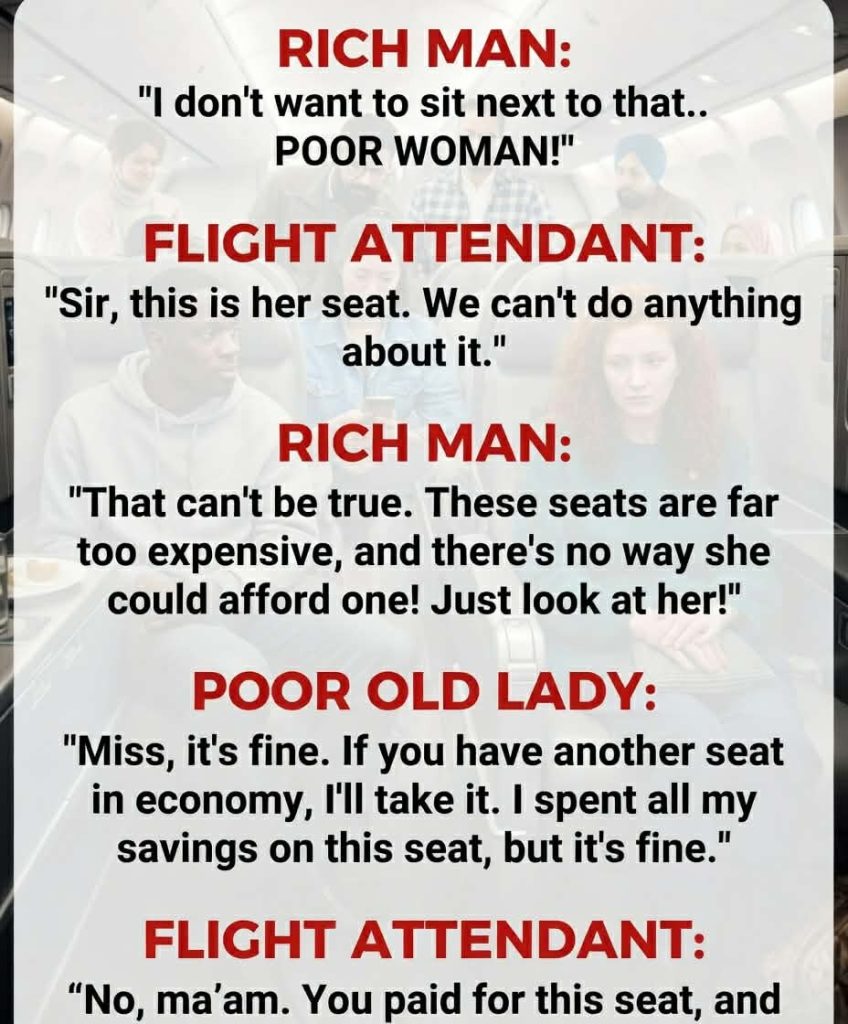
The first thing Franklin noticed about the elderly woman was her shoes.
Worn.
Carefully polished, but old enough to reveal years of repair along the soles.
The second thing he noticed was that she seemed nervous the moment she stepped into business class.
That, more than anything else, convinced him she did not belong there.
Passengers boarding international flights often carry invisible confidence. Wealth moves comfortably. Experience settles naturally into expensive spaces. But the woman standing uncertainly near seat 3A looked overwhelmed by everything around her—the wide leather seats, the soft lighting, the glasses of sparkling water being offered before takeoff.
She clutched a faded blue handbag tightly against her chest as though afraid someone might ask her to leave at any moment.
Franklin sighed quietly and glanced back at his laptop.
Another delayed flight.
Another exhausting business trip.
He already felt irritated before boarding, and the woman’s confusion only sharpened his impatience further.
The flight attendant smiled warmly at the elderly passenger.
“May I help you find your seat, ma’am?”
The woman nodded nervously and handed over her boarding pass with slightly trembling fingers.
“Thank you,” she whispered softly.
The attendant checked the ticket.
“You’re right here in 3A.”
Franklin looked up immediately.
Beside him.
Of course.
The woman blinked in surprise.
“This seat?” she asked carefully, as though certain there must be some mistake.
“Yes, ma’am,” the attendant replied kindly. “This is your seat.”
Several nearby passengers exchanged subtle glances.
Franklin noticed them too.
The silent assumptions.
The same ones already forming inside his own mind.
How could someone dressed so modestly afford business class on an international flight?
The elderly woman hesitated before sitting down slowly, apologizing under her breath when her purse brushed the armrest.
“I’m sorry,” she murmured. “I don’t travel much.”
Franklin forced a thin polite smile.
“No problem.”
But internally, judgment had already taken root.
People rarely admit how quickly they measure worth by appearances.
Expensive watch.
Tailored clothes.
Confidence.
Age.
Accent.
Shoes.
Human beings construct entire stories from details that often reveal almost nothing real.
The plane began boarding fully around them while the woman remained unusually still in her seat, hands folded tightly atop her purse like someone trying desperately not to inconvenience the world around her.
Franklin returned to answering emails.
Yet throughout takeoff, he kept noticing small things about her.
The way she carefully read every instruction card twice.
The way she flinched slightly whenever turbulence rattled the cabin.
The way she quietly refused champagne because she did not want to “cause trouble” asking questions about the menu.
There was gentleness in everything she did.
Not weakness.
Gentleness.
Still, Franklin remained emotionally distant.
Until the purse fell.
It happened nearly two hours into the flight.
The woman reached down too quickly when the plane shifted unexpectedly, and the faded handbag slipped from her lap onto the floor between their seats.
Several items spilled out.
Lipstick.
Tissues.
A small pill container.
And a gold locket attached to a delicate chain.
The moment the necklace hit the floor, the woman gasped sharply.
Not with annoyance.
With panic.
“Oh no,” she whispered urgently.
Franklin instinctively bent down to help retrieve it before another passenger stepped on the chain.
The locket felt surprisingly heavy in his hand.
Old.
Expensive.
Far more valuable than anything else she carried.
The woman’s eyes filled instantly with relief when he handed it back.
“Thank you,” she breathed.
Her fingers closed around the necklace carefully, almost reverently.
“It’s beautiful,” Franklin admitted before thinking.
A soft sadness crossed her face.
“It belonged to my mother.”
Something in her tone made him pause.
Not sentimental performance.
Grief.
Old grief.
The kind polished smooth by decades of carrying it silently.
“She gave it to me before my father left for the war,” the woman explained quietly while looking down at the locket resting in her palm. “It was the last thing connecting all of us together.”
Franklin listened despite himself.
Outside the windows, clouds stretched endlessly across darkening sky while the cabin lights dimmed into soft evening gold.
The woman smiled faintly.
“My name is Stella, by the way.”
“Franklin.”
“Do you travel often?”
“Too often.”
She nodded gently.
“My son travels constantly too.”
The statement carried unusual weight somehow.
Franklin noticed it immediately.
“You’re visiting him?”
For a moment Stella did not answer.
Instead, she carefully opened the locket.
Inside rested a tiny faded photograph of a baby boy.
“He doesn’t know I’m coming,” she admitted softly.
Franklin frowned slightly.
“You’re surprising him?”
A sad smile touched her lips.
“Not exactly.”
Silence settled briefly between them.
Then, slowly, Stella began telling the story.
Not dramatically.
Not seeking sympathy.
Simply speaking with the quiet honesty of someone who carried memories too long alone.
She grew up during difficult years.
Her father died overseas before she turned five.
Her mother worked endlessly to survive.
At seventeen, Stella fell in love with a young mechanic named Daniel who promised marriage and stability.
Instead, he disappeared after learning she was pregnant.
Suddenly alone and desperate, Stella gave birth to a son she adored immediately but could not financially support.
“I thought love was enough,” she said quietly. “Sometimes it isn’t.”
Franklin said nothing.
The plane hummed steadily around them while most passengers slept or watched movies unaware that decades of hidden sorrow were unfolding quietly in seat 3A.
“My aunt arranged an adoption,” Stella continued. “A good family. Stable. Educated. Everything I couldn’t give him.”
Her fingers tightened around the locket.
“It nearly destroyed me.”
Franklin glanced toward her carefully.
“You found him later?”
“Yes.”
The single word carried an ocean inside it.
Stella explained how she spent years searching after finally becoming financially stable enough to try reconnecting.
Eventually she located him.
Successful.
Educated.
Living across the country.
“He agreed to meet me once,” she said softly.
Franklin waited.
“He was polite,” Stella continued. “But I represented pain to him. Confusion. Questions. He already had parents. A life. I think my existence complicated the story he built to survive.”
“What happened after that?”
Stella looked down.
“He asked me not to contact him again.”
The sentence landed heavily between them.
Franklin suddenly felt ashamed remembering his earlier assumptions.
This woman beside him carried entire lifetimes of sacrifice and grief while he reduced her to worn shoes and nervous body language.
“What changed now?” he asked quietly.
Stella smiled faintly.
“Tomorrow is his birthday.”
Franklin frowned slightly.
“You’re flying across the country just for that?”
“I only wanted to be nearby,” she admitted gently. “Same city. Same sky. That’s enough.”
The simplicity of the answer broke something inside him unexpectedly.
No demands.
No expectations.
Just proximity.
The smallest possible form of love.
Hours passed differently after that.
Franklin stopped working entirely.
Instead, he listened.
Stella told stories about factory jobs, tiny apartments, night classes, lonely holidays, and years spent wondering whether her son was happy.
Not bitterly.
Never bitterly.
That was what affected Franklin most.
Despite everything she lost, tenderness still survived inside her.
At one point she laughed quietly while describing how she practiced introducing herself to her son again hundreds of times before finally meeting him.
“What did you say?” Franklin asked.
Her smile trembled slightly.
“Hello. I’m the woman who loved you first.”
Franklin looked away toward the dark airplane window immediately.
Something tightened painfully in his chest.
The cabin lights dimmed further as the plane prepared for descent several hours later.
Passengers stirred awake around them.
Flight attendants moved quietly through aisles collecting glasses and blankets.
Then the intercom crackled softly overhead.
A male voice filled the cabin.
“Ladies and gentlemen, this is your captain speaking. We’ll begin final descent shortly.”
Routine.
Ordinary.
Until the voice paused.
Then continued again more slowly.
“There is also someone special aboard tonight.”
The entire cabin grew subtly quieter.
Franklin turned toward Stella automatically.
Her face had gone completely pale.
The voice over the speaker trembled almost imperceptibly now.
“For many years,” the captain continued carefully, “I believed certain stories about abandonment and loss. I carried anger without fully understanding the people behind those decisions.”
Stella’s hands began shaking.
Passengers looked around in confusion.
Franklin stared at her wide-eyed.
The voice continued.
“But time changes people. And sometimes adulthood teaches us truths childhood cannot understand.”
Stella covered her mouth suddenly.
“Tonight,” the captain said softly, “my birth mother is flying with us.”
A stunned silence spread across the cabin.
Franklin felt chills race across his arms.
The voice broke slightly before continuing.
“She once believed giving me away meant losing me forever. But if you’re listening right now, Stella… I want you to know something.”
Tears spilled down Stella’s face silently.
“You never stopped loving me. And I never stopped wondering about you either.”
Several passengers openly cried now without fully understanding the history involved.
Franklin could barely breathe.
The captain inhaled shakily over the speaker.
“I spent years protecting myself from questions that hurt too much to ask. But I don’t want another birthday to pass pretending distance matters more than love.”
The cabin remained utterly silent.
Then came the final words.
“So if you’ll wait for me at the gate… I’d really like to see my mother again.”
Stella broke completely then.
Not dramatically.
Quietly.
Like decades of restrained grief finally collapsed under the weight of unexpected grace.
Franklin reached for her hand instinctively.
She squeezed it tightly while sobbing softly into trembling fingers.
When the plane landed, nobody rushed to stand immediately.
Passengers remained strangely still as though everyone understood they had witnessed something sacred.
At the gate, Stella hesitated near the exit trembling with visible fear.
“What if he changes his mind?” she whispered.
Franklin smiled gently.
“He won’t.”
The terminal doors opened.
And there he stood.
Still wearing his captain’s uniform.
Middle-aged now.
Tall.
Nervous.
Eyes already full of tears.
For one suspended moment neither moved.
Then Stella whispered his name.
And suddenly decades disappeared between them.
He crossed the distance first.
The embrace looked almost painful in its intensity, as though both feared letting go might somehow return them to separation again.
Passengers nearby quietly wiped tears.
Airport employees pretended not to stare.
Franklin stood several feet away watching the reunion unfold while shame and gratitude tangled together inside him.
Hours earlier he judged Stella as someone who did not belong in business class.
Now he realized she carried more dignity, strength, and love than many people he had admired his entire life.
Wealth fades.
Status disappears.
Appearance deceives.
But sacrifice leaves marks deeper than any outward measure of value.
As Stella held her son tightly beneath the bright airport lights, Franklin understood something he would never forget:
Sometimes the people who seem smallest in the room are carrying the heaviest stories.
And sometimes love survives long enough to find its way home anyway.