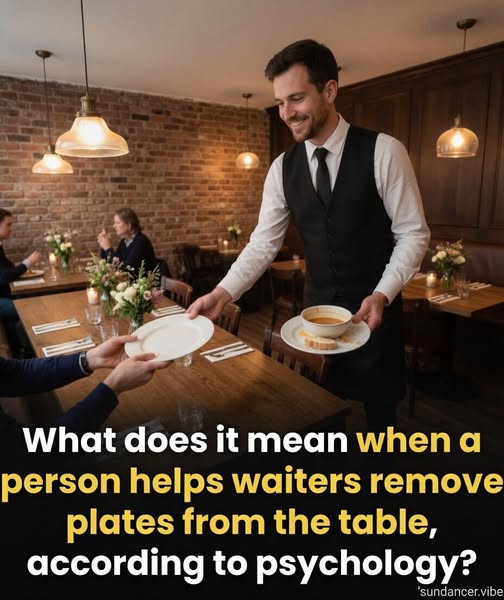
In everyday life, people often reveal the most about themselves through the smallest actions.
Not the dramatic speeches. Not the carefully planned gestures. Not the public displays designed to impress a crowd. The clearest reflections of character usually appear in quiet moments that happen almost automatically, without performance or attention. A person holding the door without thinking. Someone noticing another person’s discomfort before it is spoken aloud. A stranger picking up something another person dropped. Or, in one of the most ordinary yet revealing social situations, someone helping a waiter clear the table after a meal.
At first glance, the gesture seems insignificant.
Passing plates to the edge of the table, stacking dishes neatly, handing over empty glasses, or moving items to make cleanup easier hardly feels profound. Many people barely notice it happening. Yet psychology suggests that these small, low-stakes behaviors often reveal deeper truths about personality, emotional intelligence, empathy, and the way individuals relate to the world around them.
That is partly because small actions tend to be less calculated.
Large acts of generosity can sometimes involve recognition, social reward, or personal image. People may donate publicly, volunteer visibly, or behave generously when they know others are watching. But helping a waiter often happens instinctively, in a moment where there is little to gain socially. The gesture is usually quick, practical, and unnoticed by most people at the table. Precisely because it is subtle, it can offer a more authentic glimpse into someone’s natural orientation toward others.
Psychologists have long argued that spontaneous behavior often reveals underlying values more accurately than rehearsed behavior. When people act without overthinking, they tend to rely on their habitual patterns of empathy, awareness, and social instinct. Helping a waiter clear a table may seem minor, but it often reflects a broader internal mindset—one shaped by how a person sees effort, responsibility, cooperation, and shared humanity.
One of the strongest psychological traits associated with this behavior is empathy.
Empathy is more than kindness. In psychology, it refers to the ability to recognize, understand, and emotionally respond to the experiences of another person. Someone who helps a waiter is often responding to an unspoken awareness of workload and effort. They notice the server balancing multiple plates, moving quickly between tables, managing pressure, or trying to keep the dining area organized.
Most importantly, they notice it without needing it explained.
That awareness matters.
Empathetic individuals tend to process environments differently from people who are more self-focused. They naturally scan social situations for emotional and practical cues. They notice exhaustion in facial expressions, stress in body language, or tension in hurried movement. Even if they do not consciously analyze these signals, their brains register them automatically.
As a result, small acts of assistance often emerge naturally.
The person helping the waiter may not even think deeply about it. They simply see an opportunity to reduce friction for another human being and respond instinctively. In psychological terms, this reflects prosocial behavior—actions intended to benefit others without expectation of direct personal reward.
Prosocial behavior is one of the foundations of healthy social functioning. It includes everyday actions such as sharing, comforting, cooperating, assisting, and supporting others in ordinary environments. These actions may appear small individually, but collectively they shape the emotional atmosphere of society.
Helping a waiter is a classic example because it exists in a space where assistance is optional.
Nobody is obligated to do it.
Most restaurants are structured around clear social roles: customers dine while servers manage the service. Because of this structure, choosing to assist even slightly represents a willingness to step beyond passive participation. It reflects a mindset that sees interaction not as rigidly divided by status or role, but as something more cooperative and human.
This is where emotional intelligence becomes especially relevant.
Emotional intelligence refers to the ability to recognize, understand, regulate, and respond effectively to emotions—both one’s own and those of others. People with higher emotional intelligence tend to possess stronger social awareness, meaning they pay attention to how situations affect everyone involved, not just themselves.
In a restaurant setting, many people remain fully absorbed in their own experience: the food, conversation, entertainment, or convenience. Someone who helps clear the table, however, is often paying attention to the broader environment. They notice when the server is overwhelmed, when space is limited, or when small cooperation could improve the situation.
This type of awareness reflects a subtle but important psychological trait: the ability to mentally include other people in one’s experience of the environment.
That may sound simple, but it changes behavior dramatically.
People who possess stronger social awareness often move through life with a greater sense of interconnectedness. They unconsciously ask questions like:
“How might my behavior affect someone else?”
“What would make this situation easier for everyone involved?”
“Can I contribute something useful here?”
These questions rarely appear consciously in everyday moments, yet they influence behavior constantly.
Helping a waiter also reveals something about a person’s relationship with hierarchy.
Restaurants operate within socially defined roles. Servers serve. Customers receive service. Many people unconsciously treat those roles as indicators of status, whether they realize it or not. Psychology refers to this tendency through concepts like social dominance orientation, which reflects how strongly individuals prefer hierarchical relationships within society.
People who willingly help service workers often demonstrate lower levels of rigid hierarchical thinking. They may still respect professional boundaries, but they do not view cooperation as beneath them. Instead, they see the interaction as occurring between equals participating in different responsibilities.
This reflects a more egalitarian social perspective.
In practical terms, it means the individual is less likely to divide people mentally according to perceived status. They recognize effort regardless of role and respond to people as fellow human beings rather than as invisible parts of a system.
That distinction matters deeply in social psychology because everyday dignity influences emotional well-being more than many people realize.
Servers, retail workers, cleaners, drivers, and hospitality staff frequently report that the most emotionally exhausting part of their work is not physical labor, but feeling invisible or dehumanized. Small gestures of acknowledgment—eye contact, politeness, patience, appreciation, or brief assistance—can dramatically affect how respected people feel during interactions.
Helping clear a table may therefore communicate something larger than efficiency.
It quietly communicates recognition.
It says, in a subtle way: “I see your effort.”
Interestingly, psychology also links these behaviors to upbringing and learned social modeling.
People often develop their habits of consideration early in life by observing caregivers, family members, teachers, or communities. Children who grow up watching adults treat workers respectfully are more likely to internalize similar patterns themselves. Over time, these behaviors become automatic expressions of personal values rather than conscious decisions.
This is one reason small gestures can feel so revealing. They are often deeply habitual.
Someone who instinctively thanks staff, organizes shared spaces, or notices practical needs around them may have spent years absorbing messages about cooperation, respect, and consideration.
Past experience can also influence this behavior strongly.
Individuals who have worked in restaurants, retail, hospitality, or customer service jobs frequently develop what psychologists call experiential empathy. Because they personally understand the physical and emotional demands of service work, they recognize pressures others might overlook.
A former server, for example, may immediately notice when a waiter is handling too many tables at once or struggling to carry multiple dishes efficiently. Their response is informed not only by empathy, but by memory.
However, personal experience is not required for kindness.
Many people develop strong social awareness simply through observation, emotional sensitivity, or deeply held values about respect and contribution.
Another fascinating psychological layer involves initiative and agency.
Some individuals tend to remain passive unless directly instructed otherwise. Others naturally step into situations where they believe they can contribute positively, even in small ways. Helping a waiter often reflects this second pattern.
Psychologists sometimes associate this tendency with proactive personality traits.
Proactive individuals generally feel comfortable taking small independent actions when they notice opportunities to improve situations. Importantly, this does not necessarily mean they seek control or attention. Often, it means they feel internally responsible for participating in the environment around them rather than simply existing within it.
That mindset influences countless everyday behaviors.
These are often the people who tidy shared spaces without being asked, help organize group activities naturally, or assist strangers instinctively during minor inconveniences. Their brains lean toward participation instead of detachment.
At the same time, psychology warns against oversimplifying human behavior.
Helping a waiter is not a perfect test of character, nor does failing to do so automatically indicate selfishness or lack of empathy. Human behavior is influenced heavily by context, culture, personality, mood, social norms, and situational interpretation.
In some cultures, assisting service staff is considered respectful and cooperative. In others, it may be viewed as interfering with professional responsibilities. Some people avoid helping because they worry they might create more work or disrupt established procedures.
Context changes meaning.
Additionally, people vary significantly in their social comfort levels. An introverted or anxious person may hesitate to interact physically in shared spaces even while feeling deep empathy internally. Another person may simply be distracted, emotionally overwhelmed, or mentally preoccupied during the interaction.
Psychology consistently emphasizes patterns over isolated moments.
What matters more than one action is the broader consistency of how someone treats people across different environments and circumstances.
Still, small moments remain valuable because they reveal tendencies.
And tendencies shape relationships.
One particularly important psychological distinction involves motivation.
The same action can emerge from different internal reasons.
One person may help a waiter purely out of compassion. Another may do it for efficiency, hoping to leave the restaurant faster. Someone else may unconsciously perform the gesture to appear polite or socially aware in front of others.
Human motives are rarely singular.
Psychologists recognize that behavior often contains multiple overlapping motivations simultaneously. A person may genuinely want to help while also enjoying the feeling of being perceived positively.
The critical difference usually lies in whether the behavior depends heavily on observation.
Internally motivated behaviors tend to remain relatively consistent regardless of who is watching. Externally motivated behaviors are more likely to fluctuate according to social visibility and reward.
This is why quiet kindness often feels emotionally meaningful.
There is something deeply reassuring about watching someone behave thoughtfully in moments where there is little personal benefit attached to the action.
It suggests authenticity.
More broadly, gestures like helping a waiter contribute to something larger than individual personality traits. They help shape the emotional tone of everyday public life.
Modern life often pushes people toward speed, distraction, and self-focus. Many public interactions become transactional: brief exchanges designed purely around efficiency. Yet small acts of awareness interrupt that pattern. They reintroduce humanity into structured environments.
A simple gesture can change the emotional atmosphere of an interaction.
A stressed worker feels acknowledged.
A stranger feels respected.
A routine exchange feels warmer and more human.
These moments may seem insignificant individually, but psychologically they matter because repeated social experiences shape how people perceive society itself. Environments filled with small acts of consideration tend to feel safer, kinder, and more emotionally cooperative.
In contrast, environments dominated by indifference gradually increase emotional distance between people.
This is one reason psychologists often emphasize micro-interactions in studies of social well-being. Tiny moments repeated consistently across daily life influence collective emotional health more than people realize.
Helping a waiter clear the table is ultimately meaningful not because it is dramatic, but because it reflects something fundamental about human connection.
It occurs in a moment where no assistance is required.
Where passivity is acceptable.
Where convenience could easily override awareness.
And yet some people still choose to contribute.
That choice, however small, reveals an orientation toward the world. A tendency to notice rather than ignore. To participate rather than detach. To recognize effort rather than overlook it.
Psychology does not interpret these behaviors as rigid labels or definitive measurements of moral worth. Human beings are far too complex for that. Instead, psychology sees them as windows—small glimpses into how people think about others, navigate social environments, and express values through ordinary action.
Sometimes the clearest reflections of character appear not in extraordinary moments, but in quiet interactions nobody expects to matter.
A stacked plate.
A passed glass.
A brief moment of cooperation between strangers.
And within that ordinary exchange, something surprisingly meaningful becomes visible: the deeply human instinct to notice another person’s effort and respond with consideration, even when no one asked.