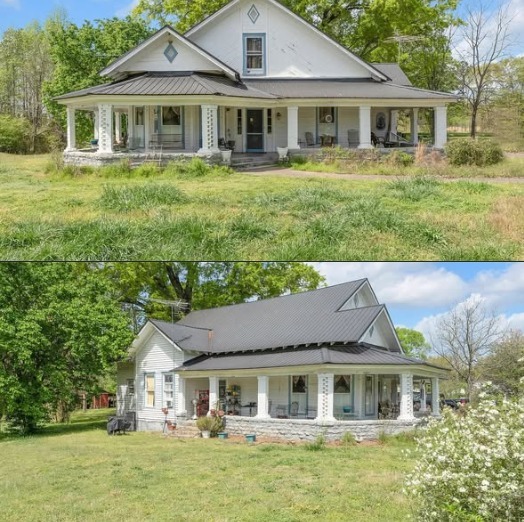
By the time most people noticed the old farmhouse outside Tignall, Georgia, they had already driven past dozens of newer homes with polished siding, oversized garages, and carefully landscaped yards designed to look perfect in listing photos.
But this house was different.
It did not beg for attention.
It sat quietly behind a stretch of open land and mature trees, weathered by time yet still standing with a kind of stubborn dignity that newer homes could never imitate. The gravel driveway curved gently toward the property as if intentionally slowing visitors down before they reached the front porch. And when the late afternoon sun hit the faded exterior just right, the place seemed less abandoned than simply patient.
Patient for someone to notice what it still had left to offer.
The early 1900s farmhouse, priced at $249,900, rests on approximately nine acres in rural Wilkes County and carries the kind of presence only age can create. With roughly 2,861 square feet, four bedrooms, two bathrooms, a barn, mature fruit and nut trees, and wide-open acreage stretching around it, the property offers far more than a simple fixer-upper.
It offers possibility.
The kind that cannot be manufactured.
The kind that waits quietly beneath peeling paint, creaking floors, and rooms that have witnessed generations of ordinary life.
Long before modern subdivisions spread across nearby towns, homes like this were built with permanence in mind. They were not designed around trends or resale strategies. They were built for families who expected to remain for decades. You can still feel that intention the moment you step onto the front porch.
The boards creak beneath your shoes, but not weakly.
The sound feels lived-in.
Earned.
The porch itself stretches across the front of the home like an invitation to slow down. In another era, it would have been filled with rocking chairs, iced tea glasses, and conversations carried gently through humid Georgia evenings. Even now, despite the years, the view remains calming—open land, scattered trees, distant sky, and the kind of silence people from crowded cities often forget exists.
Inside, the home reveals itself gradually.
Nothing about it feels rushed.
The entryway opens into large rooms with tall ceilings and original proportions rarely found in modern construction. Light filters softly through aging windows, illuminating worn floors and vintage trim work that still hints at the home’s former elegance.
Yes, the property needs restoration.
No one walking through would mistake it for move-in ready luxury.
But renovation projects like this attract a very specific type of buyer—someone capable of seeing beyond temporary imperfections and recognizing the enduring value underneath them.
Because beneath the cosmetic wear, the house still possesses strong bones.
And perhaps more importantly, it still possesses soul.
Many historic homes lose their identity after decades of neglect or careless remodeling. This one somehow avoided that fate. Though time has left its marks, much of the original character remains intact. The layout still reflects early twentieth-century craftsmanship, where rooms were spacious, practical, and intentionally connected to everyday family life rather than designed solely for appearances.
The kitchen, while outdated, still serves as the emotional center of the house. One can easily imagine generations gathering there during holidays, canning vegetables from the garden, or escaping summer heat beneath the steady hum of old ceiling fans.
Nearby rooms carry similar traces of memory.
A corner where a piano may once have stood.
Walls that likely displayed family photographs for decades.
Windows through which children once watched thunderstorms rolling across the fields.
That lingering sense of history cannot be recreated artificially.
It either survives or it disappears.
Here, it survives.
One particularly valuable feature already completed is the metal roof, which offers both durability and peace of mind for future restoration efforts. Replacing a roof on a historic property can quickly become overwhelming financially, so the existing metal roofing represents a meaningful advantage for buyers hoping to focus their resources on interior improvements and structural updates.
Outside, the acreage expands the property’s appeal even further.
Nine acres provide flexibility that is increasingly difficult to find at this price point.
The land offers room not only for privacy but for lifestyle possibilities many buyers spend years searching for. Gardening, hobby farming, livestock, recreational trails, orchards, workshops, outdoor entertaining, or simply enjoying space untouched by immediate neighbors—all become realistic options here.
Scattered across the property are mature fruit and nut trees, including peach, pear, pecan, and walnut varieties. These trees do more than add visual charm. They root the property in a long agricultural tradition that once defined much of rural Georgia life.
Someone planted those trees decades ago expecting future harvests.
That detail matters.
Because land cared for across generations carries a different energy than land developed quickly for profit.
The barn standing nearby reflects that same quiet endurance.
Weathered but functional, it offers opportunities for storage, workshops, farming equipment, livestock shelter, or creative restoration projects. Many buyers today dream of converting old barns into studios, event spaces, guest houses, or hobby areas, and this structure provides the kind of authentic foundation difficult to replicate authentically.
Even the carport contributes practical value without disrupting the property’s rustic character.
And then there is the setting itself.
Tignall remains one of those increasingly rare small Southern communities where life still moves a little slower. Located in northeastern Georgia, the town offers rural peace while remaining within driving distance of larger communities and outdoor recreation areas. For buyers exhausted by traffic, overcrowding, and constant noise, places like this feel almost unfamiliar at first.
The nights grow genuinely dark.
The mornings arrive quietly.
And the absence of constant distraction begins to feel less uncomfortable and more restorative with each passing day.
Properties like this also attract growing interest from buyers seeking self-sufficiency and sustainable living opportunities. The acreage, trees, barn, and existing infrastructure create a strong foundation for homesteading ambitions without requiring the overwhelming scale of large agricultural operations.
Imagine collecting eggs in the morning while sunlight moves slowly across the fields.
Imagine growing vegetables instead of purchasing them.
Imagine children learning seasons through gardens rather than smartphone weather apps.
That lifestyle may sound romanticized to some people, but for many buyers today, it represents something increasingly valuable: a return to intentional living.
Of course, restoration work requires honesty too.
Historic homes demand patience.
They require investment, planning, and flexibility.
Buyers considering a property like this must understand that renovation rarely happens perfectly or quickly. There will be surprises hidden behind walls, repairs that cost more than expected, and moments when progress feels frustratingly slow.
But experienced renovators often say the same thing afterward.
The homes worth saving are rarely the easiest ones.
And this farmhouse feels worth saving.
Because beneath every repair project lies something increasingly difficult to build from scratch: authenticity.
Modern construction can imitate farmhouse aesthetics with decorative beams and artificial distressing, but it cannot replicate the emotional texture created by a century of real use. It cannot manufacture the feeling of original hardwood worn smooth by generations of footsteps or recreate the proportions of rooms built before television determined furniture placement.
This house earned its imperfections honestly.
That honesty gives it value beyond square footage alone.
Walking through the bedrooms upstairs, one notices how differently older homes interact with light. The windows frame the landscape naturally rather than merely functioning as architectural accessories. Trees sway outside. Wind moves softly through branches. Every room feels connected to the surrounding land.
That connection matters more than many buyers initially realize.
Especially now.
In an era where so much of modern life feels temporary, digital, and disposable, properties like this offer something grounding. They remind people that homes were once built not merely as investments but as anchors for entire lives.
And perhaps that explains why historic fixer-uppers continue attracting emotionally invested buyers despite the labor involved.
Because restoring an old home is rarely just about real estate.
It becomes personal.
Each repaired floorboard, restored doorway, painted wall, and replanted garden slowly transforms the property into a collaboration between past and present.
The original builders begin the story.
New owners continue it.
For someone with vision, this farmhouse could evolve in countless directions.
A restored family estate.
A weekend retreat.
A hobby farm.
A bed-and-breakfast.
An artist’s sanctuary.
A retirement homestead.
Or simply a peaceful home filled with space, history, and breathing room.
The price point itself also makes the property particularly intriguing in today’s market. Finding nearly 3,000 square feet on nine acres with mature trees, outbuildings, and historic character for under $250,000 has become increasingly uncommon, especially in regions experiencing renewed interest in rural living.
While the renovation needs certainly factor into the pricing, many buyers will recognize the long-term potential immediately.
Land alone continues appreciating steadily in many rural Southern areas.
Historic properties with acreage have become especially attractive to buyers seeking alternatives to dense suburban development.
And unlike cookie-cutter homes built in rapidly expanding neighborhoods, no one can recreate this exact property once it changes hands.
Its age, setting, trees, layout, and history make it singular.
Even small details contribute to the atmosphere.
The sound of gravel beneath tires.
The uneven texture of old porch steps.
The faint scent of aged wood inside shaded rooms.
The way evening light settles across the fields before disappearing behind the tree line.
These are not features easily captured in listing descriptions, yet they often become the reasons buyers fall in love with rural historic homes in the first place.
There is also something emotionally compelling about rescuing a property before it disappears completely.
Too many historic farmhouses across the South collapse slowly from neglect until demolition becomes inevitable. Each loss erases another small piece of regional history and craftsmanship that newer construction rarely replaces meaningfully.
This home still has time.
Still has structure.
Still has beauty waiting beneath the wear.
It simply needs someone willing to invest care rather than convenience.
Perhaps that future owner is someone leaving city life behind after years of stress.
Perhaps it is a young family searching for land and freedom.
Perhaps it is a retired couple finally pursuing the restoration project they always imagined.
Or perhaps it is simply someone driving down a quiet Georgia road who suddenly notices an old farmhouse standing patiently among the trees and feels something unexpected settle in their chest.
Not certainty exactly.
Recognition.
Because the best historic homes do not merely provide shelter.
They invite stewardship.
And this property, despite its imperfections, still carries the quiet dignity of a place that once held generations of ordinary joys—birthday dinners, porch conversations, Sunday mornings, hard seasons survived together, children growing older beneath the same roof year after year.
That kind of history lingers.
Not loudly.
But steadily.
Waiting for someone willing to continue it.
Sold as-is, the farmhouse does not pretend to be flawless.
It offers no staged perfection.
No artificial luxury.
No illusion of effortless ownership.
What it offers instead is far rarer.
Land.
Silence.
Character.
History.
Potential.
And the opportunity to breathe life back into a beautiful piece of rural Southern history before time carries it away completely.
For the right buyer, that may be worth far more than polished countertops or brand-new construction ever could be.