I used to believe love was supposed to feel overwhelming.
Not peaceful.
Not stable.
Not patient.
I thought real love arrived like a storm—urgent, consuming, impossible to resist. I believed intensity meant destiny. I confused obsession with connection and emotional chaos with passion. And because of that confusion, I became the kind of woman I once swore I would never become.
The other woman.
Even now, writing those words feels uncomfortable in a way it never did back then. At the time, I softened the truth with prettier language. I called it complicated. I called it fate. I called it an emotional connection too powerful to ignore. Anything except what it really was: an affair with a married man who already belonged to a life that was not mine.
When I met Daniel, he was already a husband and already a father of three. He wore exhaustion in a way that made me feel important whenever he opened up to me. He spoke softly about feeling misunderstood, trapped, emotionally disconnected. Every conversation painted him as a man carrying invisible pain no one else seemed willing to see.
I saw myself as the person who finally understood him.
That was the first lie I told myself.
At first, it felt innocent enough. Long conversations after work. Private jokes. Lingering eye contact that lasted slightly too long. The kind of emotional intimacy people pretend is harmless because admitting otherwise would force accountability too early.
He talked about his wife often.
But never cruelly.
That almost made it worse.
He described her as distant. Tired. Focused entirely on the children. He said their marriage had become functional instead of loving. He spoke like a man grieving something already dead rather than betraying something still alive.
And I believed him.
I believed every carefully chosen sentence because believing him allowed me to continue wanting him without confronting the moral reality underneath it.
The first time his wife contacted me directly, I remember exactly where I was.
I was sitting in my apartment folding laundry when my phone rang from an unknown number. Her voice shook slightly when she introduced herself. Not with anger at first. With restraint.
That restraint haunts me now.
She asked me quietly if I was involved with her husband.
I should have hung up.
I should have apologized.
I should have felt shame immediately.
Instead, I felt defensive.
Because once people become emotionally invested in wrongdoing, they begin protecting the fantasy at all costs.
I denied enough to avoid sounding cruel while admitting enough to establish dominance. She asked me to stop speaking to him. Then she pleaded. I still remember hearing her trying to hold herself together while asking another woman not to help destroy her family.
And I laughed softly under my breath.
Not because it was funny.
Because I had already decided she was pathetic.
That is the part I regret most—not even the affair itself, but the cruelty I wrapped around it. I transformed another woman’s pain into evidence that I had “won.” I interpreted her heartbreak as weakness because acknowledging her humanity would have forced me to face my own behavior honestly.
I told her things I can barely repeat now.
That maybe if she had been a better wife, he wouldn’t need someone else.
That marriages fail all the time.
That she needed to accept reality.
I remember hanging up feeling triumphant.
As if stealing someone else’s stability somehow proved my worth.
A few months later, he left her.
Not dramatically.
No screaming matches.
No public collapse.
Just slow emotional erosion until one day he moved out of their family home and into my apartment with boxes full of half-packed clothes and unresolved damage.
I mistook his willingness to abandon his family as proof of love.
That was the second lie I told myself.
I never stopped to ask what kind of man walks away from three children while calling it personal growth.
I never questioned why every story positioned him as the misunderstood victim.
I never noticed how carefully he avoided accountability while still collecting sympathy from everyone around him.
Instead, I focused on the fact that he had chosen me.
Or at least I thought he had.
In reality, I was not chosen.
I was simply next.
But people trapped inside emotional delusion cannot recognize patterns while they are actively participating in them.
When we started living together, I treated our relationship like the beginning of a beautiful new chapter. I bought furniture. I planned vacations. I imagined weddings. I convinced myself I had built something meaningful out of emotional wreckage.
The truth was far uglier.
I had moved into a space built on instability, dishonesty, and avoidance. But because I was emotionally invested, I kept repainting reality until it looked softer than it actually was.
The first time I saw his children after the separation, something inside me shifted briefly.
Not enough to stop.
Just enough to notice.
They did not look angry.
That would have been easier.
They looked confused.
The youngest clung silently to his father’s leg while staring at me like I was a stranger standing inside a memory that no longer made sense. The oldest barely spoke at all. Their sadness was quiet, which somehow made it worse.
Children do not always express heartbreak dramatically.
Sometimes they simply become quieter.
I remember feeling discomfort rise in my chest, but I pushed it down immediately. I told myself families changed all the time. I told myself children adapted. I told myself their father deserved happiness too.
People can justify almost anything when they benefit from the lie.
Over time, however, cracks began forming around the edges of our relationship.
Small inconsistencies.
Subtle emotional absences.
He became harder to reach at night sometimes. Conversations about his children irritated him more easily. Responsibilities frustrated him. He complained about pressure constantly. And eventually, I noticed something terrifying:
The same complaints he once made about his wife slowly became complaints about me.
I was too emotional.
Too demanding.
Too sensitive.
Too focused on the future.
The language sounded eerily familiar because it was.
I had become the next woman standing inside the exact same cycle.
Still, I ignored the warning signs.
Because by then I was pregnant.
The pregnancy changed everything emotionally for me. I believed it anchored us permanently. I thought carrying his child transformed our unstable relationship into something real and irreversible.
That was the third lie I told myself.
The night everything finally unraveled began ordinarily.
He told me he had to work late, so I went alone to a routine appointment. I remember sitting in the doctor’s office feeling strangely hopeful. I held the ultrasound photo afterward like proof that our future finally had structure.
Driving home, I imagined baby names.
Bedrooms.
Family holidays.
A future.
I truly believed I had finally secured the life I fought so hard to claim.
Then I reached my apartment.
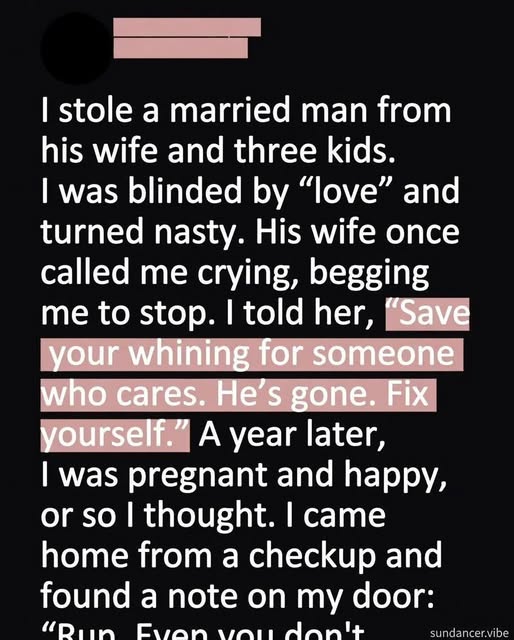
There was a note taped neatly to the front door.
Just four words.
“Run. Even you don’t deserve it.”
I stared at it for several seconds before laughing nervously.
I assumed it was bitterness from someone connected to his ex-wife. Maybe a friend. Maybe family. Maybe someone angry enough to try frightening me.
But something about the message unsettled me deeply.
Not because it sounded threatening.
Because it sounded sincere.
That night, around midnight, my phone lit up from an anonymous account.
A single image appeared first.
Daniel standing beside a woman.
His ex-wife.
Not old photos.
Recent ones.
Then another image arrived.
And another.
And another.
Photos of them together over several months.
Then one image stopped my breathing completely.
She was pregnant.
Smiling beside him in front of a house I had never seen before.
At first, my brain refused to process it.
The timeline made no sense.
Until it did.
Slowly.
Painfully.
Horrifically.
He had never truly left her.
Or rather, he had left and returned repeatedly in ways neither of us fully understood because he carefully controlled the information each woman received.
Everything collapsed at once.
Every excuse.
Every justification.
Every illusion I built around our relationship.
Then the messages began.
Not from strangers.
From her.
The woman I had humiliated.
The woman I had mocked while she begged me to stop seeing her husband.
The woman I dismissed as weak and dramatic.
And somehow, unbelievably, she was the only person speaking to me honestly.
There was no cruelty in her messages.
That shattered me more than rage would have.
She did not insult me.
Did not threaten me.
Did not celebrate my humiliation.
She simply told me the truth.
She explained that I was not the first woman this had happened with.
Not even close.
She said she recognized the pattern immediately because she herself had once been in my position years earlier with another woman before their marriage even began.
That revelation made me physically sick.
I was not the exception.
I was not special.
I was participating in a revolving cycle of emotional manipulation that existed long before me and would likely continue after me too.
She told me something I will never forget:
“You didn’t steal a happy man. You inherited an unstable one.”
I cried harder reading that sentence than I did after discovering his lies.
Because deep down, I already knew it was true.
She sent proof carefully, methodically, almost compassionately. Financial records. Dates. Messages. Evidence of overlapping relationships. Evidence that while I believed we were building a future together, he had quietly maintained emotional and physical ties elsewhere too.
And suddenly, the woman I once viewed as my enemy became the only person trying to save me.
That realization broke something open inside me.
For hours, I sat motionless in my apartment staring at the ultrasound photo beside my phone.
Everything I believed about love suddenly looked grotesque under honest light.
I thought about the children.
About the family dinners interrupted by secrecy.
About the phone call where she begged me to stop.
About the version of myself who interpreted another woman’s heartbreak as victory.
And for the first time, I stopped defending him.
Completely.
No excuses.
No romanticizing.
No rewriting reality.
I finally saw him clearly.
Not as a tortured man divided between impossible emotions.
But as someone deeply comfortable allowing women to destroy each other while he remained emotionally unaccountable at the center of the chaos.
That clarity changed everything.
Leaving him was not dramatic.
No screaming.
No shattered dishes.
No cinematic confrontation.
Honestly, the ending felt disturbingly quiet.
I simply started emotionally withdrawing from the fantasy piece by piece until nothing remained worth protecting.
When I finally told him I was leaving, he barely reacted.
That hurt more than anger would have.
He looked tired.
Resigned.
Almost unsurprised.
As if part of him already understood this was inevitable because repetition eventually exposes itself no matter how carefully someone manages the lies.
He did not beg me to stay.
Did not fight for us.
Did not ask meaningful questions.
And somehow, that silence confirmed everything.
I left carrying two things:
My unborn child.
And the unbearable understanding that love without accountability is not love at all.
It is repetition.
Since then, I have spent years rebuilding myself from the inside out.
Not just recovering from betrayal, but confronting the person I became while participating in it.
That part matters.
Because healing without accountability becomes self-pity.
And I was not only harmed in this story.
I harmed others too.
I helped destroy emotional stability for children.
I mocked a woman in pain.
I mistook cruelty for confidence.
I weaponized another person’s vulnerability to protect my fantasy.
Owning that truth was necessary.
Painful, but necessary.
The woman I once viewed as weak taught me more about strength than anyone else ever has.
She had every reason to hate me.
Every reason to let me collapse inside the same illusion that once trapped her.
Instead, she chose honesty.
Not because I deserved kindness.
But because she understood something I did not yet understand myself:
Women trapped inside cycles like this often confuse competition with love until someone finally interrupts the pattern.
She interrupted mine.
And in doing so, she probably saved my child from growing up inside the same instability that damaged so many others before us.
Today, when people romanticize affairs by calling them destiny or soul connections, I think carefully before speaking.
Because I once believed those things too.
But real love does not require deception to survive.
Real love does not thrive by humiliating another person.
Real love does not ask children to absorb emotional destruction so adults can feel desired.
And real love certainly does not repeat the same damage across different women while calling itself complicated.
What I experienced was not romance.
It was emotional addiction disguised as intimacy.
And the anonymous message taped to my door that night became the first honest thing anyone had given me in years.
“Run. Even you don’t deserve it.”
At the time, I thought those words were an attack.
Now I understand they were mercy.