Hidden quietly within the historic heart of Akron, Ohio, beyond the rush of modern traffic and tucked behind mature trees and aging landscape, stands a home that seems suspended between two worlds.
One world belongs to the past.
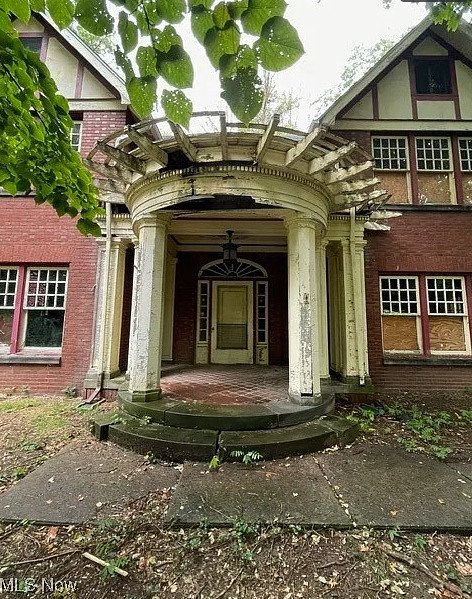
The other waits patiently for the future.
Built in 1912, this remarkable seven-bedroom estate is more than just an old house in need of repairs. It is a surviving piece of architectural history — a fading but still magnificent reminder of an era when homes were designed not simply to function, but to inspire. Behind its weathered exterior lies over 5,000 square feet of handcrafted woodwork, grand fireplaces, towering ceilings, elegant staircases, and forgotten beauty waiting for someone bold enough to restore it.
To some, it may appear abandoned.
To others, it is an extraordinary opportunity.

Because beneath the peeling paint, empty rooms, and signs of time remains something increasingly rare in modern America:
true craftsmanship.
The estate sits on 1.65 acres near Akron’s beloved Wallhaven and Highland Square neighborhoods, offering privacy, history, and immense restoration potential in one of Ohio’s most fascinating forgotten residential properties.
And for those who understand historic homes, it represents something even more valuable:
a chance to rescue a legacy before it disappears forever.

A Mansion Born During Akron’s Golden Era
When this home was first constructed in 1912, Akron was thriving.
The city stood at the center of America’s booming rubber industry and was rapidly transforming into one of the country’s most prosperous industrial hubs. Wealthy entrepreneurs, civic leaders, and prominent professionals commissioned impressive residences that reflected both success and sophistication.
This estate was among them.

Designed by the respected architectural partnership of Hagloch and Potter for original owner M.S. Long, the home embodied the ambition and elegance of early 20th-century American design. Every detail reflected the belief that a home should communicate permanence, refinement, and artistry.
Unlike many modern houses built quickly for efficiency, homes of this era were crafted patiently by skilled carpenters, masons, and artisans whose work was meant to endure for generations.
More than a century later, much of that craftsmanship still survives.
And that is what makes the property so extraordinary.
A Storied Home With a Colorful Past
Over the decades, the estate passed through different hands, each adding another layer to its already rich history.
Among its most notable owners was Murray Parker, a larger-than-life figure whose life story reads almost like fiction. Parker reportedly worked at various times as a cowboy, grocer, lawyer, legislator, commissioner, and restaurateur — a remarkable collection of roles that mirrored the restless ambition of early American life.
That colorful history gives the home an added sense of personality and depth.

Historic houses often absorb the identities of those who live inside them, and this property feels shaped by generations of stories, celebrations, hardships, reinventions, and quiet everyday moments now lost to time.
Walking through the estate today, one cannot help imagining the lives once unfolding within its walls.
Formal dinners beneath glowing chandeliers.
Family gatherings around crackling fireplaces.
Children racing down long hallways.
Guests arriving beneath the porte cochere as automobiles replaced horse-drawn carriages outside.
The home still carries traces of all of it.
The Exterior Still Commands Attention
Even after decades of wear, the mansion’s exterior remains deeply impressive.
The porte cochere immediately captures attention — a striking architectural feature once designed to shelter arriving guests from rain and snow as they stepped from elegant carriages or early automobiles.
Wide overhanging eaves frame the roofline with quiet dignity.
Multi-paned windows reflect the craftsmanship of another era.
Intricate wood detailing still hints at the home’s former grandeur despite the passage of time.
There is something hauntingly beautiful about the property’s current state.
Nature has softened parts of the estate.
Time has weathered its surfaces.
Yet the structure itself still stands proudly, refusing to surrender its identity.
The surrounding 1.65-acre property adds even more appeal. Mature trees and expansive green space create a sense of seclusion uncommon within city limits. The grounds offer room for gardens, outdoor entertaining spaces, walking paths, or simply the luxury of privacy in an increasingly crowded world.
For restoration enthusiasts, the land alone feels filled with possibility.
Stepping Inside Feels Like Entering Another Era
The moment visitors cross the threshold, the true soul of the home reveals itself.
At the center of the foyer stands an extraordinary red oak staircase — massive, elegant, and handcrafted with the kind of detail rarely seen in contemporary construction. It rises through the house not merely as a functional feature, but as an architectural statement.
The staircase alone tells a story about the era in which the home was built.
This was a time when builders believed beauty mattered.
When wood was carved by hand.
When homes were designed to impress visitors from the very first step inside.
Throughout the main floor, original oak woodwork continues to dominate the interior with warmth and richness.
Pocket doors glide between rooms.
French doors filter natural light elegantly through the space.
Coffered ceilings create texture and visual depth overhead.
And scattered throughout the house are grand fireplaces that once served as both practical heat sources and gathering places for conversation and family life.
Despite the home’s current condition, the craftsmanship remains astonishing.
Even weathered, it feels impossible to replicate.
Rooms Designed for Gathering and Connection
One of the most striking aspects of the estate is the scale and flow of its main living spaces.
Unlike many modern homes designed around isolated entertainment areas or open-concept minimalism, this mansion reflects an earlier philosophy centered on gathering, conversation, and layered functionality.
The formal living room feels expansive yet intimate, anchored by original wood detailing and a stately fireplace.
Nearby, the dining room evokes visions of holiday dinners, candlelight, and long evenings filled with guests and conversation.
Each room feels intentionally proportioned to encourage presence rather than haste.
A sunroom positioned on the east side of the house catches the morning light beautifully, offering what was once likely a peaceful retreat for reading, coffee, or quiet reflection.
Elsewhere, a former study has already been converted into a first-floor bedroom with an attached full bath, creating flexibility for future owners who may desire multigenerational living or accessibility accommodations.
A smaller den nearby offers another layer of warmth and intimacy.
Together, the spaces create a home that feels both grand and deeply livable.
The Kitchen: A Blank Canvas Full of Possibility
Unlike many preserved historic homes where renovations can feel restrictive, this estate offers something rare:
creative freedom.
The kitchen has been completely gutted, leaving behind an open framework ready for transformation.
For some buyers, that may initially seem intimidating.
For restoration enthusiasts, it is an extraordinary opportunity.
The space could become:
a classic period-inspired kitchen with custom cabinetry and vintage detailing
a dramatic chef’s kitchen blending old-world architecture with modern luxury
or a balanced fusion of contemporary convenience and historic character
Because so much of the original home survives intact, the kitchen presents a chance to design something truly personal while still respecting the home’s heritage.
The Second Floor Continues the Story of Elegance
Upstairs, the estate’s scale becomes even more impressive.
The owner’s suite anchors the second floor with remarkable presence. Featuring its own fireplace and generous proportions, the room easily supports the creation of a luxurious private retreat complete with sitting areas or reading nooks.
Additional ensuite bedrooms provide flexibility for family members or guests.
One bedroom includes access to a private sun porch, adding another charming reminder of how thoughtfully the home was designed for comfort and daily enjoyment.
Elsewhere on the floor, practical details reveal the sophistication of early 20th-century planning.
A cedar closet.
A family bath.
A maid’s closet that could easily be reimagined as a modern laundry area.
These details illustrate how the estate balanced grandeur with function.
The Third Floor Holds Endless Potential
The third floor introduces yet another layer of opportunity.
Here, additional bedrooms, a full bath, built-in linen storage, and a spacious bonus room create countless possibilities for future use.
The area could become:
a guest suite
an artist’s studio
a home office
a library
a playroom
a private apartment
or even a creative retreat space
The flexibility of the layout makes the estate uniquely adaptable for modern lifestyles while still preserving its historic soul.
The Detached Carriage House May Be the Property’s Hidden Gem
Beyond the main residence sits one of the property’s most exciting features:
a detached carriage house with seven garage bays.
Two of the bays already include a roughed-in apartment space above, creating tremendous potential for additional living quarters, rental income, guest accommodations, or creative workspace.
Few historic properties retain such functional secondary structures in this condition.
For collectors, entrepreneurs, artists, or multigenerational families, the carriage house dramatically expands what the estate could become.
Why Historic Homes Like This Matter
Properties like this are becoming increasingly rare.
Across America, countless historic homes have been demolished, stripped of original character, or irreversibly altered in pursuit of convenience and modernization.
Yet homes like this preserve something irreplaceable:
the artistry of another era.
The carved woodwork.
The handcrafted details.
The architectural ambition.
The sense that homes were once built not simply as investments, but as lasting works of design.
Restoring such a property is not merely renovation.
It is stewardship.
It is preserving history for future generations.
The Emotional Pull of Restoration
People who fall in love with historic homes often describe the feeling as emotional rather than practical.
They do not simply see damaged walls or outdated systems.
They see possibility.
They imagine fireplaces lit again after decades of silence.
They picture restored wood glowing beneath natural light.
They hear echoes of the lives once lived there.
This Akron estate inspires exactly that kind of imagination.
Despite the work it requires, the home radiates character, dignity, and untapped beauty.
It asks not for perfection, but for vision.

A Rare Opportunity Waiting for the Right Person
Restoration projects are never easy.
They require patience, resources, creativity, and resilience.
But homes like this offer something impossible to mass-produce:
authenticity.
No newly built luxury house can replicate the craftsmanship, proportions, or emotional atmosphere of a genuine 1912 estate.
That is why historic properties continue captivating dreamers, preservationists, and visionaries willing to invest in their future.
This Akron mansion is not merely a forgotten building.
It is a survivor.
A piece of Ohio history still standing after more than a century.
And for the right buyer, it offers the chance to do something extraordinary:
to rescue beauty from decline,
to honor craftsmanship from another age,
and to give a magnificent old home the second life it deserves.
Because beneath the dust, silence, and years of neglect, the soul of this estate still remains remarkably alive.
Waiting patiently for someone to bring it home again.


7 bedrooms/6 bathrooms! Diamond in the Rough! Over an acre in Ohio. $395,000
