Questions surrounding age, stamina, health, and cognitive sharpness have become impossible to separate from modern American politics, especially when the discussion centers around high-profile leaders serving in positions of enormous global responsibility. Few public figures have faced more persistent scrutiny on those subjects than Donald Trump. For years, conversations about his energy, memory, temperament, and overall fitness for office have dominated political commentary, social media debates, cable news segments, and online speculation. Supporters frequently point to his aggressive campaign schedule, lengthy speeches, packed public appearances, and willingness to maintain an intense pace despite his age as evidence that he remains mentally sharp and physically capable. Critics, meanwhile, continue arguing that certain public remarks, verbal mistakes, impulsive comments, and unusual behavior patterns raise broader concerns about aging and long-term cognitive decline.
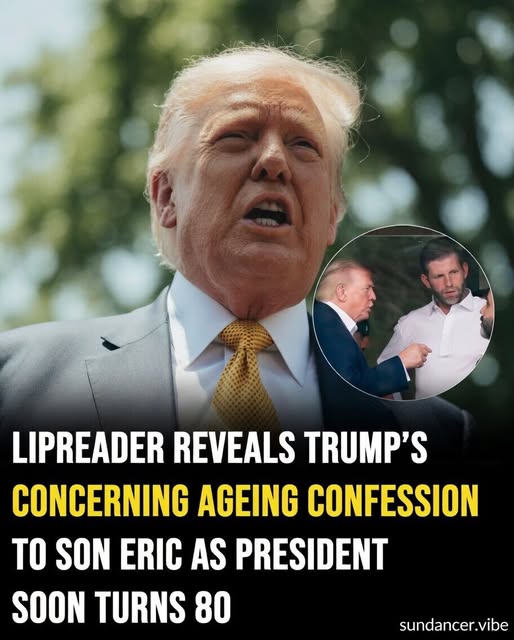
Now, a fresh claim from a professional lipreader has once again pushed Trump’s age into the center of national conversation after an alleged private exchange between the president and his son, Eric Trump, surfaced online following a recent LIV Golf appearance. According to the interpretation, Trump made a surprisingly candid remark acknowledging his age after Eric reportedly reminded him that he would soon turn eighty years old. Whether people interpreted the moment as humorous, reflective, relatable, or concerning, the alleged conversation quickly reignited debate over what advanced age means for political leadership in America.
The reported exchange allegedly took place during a LIV Golf tournament event held at Trump National Golf Club Washington D.C., where Trump appeared publicly over the weekend. The tournament itself attracted attention because Trump has increasingly used golf appearances and sporting events as opportunities to remain highly visible outside traditional political rallies and policy announcements. According to professional lipreader Nicola Hickling, the brief conversation occurred while Trump and Eric stood behind protective glass observing the event.
Hickling later claimed that Eric told his father, “Dad, you know you’re going to be 80 years old,” prompting Trump to allegedly respond, “After he said this, I felt old.” Trump reportedly followed the statement with the familiar phrase, “You’re only as old as you feel, right?”
The alleged remarks spread rapidly across political and entertainment media because they seemed notably different from Trump’s carefully maintained public persona. Throughout his political career, Trump has consistently emphasized dominance, stamina, confidence, strength, and superiority over opponents. Rarely has he publicly acknowledged vulnerability, uncertainty, or physical limitation. That contrast is precisely why the lipreader’s interpretation gained such immediate traction online.
To some observers, hearing Trump casually acknowledge feeling old sounded unexpectedly human and relatable. Others dismissed the interpretation entirely, arguing that lipreading remains inherently uncertain and should never be treated as confirmed fact without direct audio verification. Even so, the story resonated because it aligned directly with an ongoing national debate already surrounding Trump’s age and long-term fitness for office.
The conversation surrounding Trump’s cognitive health has intensified dramatically over recent years as he approaches his eightieth birthday while continuing to occupy one of the most demanding political roles in the world. Trump himself has repeatedly defended his mental sharpness in public appearances and interviews, often referencing cognitive tests he claims to have passed successfully. He has publicly stated multiple times that he “aced” cognitive screenings, including the Montreal Cognitive Assessment, commonly known as the MoCA.
The MoCA examination is commonly used to screen for cognitive impairment by evaluating memory, attention, language ability, abstraction, executive function, and spatial awareness. Trump supporters frequently cite his willingness to discuss such testing openly as evidence of confidence and transparency regarding his health.
Critics, however, argue that basic cognitive screenings alone do not fully address broader concerns about judgment, emotional regulation, impulsiveness, or long-term neurological changes. Those concerns intensified further after comments from former Trump legal adviser Tyler Cobb gained media attention. Cobb publicly claimed that Trump may be displaying signs associated with frontal lobe decline and possible dementia-related behavior. He described the president as increasingly impulsive and emotionally unrestrained, suggesting that existing personality traits could potentially be amplified by age-related neurological changes.
Because the criticism came from a former administration insider rather than solely political opponents, the remarks generated particularly strong reactions. Trump allies immediately rejected Cobb’s claims as politically motivated attacks designed to damage public confidence rather than legitimate medical analysis.
The divide reflects a larger reality about modern American politics: discussions surrounding presidential health are rarely treated as neutral medical conversations. Instead, they quickly become deeply tied to ideology, loyalty, fear, identity, and partisan conflict.
As debate intensified, some political figures renewed discussion surrounding mechanisms that could formally evaluate presidential fitness. Critics specifically referenced the Twenty-fifth Amendment to the United States Constitution, which outlines procedures for addressing situations in which a president may become unable to fulfill the duties of office.
Congressman Jamie Raskin reportedly advocated broader discussions regarding a potential commission capable of assessing presidential fitness in coordination with Vice President JD Vance. Raskin argued that Trump’s recent rhetoric, public communication style, and international statements raised concerns serious enough to warrant national attention.
Supporters of Trump strongly rejected such arguments, accusing critics of weaponizing mental health accusations as a political strategy. They argue that opponents have spent years attempting to portray Trump as unstable not because of verified medical evidence, but because they fundamentally oppose his policies, leadership style, and political influence.
The broader argument reflects an increasingly important trend in American politics where age itself has become a central campaign issue across party lines. Voters are increasingly asking whether elderly political leaders can realistically continue managing the extraordinary pressures, travel demands, crisis response responsibilities, and constant decision-making required by the presidency.
At the same time, many Americans remain skeptical of narratives built largely around speculation rather than confirmed diagnoses or transparent medical evaluations. As a result, every pause, stumble, joke, verbal slip, or unscripted comment made by older political figures becomes intensely scrutinized for possible signs of decline.
The alleged exchange between Trump and Eric resonated for another reason as well: it sounded emotionally familiar to many families regardless of political affiliation.
Aging inevitably forces difficult conversations, even for wealthy and powerful public figures. Parents who once projected endless energy eventually hear children reminding them about time, health, mortality, and physical limitations. For many observers, the reported moment sounded less like a political controversy and more like a recognizable family interaction suddenly magnified beneath a national spotlight.
Trump has spent decades cultivating an image built around confidence, ambition, resilience, and relentless competitiveness. Hearing him allegedly acknowledge feeling old, even briefly, introduced a moment of vulnerability that some supporters interpreted as refreshingly honest rather than alarming.
Others interpreted the same alleged comment very differently, arguing that it reinforced broader concerns about whether someone approaching eighty years old can continue handling the immense physical and psychological demands of modern leadership.
Either way, the reaction revealed how deeply Americans project their own beliefs and anxieties onto aging public figures.
Some voters associate advanced age with wisdom, experience, resilience, and perspective. Others associate it with instability, decline, fatigue, or diminished adaptability. Trump’s presidency exists directly at the center of that national tension. Every rally, golf outing, interview, speech, or unscripted interaction becomes additional evidence for people already determined either to defend or criticize him.
The lipreader’s interpretation may never be conclusively verified, but the reason it spread so rapidly is because it touched an already sensitive national nerve.
For now, Trump himself continues showing little public indication that he intends to slow down politically. He remains highly visible, continues delivering lengthy public remarks, aggressively attacks opponents, participates in media appearances, and maintains the combative political style that first propelled him into the White House years ago.
Whether supporters interpret that persistence as proof of strength or critics interpret it as denial depends largely on perspective.
What remains undeniable is that age has become one of the defining political discussions of this era — not only for Trump, but for American leadership more broadly. The presidency places extraordinary physical, emotional, and mental demands on whoever occupies the office, and voters increasingly question how those demands intersect with advanced age.
The alleged golf-course conversation with Eric Trump may eventually disappear into the endless churn of political headlines, but it also reflected something larger than politics itself. Beneath the rallies, legal battles, policy fights, headlines, and media spectacle exists an aging father hearing his son remind him that eighty years old is approaching.
Some people viewed the moment as concerning. Others saw humor, honesty, or humanity in it.
But perhaps the strongest reason the story resonated is because it reflected something universal: the strange realization that no matter how powerful, wealthy, famous, or influential someone becomes, there eventually comes a moment when age quietly enters the conversation whether they are ready for it or not.