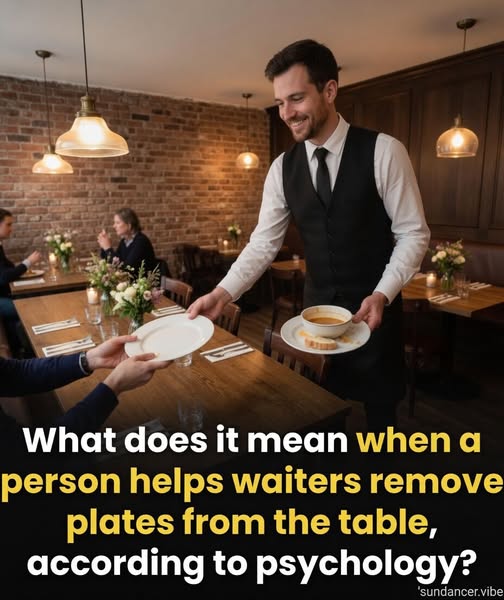
In the quiet rhythm of everyday dining, where conversations overlap with the clinking of cutlery and servers move quickly between tables, there are small behaviors that often go unnoticed—but rarely go unmeasured by human psychology. One of these is the simple act of helping a waiter clear the table. It may seem insignificant, almost automatic, yet psychologists suggest that these unprompted gestures can offer meaningful insight into how a person perceives others, navigates social environments, and expresses internal values through action rather than words.
Unlike grand or performative gestures, which are often shaped by social visibility, helping a server tends to occur in low-attention moments. It is precisely this lack of external reward or recognition that makes the behavior psychologically interesting. When no one is watching closely, people tend to act more in line with internal disposition than social expectation. In this way, small acts of assistance can reflect underlying traits that are otherwise difficult to observe directly.
One of the most commonly associated psychological qualities is empathy. Empathy is the capacity to recognize and, to some extent, emotionally understand the experiences of others. In a restaurant setting, this might manifest as noticing that a server is managing multiple tables, carrying heavy trays, or moving quickly under pressure. A person who helps clear space or stack plates is often responding to this awareness. Importantly, this does not necessarily require deep emotional connection or conscious moral reasoning. Instead, it can emerge as a subtle sensitivity to effort and strain in others.
Closely related to empathy is prosocial behavior, which refers to voluntary actions intended to benefit others. Helping a waiter is a clear example of this, especially when it is done without expectation of acknowledgment. From a psychological perspective, prosocial behavior is often driven by internalized values rather than external incentives. People who frequently engage in such actions tend to operate with a belief that small contributions matter, even when they do not change outcomes dramatically. This reflects a mindset where helpfulness is a default orientation rather than a calculated choice.
Another important dimension is social awareness, which is a core component of emotional intelligence. Social awareness involves recognizing the dynamics of a situation—who is under pressure, what is needed, and how one’s behavior fits into the broader environment. In a busy restaurant, most individuals focus primarily on their own experience: the food, the conversation, or the occasion. Someone who naturally assists a waiter is often attuned to the surrounding system, noticing inefficiencies or burdens and responding intuitively. This reflects a heightened sensitivity to context and interpersonal flow.
Emotional intelligence extends this further by combining awareness of others with appropriate behavioral responses. It is not simply about noticing that someone is busy, but about choosing an action that is helpful without being intrusive. For example, stacking plates neatly or passing empty glasses to the edge of the table reflects an understanding of both assistance and boundaries. This balance is significant—it suggests the person is not only observant but also socially calibrated.
Interestingly, this behavior can also reflect how someone relates to hierarchy and social roles. In many environments, there is an unspoken structure: servers serve, guests receive. People who step outside this passive role may hold a more flexible view of social interaction. Rather than strictly adhering to defined boundaries, they may see service environments as shared spaces where cooperation is appropriate when helpful. Psychologically, this can align with lower social dominance orientation, which refers to reduced preference for rigid hierarchies and greater comfort with equality-based interactions.
Experience also plays a meaningful role. Individuals who have worked in hospitality or service industries often develop firsthand understanding of workload pressure and emotional labor. This lived experience can translate into heightened sensitivity when they are customers themselves. However, it is not limited to direct experience. Many people develop similar awareness through observation, upbringing, or value systems that emphasize consideration and respect for labor.
Another relevant trait is initiative or proactivity. Some individuals naturally take action when they see a small opportunity to contribute, even without instruction. This proactive tendency is not about control or dominance but about responsiveness. In a restaurant setting, this might appear as quietly organizing items on the table or helping create space for efficient service. These actions are typically subtle, respectful, and aligned with maintaining smooth social interaction rather than disrupting it.
However, psychology also emphasizes caution in interpreting isolated behaviors. Helping a waiter does not automatically define someone as empathetic or highly emotionally intelligent. Human behavior is influenced by context, mood, cultural norms, and situational dynamics. In some cultures, such actions are considered standard courtesy, while in others they may be less common or even discouraged. Similarly, a person may act differently depending on the group they are with or their emotional state at the time.
Intent is another important factor. The same behavior can arise from different motivations. One person may act purely out of kindness and attentiveness, while another may do so for efficiency or to reduce waiting time. In some cases, it may even serve a subtle social signaling function, demonstrating awareness or politeness in front of peers. Psychology recognizes that human actions are often multi-determined, meaning several motives can exist simultaneously beneath a single behavior.
What matters most, therefore, is not the isolated act but the pattern over time. Consistent small behaviors across different contexts tend to reveal more about personality than one-off actions. Someone who repeatedly shows attentiveness in low-stakes environments is more likely reflecting stable internal traits than situational convenience.
Ultimately, helping a waiter clear the table is less about the plates, glasses, or physical task itself, and more about what it reveals regarding attention, awareness, and orientation toward others. It reflects a moment where self-focus briefly expands to include the surrounding environment. In that expansion, a subtle but meaningful psychological signal appears: the recognition that one is part of a shared human system where even small actions can ease another person’s load.
These gestures may never be recorded, rewarded, or remembered. Yet they contribute quietly to the emotional texture of everyday life. They influence how interactions feel, how spaces function, and how people experience being around one another.
In the end, psychology does not treat such behavior as a label or a test, but as a small window into something larger—the human tendency to notice, to respond, and, in simple unnoticed ways, to make life a little easier for someone else without being asked.