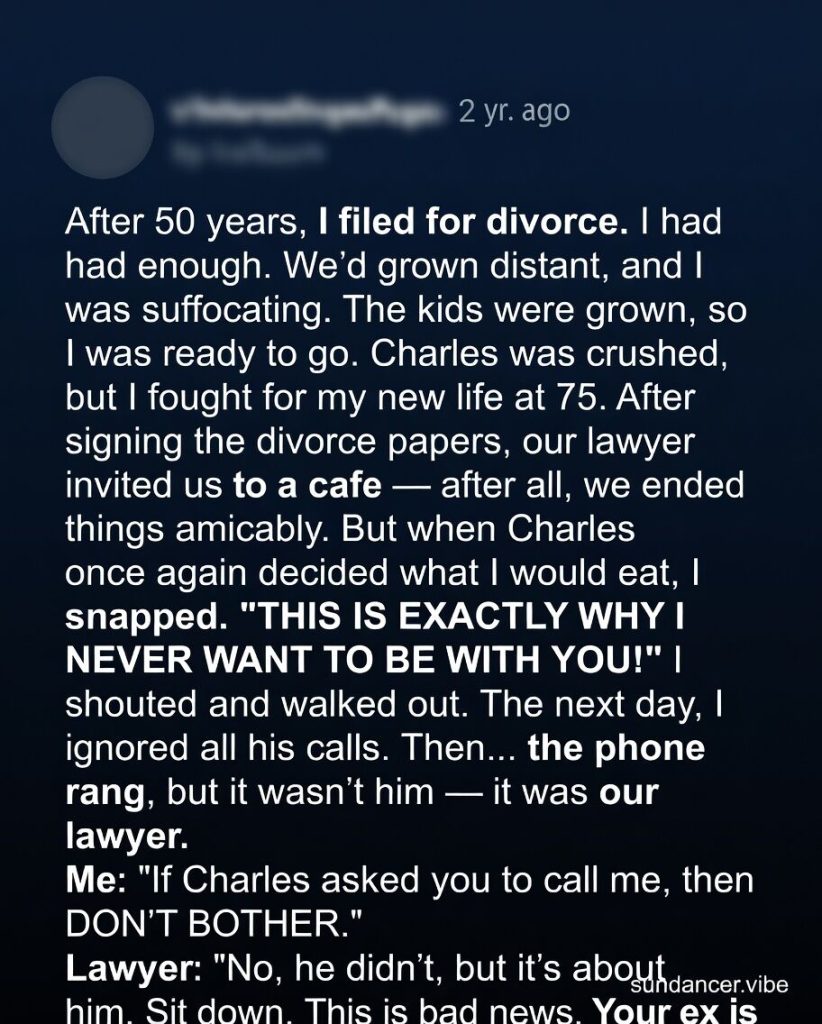
For more than half a century, Rose and Charles had built a life that many people admired from a distance. They were the couple others pointed to when speaking about lasting love, the kind of partnership that seemed almost untouched by time. They had weathered illnesses, financial struggles, career changes, family losses, and all the unpredictable seasons that come with sharing a life for decades. Their story looked steady, dependable, even beautiful.
Friends envied the quiet familiarity between them. Their children often spoke about how comforting it was to grow up in a home where love felt permanent. Even in old age, Rose and Charles still sat together at family gatherings with the ease of two people who knew each other completely. They finished each other’s sentences, exchanged silent glances across crowded rooms, and moved through routines polished smooth by years of repetition.
But like many long marriages, theirs contained layers invisible to outsiders.
The public version of a relationship rarely reveals the private loneliness hidden beneath ordinary habits. And while their life together looked stable from the outside, something inside Rose had slowly begun to unravel.
At seventy-five years old, she found herself wrestling with emotions she could no longer ignore. It wasn’t that she hated Charles. In many ways, she still loved him deeply. But over the years, she had quietly buried pieces of herself beneath compromise, responsibility, and routine. The sacrifices she once made willingly had started to feel heavier with age.
Small frustrations accumulated slowly.
Comments she once brushed aside lingered longer now. Habits that once seemed caring began to feel restrictive. Even simple acts—Charles ordering her meals at restaurants because he “already knew what she liked,” adjusting the thermostat without asking, reminding her to bring a sweater, speaking on her behalf during conversations—started to feel less like love and more like control.
None of it seemed dramatic in isolation.
That was the problem.
The resentment didn’t come from one catastrophic betrayal. It came from thousands of tiny moments that had layered themselves together over decades. Quiet compromises. Unspoken disappointments. Parts of herself she felt had disappeared so gradually she barely noticed until she was older and running out of time.
As retirement stretched on and their children built lives of their own, Rose found herself facing a question she had spent years avoiding:
Who was she outside of being Charles’s wife?
The question unsettled her deeply.
For decades, her identity had revolved around family, marriage, caregiving, and shared responsibilities. She had moved where Charles’s career required. She had adjusted her dreams around practical realities. She had supported, accommodated, softened, and sacrificed in ways that once felt natural.
But now, in the quietness of later life, she felt restless.
Not because her life had been terrible.
Because it had been so predictable.
She began imagining a version of herself untouched by obligation. A life where she made decisions independently. A future, however brief, shaped entirely around her own desires instead of shared routines.
The thought both thrilled and frightened her.
At first, she pushed it away. Divorce at seventy-five felt unimaginable. Who leaves after fifty years? Who dismantles an entire lifetime when there are more years behind you than ahead?
But the feeling refused to disappear.
Instead, it grew stronger.
Months passed with increasing tension between them. Conversations became shorter. Silences stretched longer. Charles noticed the emotional distance but struggled to understand its source. From his perspective, he had spent his life caring for Rose. Everything he did, he believed, came from love.
He didn’t realize how differently she had started interpreting those same actions.
One evening, after months of internal conflict, Rose finally spoke the words she had rehearsed silently in her mind countless times.
“I want a divorce.”
The sentence shattered the room.
Charles stared at her in stunned disbelief, unable to fully process what he had heard. For a moment, he genuinely thought she might be joking. But when he saw the exhaustion and determination in her eyes, reality settled heavily over him.
After fifty years together, his wife wanted to leave.
The pain that crossed his face was immediate and devastating.
Yet even in heartbreak, Charles remained calm.
He didn’t yell.
He didn’t beg.
He didn’t accuse her of betrayal.
Instead, he sat quietly, absorbing the weight of a future he had never imagined possible. His silence unsettled Rose almost more than anger would have. Part of her expected resistance, arguments, pleas to reconsider. Instead, Charles simply nodded slowly, as though honoring her choice mattered more to him than protecting himself from pain.
The divorce process moved forward with surprising speed.
Their lawyer handled the paperwork gently, almost cautiously, aware of the emotional gravity behind two elderly people dissolving a marriage that had lasted longer than many people’s entire lives. Friends and family reacted with confusion and disbelief. Some quietly took sides. Others avoided discussing it entirely.
No one truly understood.
Not even Rose fully understood all the emotions driving her decision.
As the final paperwork neared completion, the lawyer suggested something unexpected: one last dinner together. A peaceful goodbye. A chance to honor the decades they had shared rather than ending everything in bitterness.
Reluctantly, Rose agreed.
Charles chose the same restaurant where he had proposed to her more than fifty years earlier.
The familiarity of the place felt almost surreal. The soft lighting, the polished wood, the quiet music drifting through the dining room—it all carried echoes of younger versions of themselves. Versions filled with hope and certainty about a future they believed would last forever.
Charles arrived early.
When Rose entered, he stood instinctively, just as he always had. The gesture made her chest tighten unexpectedly. For a brief second, she saw not the aging man before her but the young man who once waited nervously for her outside movie theaters and held her hand during thunderstorms.
They sat together awkwardly at first.
Years of familiarity suddenly felt fragile.
Still trying to care for her in the ways he understood best, Charles asked the waiter to dim the lighting slightly because Rose’s eyes had become sensitive over the years. He ordered her favorite salad without asking because he knew it by heart.
To him, these were acts of devotion.
To Rose, in that moment, they felt suffocating.
Every gesture reminded her of the identity she was trying desperately to reclaim. Instead of feeling loved, she felt managed. Defined. Reduced to routines and assumptions built over decades.
Frustration rose quickly inside her.
The dinner became tense.
Small comments sharpened into emotional distance. Charles struggled to understand why his efforts seemed to upset her further. Rose felt increasingly trapped by the invisible weight of shared history pressing against every interaction.
Finally, overwhelmed and exhausted, she stood abruptly.
“I can’t do this,” she whispered.
Then she left.
Charles remained seated alone at the table where he had once asked her to spend forever with him.
The image haunted him.
That night, unable to sleep, Charles sat quietly at his desk in the dim light of their nearly empty house. Around him were traces of an entire lifetime—photographs, old birthday cards, souvenirs from vacations, reminders of children once small enough to carry.
Everything suddenly felt unbearably fragile.
He pulled out a sheet of paper and began writing.
The letter came slowly at first, then all at once.
He wrote about the day they met.
About the fear and excitement he felt proposing to her.
About the years they struggled financially but still laughed together late at night.
About holding their newborn children.
About growing older beside her.
He admitted mistakes he had never fully recognized before. He acknowledged that perhaps his version of love had sometimes felt controlling rather than caring. He confessed that many of the habits Rose resented came not from arrogance, but fear—fear of losing her, fear of failing her, fear of not knowing how else to show love.
“I never wanted to hold you back,” he wrote carefully.
“I only wanted to take care of you the best way I knew how.”
He thanked her for every year they shared.
Every sacrifice.
Every ordinary day.
Every memory.
By the time he finished, tears blurred the ink.
He folded the letter carefully and left it on the dresser where he knew Rose would eventually find it.
The following morning, tragedy struck without warning.
Charles suffered a massive heart attack.
Paramedics rushed him to the hospital while chaos spread through the family. Rose, still emotionally conflicted and uncertain about everything, returned to the house to gather some of his belongings.
That was when she saw the letter.
At first, she almost ignored it.
But something about the careful way it rested on the dresser made her stop.
She unfolded it slowly.
And as she read, everything inside her began to shift.
The anger she had carried for so long suddenly softened beneath the weight of his honesty. For the first time in years, she saw Charles not as the sum of her frustrations, but as a flawed human being who had spent his life trying—sometimes imperfectly—to love her.
Every gesture she once viewed through resentment looked different now.
The meals he ordered.
The reminders.
The routines.
The constant worrying.
It hadn’t been about ownership.
It had been about devotion expressed through habit.
Imperfect devotion, yes.
But real.
Painfully real.
Rose sat on the edge of the bed crying harder than she had in years. Not because she regretted wanting independence, but because she suddenly understood how easily love and frustration can become tangled together over time.
Long marriages are complicated.
Love changes forms repeatedly across decades. Passion becomes partnership. Excitement becomes routine. Caregiving becomes habit. And sometimes people become so accustomed to each other that they stop recognizing the tenderness hidden inside ordinary actions.
By the time Rose reached the hospital, fear had replaced every other emotion.
Charles lay pale and fragile beneath harsh fluorescent lights, surrounded by machines that emphasized how close she had come to losing him forever.
She took his hand immediately.
It felt colder and weaker than she remembered.
Tears streamed down her face as words spilled out between broken breaths.
“I’m sorry,” she whispered.
“I’m so sorry.”
For a moment, there was no response.
Then, slowly, Charles’s fingers tightened faintly around hers.
The smallest gesture.
Yet it carried fifty years of history inside it.
In that hospital room, stripped of pride, resentment, and fear, they saw each other clearly again—not as symbols of disappointment or obligation, but as two imperfect people who had spent their lives trying to love each other as best they could.
And suddenly, all the ordinary moments mattered more than ever.
The shared breakfasts.
The arguments.
The routines.
The compromises.
The years.
Love, Rose realized, was not always dramatic. Sometimes it looked like remembering someone’s favorite meal. Sometimes it sounded like reminders to bring a jacket. Sometimes it became so woven into daily life that you stopped recognizing it entirely until the possibility of losing it forced you to look again.
Their story did not erase the pain.
It did not magically undo decades of emotional complexity.
But it revealed something important:
Love can exist even inside misunderstanding.
Devotion can hide beneath imperfect habits.
And sometimes people only recognize the depth of what they share when time suddenly threatens to take it away forever.
For Rose, the lesson arrived painfully late but unmistakably clear.
Life is fragile.
Time is limited.
And the quiet promises people keep for decades often matter far more than the frustrations that temporarily cloud them.
Because in the end, what remained strongest between them was not resentment.
It was the simple truth that, despite everything, they had never truly stopped loving each other at all.