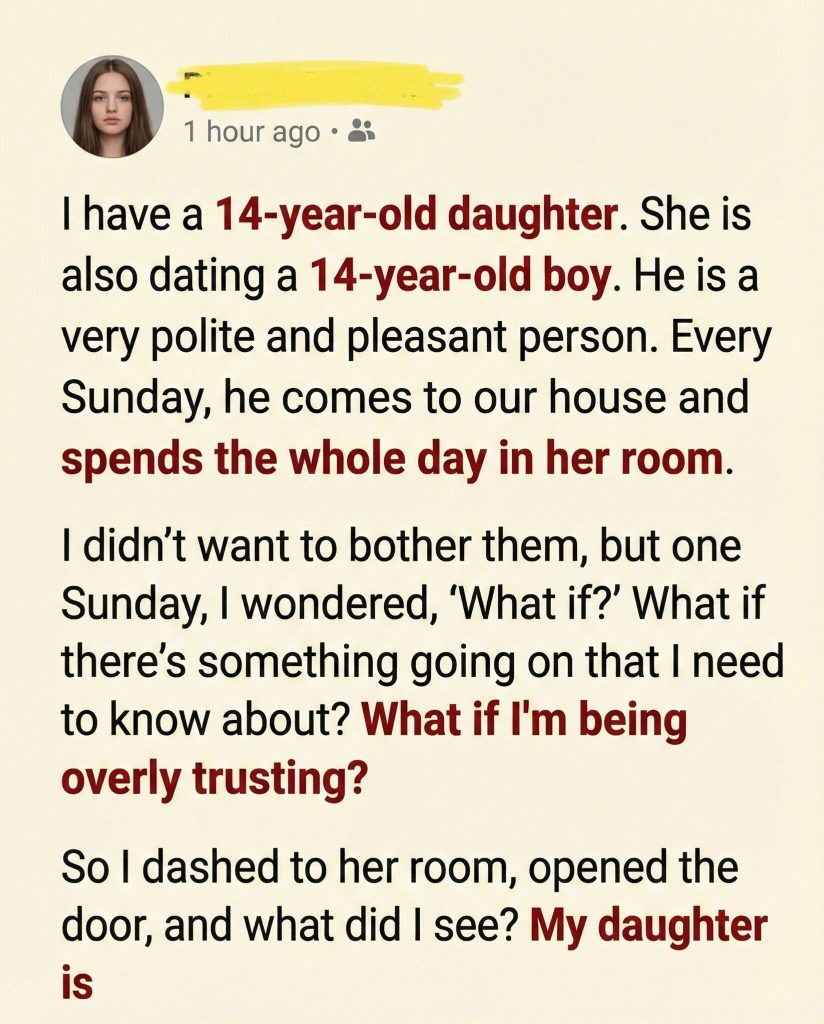
I have a fourteen-year-old daughter, and somewhere along the way I realized that parenting at this stage is less about control and more about navigating a constant tension that never fully settles. It lives quietly beneath everyday moments, shaping how you think, how you respond, how you interpret even the smallest changes in behavior. You are always balancing two opposing instincts: the desire to trust the person your child is becoming and the equally strong urge to protect them from anything that might harm them. It’s not a clear line. It shifts daily, sometimes hourly, depending on what you see, what you hear, and what you imagine. Because imagination, I’ve learned, can be just as powerful as reality when you’re a parent. A closed door becomes a question. Silence becomes a possibility. And the space between what you know and what you fear begins to fill itself with stories. Most of the time, those stories are never spoken out loud, but they influence your decisions all the same. You remind yourself that trust must be chosen, that independence is something your child needs in order to grow. Yet that quiet voice in the back of your mind never fully disappears. It asks small, persistent questions. What if you’re missing something? What if you’re being too lenient? What if this is the moment you should step in but don’t? Living in that in-between space is one of the most difficult parts of raising a teenager, because there are no clear instructions, no perfect timing, and no guarantee that you’ll always get it right.
A few months ago, my daughter started spending time with a boy from her class named Noah. From the beginning, there was nothing about him that raised immediate concern. He was polite in a way that didn’t feel rehearsed or forced. He greeted us properly, spoke respectfully, and carried himself with a quiet confidence that didn’t rely on attention. When he visited, he followed basic courtesies without needing reminders—taking off his shoes, offering to help with small tasks, thanking us for having him over. On the surface, he seemed like exactly the kind of person you hope your child will choose to be around. And yet, despite all of that, the uneasiness didn’t fully disappear. It wasn’t about him specifically. It was about the situation, the age, the unknown. Every Sunday afternoon, he would come over and the two of them would go straight to her room, closing the door behind them. There was no loud music, no constant chatter, no signs of chaos. Just quiet. At first, I told myself that this quiet was a good thing. It suggested calm, focus, maybe even a level of maturity. But over time, that same quiet began to feel different. Not suspicious exactly, but noticeable in a way that made it hard to ignore. I found myself paying attention to it more than I wanted to admit, listening for sounds that never came, noticing how long they stayed inside, how consistently this pattern repeated. It wasn’t a sudden shift into worry. It was gradual, almost subtle, like a thought that returns often enough that it begins to feel important.
One Sunday afternoon, that quiet settled over the house again, heavier than usual. I was in the hallway folding laundry, moving through a routine that should have felt ordinary. The warmth of freshly dried clothes lingered in my hands, grounding me in something simple and familiar. But my mind wasn’t focused on what I was doing. It had drifted down the hallway, toward that closed door, toward the absence of sound that suddenly felt louder than anything else. And then, without warning, a single thought surfaced and refused to leave. What if? It wasn’t dramatic or urgent. It didn’t feel like panic. It felt like responsibility. What if I was being too trusting? What if something was happening that I should be aware of? What if this was one of those moments parents later regret missing? I stood there longer than necessary, holding the same towel, feeling my heartbeat pick up in a way that didn’t quite match the situation. I tried to reason with myself, to remind myself of everything I knew about my daughter, about the kind of person she had always been. But doubt doesn’t always respond to logic. It grows quietly, feeding on uncertainty. Eventually, I convinced myself that I wasn’t overreacting. I was simply checking. Being careful. Without giving myself more time to reconsider, I walked down the hallway, each step feeling louder than it should have. I paused at her door, took a breath, and opened it.
What I saw didn’t match anything I had imagined. My daughter wasn’t sitting on her bed or whispering into her phone. She wasn’t laughing or distracted or even looking in my direction at first. She was kneeling on the floor. So was Noah. Spread out between them was a large piece of cardboard covered with handwritten notes, sketches, and carefully placed photographs. Around it were open notebooks, markers in different colors, and a laptop paused on what looked like a presentation. They both looked up at me, startled, as if I had interrupted something important. “Mom,” my daughter said quickly, her face flushing, “you weren’t supposed to see this yet.” For a moment, I couldn’t respond. My mind struggled to shift from expectation to reality. “See what?” I asked, my voice softer than I expected. Noah stood up immediately, apologizing for the mess, while my daughter stepped closer, gently taking my hand. “We’ve been working on something,” she said. There was a seriousness in her tone that made me look again, more carefully this time. That’s when I noticed the details I had missed at first glance. A photograph of my father in a hospital bed. Another of a small park. A handwritten sign that read Community Literacy Drive. Suddenly, the pieces began to come together in a way I hadn’t anticipated.
They explained it slowly, thoughtfully, as if they had spent weeks shaping the idea before speaking it out loud. My daughter told me how her grandfather had been struggling since his stroke, how he had expressed feeling lost, disconnected, as though he no longer had a role to play. Noah added that his grandmother was involved in a local community center that needed help, especially with children who were learning to read. Together, they had started building a plan—a small reading program that would bring those two needs together. My father, who had once been a teacher, could contribute again, offering guidance, selecting books, helping children develop skills while regaining a sense of purpose. What I had initially seen as scattered papers was, in fact, a structured plan. There were schedules, lists of materials, outlines for how the sessions could work, even ideas for making the experience engaging for younger kids. They had thought about logistics, timing, and resources. They had done research. They had taken something deeply personal—my father’s struggle—and connected it to something meaningful for others. It wasn’t just thoughtful. It was intentional in a way that went far beyond what I had expected. The quiet I had been questioning wasn’t emptiness. It was focus.
Sitting there with them, looking at what they had created, I felt something shift inside me. The worry that had built up over weeks didn’t just disappear—it transformed. It gave way to something more grounded, more real. Pride, yes, but also humility. I realized how easily fear had shaped my perception, how quickly I had filled silence with assumptions instead of curiosity. I had opened that door expecting to intervene, to correct, to protect. Instead, I found something that didn’t need interference. It needed acknowledgment. That evening, as we sat at the dinner table, I saw them differently. Not as children I needed to monitor constantly, but as individuals capable of thought, empathy, and action. They spoke about their plans, their ideas, their hopes for making it work. And I listened—not with suspicion, but with respect. That moment stayed with me long after the conversation ended. It reminded me that parenting is not just about preventing mistakes. It’s also about recognizing growth when it appears, even when it looks different from what you expected. Sometimes, the hardest part is stepping back enough to see it clearly.
Looking back, I understand that the closed door had never been the issue. It was what I believed it might contain that created the tension. Fear had filled that space with possibilities that weren’t grounded in reality. And while that fear came from a place of care, it still had the power to distort what I saw. What I found instead was something far more meaningful—a reminder that young people are capable of depth, of compassion, of quiet determination that doesn’t always announce itself. Not every silence hides a problem. Not every private moment signals something that needs to be corrected. Sometimes, it holds something fragile and important that is still taking shape. Since that day, I’ve tried to approach those moments differently. Not without awareness, not without boundaries, but with a willingness to pause before assuming. Because trust, I’ve learned, isn’t about certainty. It’s about allowing space for growth, even when you don’t fully understand what’s happening within it. And sometimes, when you open a door expecting to find something wrong, you might instead discover something quietly right—something that reminds you why trust, despite the fear, is still worth choosing.