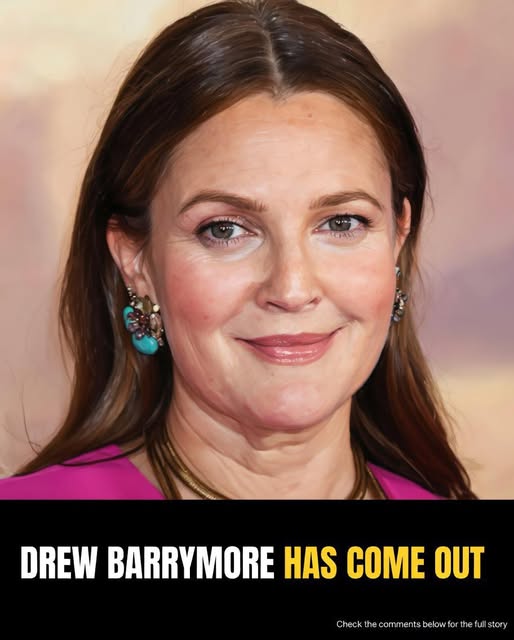
For much of her life, Drew Barrymore has existed in a space where personal identity and public perception are constantly intertwined. From childhood stardom to becoming a household name in Hollywood, her journey has been shaped not only by her talent but by the intense visibility that accompanied it. In recent years, however, there has been a noticeable shift in how she engages with that visibility. Rather than allowing it to define her, she has begun to use it as a platform for honesty—sharing experiences that are deeply personal, sometimes uncomfortable, yet profoundly relatable.
One of the most striking examples of this openness came when she spoke candidly about perimenopause, a stage of life that is often overlooked or avoided in public conversation. By discussing the emotional fluctuations, physical changes, and moments of vulnerability she has experienced, Barrymore brought attention to a topic that affects countless women but is rarely addressed with such transparency. Her willingness to speak openly about feeling unattractive at times, or emotionally unsettled, resonated with many who have faced similar challenges in silence. It was not just a revelation; it was an invitation for others to feel seen.
This moment of vulnerability aligns closely with another aspect of her recent openness—her decision to speak honestly about her identity, including her bisexuality. For someone whose life has unfolded under constant observation, the act of sharing something so personal might seem like a dramatic revelation. Yet, in Barrymore’s case, it carried a very different tone. There was no sense of spectacle or surprise. Instead, it felt grounded, almost understated, as if she was simply acknowledging something that had always been part of her understanding of herself.
This distinction matters. It reframes the narrative from one of sudden transformation to one of gradual alignment. Barrymore is not presenting a new version of herself to the world; she is allowing the world to see a more complete version of who she has always been. In doing so, she challenges the idea that identity must be revealed in dramatic, defining moments. Sometimes, it emerges quietly, through reflection and self-acceptance.
To understand the significance of this openness, it is important to consider the context of her life. Growing up in Hollywood is unlike any other experience. From a young age, Barrymore was exposed to the demands and expectations of an industry that thrives on image. There was little room for privacy, and even less for uncertainty. Her early years were marked by both extraordinary success and very public struggles, creating a narrative that often felt shaped by others rather than by herself.
Over time, she has worked to reclaim that narrative. This process has not been linear. It has involved periods of introspection, moments of reinvention, and a consistent effort to move toward a more grounded sense of self. Her openness about her personal experiences—whether related to mental health, relationships, motherhood, or identity—reflects this ongoing journey. It is not about perfection, but about progress.
When Barrymore speaks about her bisexuality, there is a sense of calm assurance that suggests this is not a new realization, but a truth she has carried with her for some time. Her words do not seek to explain or justify; they simply state. This approach is powerful in its simplicity. It removes the pressure to conform to expectations about how such disclosures should look or feel. Instead, it emphasizes the importance of authenticity over performance.
There is also a broader cultural context to consider. Conversations around identity have evolved significantly in recent years, becoming more inclusive and nuanced. However, public figures still face unique challenges when navigating these topics. Their experiences are often scrutinized, interpreted, and sometimes politicized in ways that can overshadow the personal nature of their stories. In this environment, choosing to speak openly requires both confidence and clarity.
Barrymore’s approach offers an alternative perspective. By sharing her truth without dramatization, she shifts the focus away from external reactions and toward internal alignment. Her story becomes less about how it is received and more about why it is shared. This subtle shift changes the conversation, encouraging a more thoughtful and empathetic response.
Another important element of her openness is the way it intersects with her broader journey of self-acceptance. Over the years, Barrymore has spoken about the challenges of growing up in the public eye, the impact of early fame, and the process of finding stability in adulthood. These experiences have shaped her perspective, influencing the way she approaches both her personal life and her public persona.
Her discussion of perimenopause, for example, reflects a willingness to engage with aspects of life that are often hidden or minimized. By acknowledging the physical and emotional realities of this stage, she normalizes experiences that many people feel reluctant to discuss. This openness is not limited to one topic; it extends across multiple aspects of her life, creating a consistent narrative of honesty and self-awareness.
In this context, her decision to speak about her identity feels like a natural extension of that narrative. It is another step in the process of “stopping the edit”—of choosing not to filter or omit parts of herself for the sake of comfort or expectation. This concept is particularly meaningful for someone who has spent so much of her life being edited by others, whether through media representation or public perception.
The idea of stopping the edit speaks to a larger theme of reclaiming agency. It is about deciding what to share, how to share it, and when it feels right to do so. For Barrymore, this means embracing the complexity of her identity without feeling the need to simplify or categorize it for others. It is a form of self-expression that prioritizes authenticity over clarity, allowing for nuance and individuality.
Her story also highlights the importance of timing in self-disclosure. There is often an expectation that identity must be defined and shared at a certain stage in life. Barrymore challenges this notion by demonstrating that self-understanding is an ongoing process. It evolves over time, shaped by experience, reflection, and personal growth. There is no deadline for authenticity.
This perspective is particularly valuable in a world that often prioritizes immediacy and visibility. It reminds us that personal journeys do not need to conform to external timelines. They can unfold at their own pace, guided by internal readiness rather than external pressure.
At the same time, Barrymore’s openness has a broader impact beyond her individual story. Public figures have the ability to influence cultural conversations, and when they speak honestly about their experiences, they can create space for others to do the same. By sharing her truth, she contributes to a larger dialogue about identity, acceptance, and the importance of self-expression.
This impact is not necessarily measured in headlines or reactions, but in the quieter ways people connect with her story. It may be reflected in someone feeling less alone, more understood, or more confident in their own journey. These connections are often invisible, yet deeply meaningful.
It is also important to recognize that Barrymore’s identity is just one part of a much larger narrative. She is an actress, a producer, a talk show host, a mother, and an individual who has navigated a complex and often challenging path. By integrating this aspect of her identity into her public persona, she adds depth to that narrative rather than redefining it entirely.
This integration reflects a holistic approach to self-understanding. It acknowledges that identity is multifaceted, composed of many different elements that coexist and interact. No single aspect defines the whole. Instead, it is the combination of experiences, values, and perspectives that shapes who a person is.
In many ways, Barrymore’s journey can be seen as a movement toward wholeness. It is about bringing together the different parts of herself—past and present, public and private, known and unspoken—and allowing them to exist in harmony. This process is not always easy, but it is deeply rewarding.
Her willingness to share this journey with others adds another layer of significance. It transforms her personal experiences into something that can resonate on a broader level, offering insight and inspiration to those who may be navigating similar paths. It also reinforces the idea that vulnerability can be a source of strength rather than a sign of weakness.
Ultimately, what stands out most about Barrymore’s openness is its sincerity. There is no sense of performance or calculation in the way she speaks about her experiences. Her words feel genuine, grounded in a desire to connect rather than to impress. This authenticity is what makes her story compelling, allowing it to resonate beyond the specifics of her circumstances.
In a world where public narratives are often shaped by spectacle, her approach offers a refreshing alternative. It emphasizes the value of quiet honesty, of sharing without exaggeration, and of being present in one’s truth without the need for validation.
As she continues to evolve, both personally and professionally, Barrymore’s journey remains an ongoing story. It is shaped by new experiences, changing perspectives, and a continued commitment to authenticity. Yet the foundation of that story—her willingness to be honest, to reflect, and to grow—remains constant.
In the end, her decision to speak openly about her identity is not about redefining who she is. It is about allowing herself to be fully seen, without edits or omissions. It is a quiet affirmation of self, grounded in acceptance and expressed with confidence.
And perhaps that is what makes it so powerful. Not the revelation itself, but the way it is shared—with clarity, with calm, and with a deep sense of knowing. In a life shaped by visibility, this moment represents something different: not the spotlight, but the choice to step into it on her own terms.