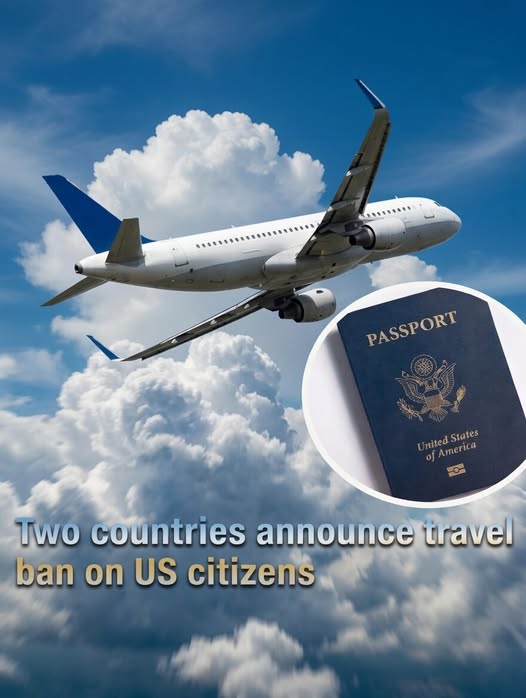
Two Countries Announce Travel Ban on U.S. Citizens, Escalating Global Tensions
A new wave of international travel restrictions is reshaping global mobility, as several nations respond to expanded U.S. entry bans with policies of their own. At the center of the controversy is U.S. President Donald Trump, whose administration has once again placed immigration control at the forefront of its agenda, triggering consequences far beyond American borders.
Earlier this year, the United States unveiled a sweeping expansion of travel restrictions affecting dozens of countries. The policy, which significantly broadens earlier measures, introduces full or partial entry bans for nationals from a wide range of nations, citing national security concerns and deficiencies in identity verification systems. With the updated list now encompassing nearly 40 countries, it represents one of the most extensive travel restriction frameworks in recent U.S. history.
The administration has framed the move as a necessary step to protect national security and encourage foreign governments to strengthen border control systems, improve data sharing, and enhance document security. Officials argue that the policy is not permanent, but conditional—meaning countries can be removed from the list if they meet specific criteria.
However, critics see the situation differently. Many governments and international observers argue that the restrictions are overly broad, lacking transparency, and risk punishing ordinary citizens rather than addressing targeted security concerns. As a result, tensions have quickly escalated.
Retaliation Begins: Reciprocity in Action
Among the most immediate responses came from Mali and Burkina Faso, both of which were included in the U.S. travel restriction list. In coordinated announcements, the two nations declared they would impose reciprocal measures on American citizens.
Officials in both countries emphasized that the decision was grounded in the principle of diplomatic reciprocity—a long-standing norm in international relations. Simply put, if one country imposes restrictions, the other may respond in kind.
For American travelers, this means new barriers to entry. Depending on implementation, these could include stricter visa requirements, prolonged processing times, or outright denial of entry. The implications extend beyond tourism, affecting aid workers, journalists, and businesses operating in the region.
The message from both governments was clear: immigration policy is not a one-way street.
A More Severe Response
While Mali and Burkina Faso opted for reciprocal measures, Niger took a more dramatic step.
Reports indicate that Niger has moved toward a near-total prohibition on U.S. citizens entering the country, including a halt in visa issuance. If fully enforced, this would represent one of the most severe retaliatory actions taken against American travelers in response to the U.S. policy.
Such a move highlights the growing frustration among affected nations, many of which view the U.S. restrictions as discriminatory or politically motivated. It also signals a broader shift, where immigration policy becomes a tool of diplomatic leverage.
A Chain Reaction in Global Relations
The consequences of these decisions extend far beyond individual countries. Historically, the United States has maintained strategic partnerships with many nations now affected by these policies, particularly in areas such as counterterrorism, humanitarian aid, and regional security.
Reciprocal travel bans complicate these relationships.
Diplomats may face new barriers. Aid organizations could encounter delays or restrictions. Business operations may become more complex and costly. Even military cooperation and intelligence sharing could be indirectly affected by deteriorating trust.
In this sense, travel restrictions are no longer just about borders—they are becoming instruments that shape broader geopolitical dynamics.
Changes at U.S. Borders
At the same time, the United States is introducing additional measures that further redefine the travel experience.
New biometric data collection systems have been rolled out at major entry and exit points, significantly expanding the government’s ability to track and verify non-citizen travelers. These measures include facial recognition technology, fingerprinting, and in some cases additional identity verification procedures.
Officials argue that such systems enhance security, reduce fraud, and streamline border operations. However, privacy advocates have raised concerns about long-term data storage, potential misuse, and the implications of collecting sensitive biometric information on a large scale.
For travelers, the result is a more complex and, in some cases, more intimidating entry process.
European Warnings and Traveler Uncertainty
The ripple effects of U.S. policy changes are also being felt across Europe. Governments such as the United Kingdom and Germany have updated their travel guidance for citizens visiting the United States.
These advisories stress that entry requirements are being strictly enforced and that even travelers with valid visas or ESTA authorization may still be denied entry at the border. In some cases, travelers have reportedly faced detention or additional questioning despite having proper documentation.
Such warnings reflect a growing uncertainty about international travel norms. What was once a relatively predictable process is becoming increasingly dependent on evolving policies and discretionary enforcement.
A Broader Shift in Global Mobility
Taken together, these developments point to a significant transformation in how countries manage borders and movement.
The expansion of U.S. travel bans, combined with retaliatory measures from affected nations, suggests a move toward a more fragmented global travel system. Instead of increasing openness and connectivity, policies are trending toward restriction, control, and conditional access.
This shift has wide-ranging implications:
- Tourism may decline in affected regions due to uncertainty and restrictions
- Business travel could become more complicated and expensive
- International students may face new barriers to education opportunities
- Diplomatic relations may grow more strained as policies escalate
At the same time, governments are signaling that these measures are part of a broader strategy—one that prioritizes national security, sovereignty, and control over borders.
What Happens Next?
The future of these policies remains uncertain.
Some governments have indicated a willingness to negotiate, suggesting that restrictions could be lifted if certain conditions are met. Others appear more entrenched, viewing the measures as necessary responses to perceived inequality in international travel rules.
For now, travelers, businesses, and policymakers alike are left navigating a rapidly changing landscape—one where access, mobility, and international cooperation are increasingly shaped by political decisions.
A World Redefined by Borders
What began as a domestic policy decision in the United States has quickly evolved into a global issue, affecting multiple continents and countless individuals.
At its core, the situation underscores a fundamental truth: in an interconnected world, decisions made by one nation rarely stay within its borders.
As countries continue to respond, adapt, and push back, the balance between security and openness remains at the center of the debate.
And for millions of people around the world, the ability to move freely across borders—once taken for granted—is becoming anything but certain.