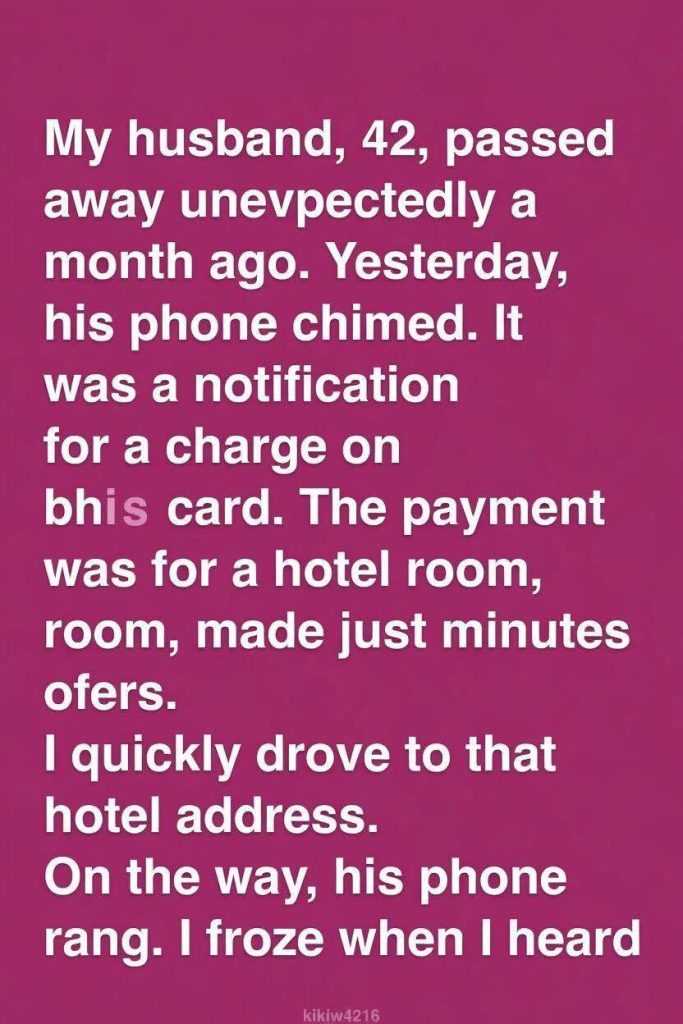
The phone rang at a moment when silence had become my only refuge.
In the weeks following my husband’s sudden death, I had grown accustomed to the quiet. It wasn’t peaceful—not really—but it was predictable. Silence didn’t ask questions. It didn’t force me to confront the reality that David was gone. It simply existed, wrapping around me like a fragile shield against everything I wasn’t ready to feel.
So when his phone lit up on the passenger seat beside me, the sound felt intrusive, almost wrong.
I stared at it for a few seconds, my heart beginning to pound in a way I hadn’t felt since the night he collapsed. The screen displayed an unknown number. Normally, I would have ignored it. But something—intuition, curiosity, or maybe something deeper I couldn’t name—made me reach for it.
“Hello?” I said cautiously.
There was a pause. Then a woman’s voice, soft and familiar in a way that made my stomach tighten instantly.
“Hey, love… are you almost here?” she said gently. “I’m already in the room. I’ve missed you.”
The words didn’t register at first. They floated in the air, disconnected from meaning, as if my mind refused to process them.
“I can’t wait to see you,” she added, a small laugh in her voice. “It’s been too long.”
My fingers tightened around the phone. My throat went dry.
She thought she was talking to him.
To my husband.
The man I had buried just one month earlier.
I ended the call without saying a word, my hand trembling as I placed the phone back down. For a moment, I simply sat there, frozen, as if any movement might make the situation more real than it already felt.
Then the phone buzzed again.
This time, it was a message.
“Room 312. Same place. I’m waiting. Miss you so much… especially after last time when you said your wife was getting suspicious.”
The world seemed to tilt.
Suspicious.
The word echoed in my mind, over and over, louder with each repetition.
I hadn’t been suspicious.
I had been grieving.
The drive to the hotel felt surreal, like moving through a dream I couldn’t wake up from.
Every logical part of me tried to intervene. It could be a mistake. A wrong number. Someone playing a cruel joke. There had to be an explanation that didn’t unravel twenty years of marriage in a matter of seconds.
But deep down, something had already shifted.
The certainty I once held about my life—about my husband—was cracking.
And I needed to know what was beneath it.
The hotel stood at the edge of town, familiar in a distant way. We had stayed there once, years ago, during a family trip. Back then, it had been just another stop along the way.
Now, it felt like the center of something I didn’t yet understand.
I sat in the parking lot for a long time, staring at the entrance, watching people come and go. Everything looked normal. Unremarkable. Safe.
But I knew better.
Because something hidden was waiting inside.
Something that had been there all along, just beyond my awareness.
When I finally stepped out of the car, my legs felt unsteady. Each step toward the building felt heavier than the last, as if I were walking toward a version of my life I wasn’t ready to face.
I didn’t stop at the front desk. I didn’t ask questions. I simply followed the hallway signs, moving almost instinctively toward the elevators.
Third floor.
Room 312.
The numbers felt sharp in my mind, carved into my memory.
Standing outside the door, I hesitated.
This was the moment.
Whatever was behind that door would change everything.
I could turn around. I could leave. I could choose not to know.
But I also knew I wouldn’t be able to live with that.
So I knocked.
The door opened slowly.
The woman who stood there looked as surprised as I felt.
She was younger than me, but not by much. Her expression shifted in an instant—from confusion to recognition to something that looked very much like fear.
“You’re…” she began, then stopped.
I didn’t say anything.
I didn’t need to.
“You’re his wife,” she finished quietly.
Not a question.
A realization.
Inside the room, the air felt thick with tension.
There were two glasses on the table. A small overnight bag near the bed. A faint scent in the air that I recognized instantly—David’s cologne.
The familiarity of it made my chest tighten.
This place wasn’t just a location.
It was a space where a different version of his life had existed.
We sat across from each other, separated by more than just physical distance.
At first, neither of us spoke.
Then, slowly, the truth began to unfold.
They had met three years earlier.
What started as something casual had become something consistent. Planned. Repeated.
He had told her things.
Not the truth—but a version of it.
“He said your marriage was… complicated,” she said carefully. “That you had grown apart. That you stayed together for the family.”
I felt a hollow ache settle in my chest.
That wasn’t the marriage I remembered.
But suddenly, I wasn’t sure what to trust.
She showed me messages.
Photos.
Dates.
Each piece fit together with unsettling precision.
Business trips that now had new meaning. Late nights that no longer felt random. Small moments I had dismissed at the time, now reappearing with a clarity I hadn’t had before.
It wasn’t chaotic.
It was structured.
He hadn’t stumbled into this life.
He had maintained it.
The realization was almost harder to process than the betrayal itself.
This wasn’t a mistake.
It was a pattern.
A second life that had existed alongside the one I knew.
What struck me most wasn’t anger.
Not at first.
It was disorientation.
The man I had loved, trusted, built a life with—he was still real.
But he was incomplete.
There had been parts of him I never saw.
Parts he never allowed me to see.
I left the hotel in silence.
There was nothing more to say.
No confrontation that could undo what I had learned.
No explanation that could restore what had been lost.
In the days that followed, I found myself searching for answers.
Not because I wanted to hold onto the pain, but because I needed to understand.
I went through financial records.
Old messages.
Emails.
Patterns emerged.
Not constant—but recurring.
There were gaps where he had pulled away, times when he had tried to return fully to our life.
But he always went back.
That was the hardest truth to accept.
Not that he had lied.
But that he had lived in between two realities.
And had never fully chosen one.
Grief became something different after that.
It was no longer just about losing him.
It was about losing the version of him I believed in.
The version of our life that had felt stable, certain, real.
Telling our children was something I approached slowly.
Carefully.
I didn’t want to replace their grief with confusion or anger.
But I also didn’t want to build their understanding on something incomplete.
So I told them the truth—gently, in pieces.
They reacted differently.
Shock.
Denial.
Hurt.
But eventually, something else emerged.
Acceptance.
Not of what he had done—but of the fact that people are more complicated than we often allow them to be.
In time, I began to see things differently too.
Not in a way that excused his choices.
But in a way that allowed me to separate the parts of him that were real from the parts that were hidden.
He wasn’t entirely one thing or the other.
He was both.
That realization didn’t erase the pain.
But it changed how I carried it.
I no longer saw my life as a lie.
But I also no longer saw it as something perfect that had been shattered.
It was something more complicated.
More human.
Healing didn’t come all at once.
It came in small moments.
Days where I didn’t think about it constantly.
Conversations that didn’t revolve around loss.
Decisions that felt like they belonged to me again.
I began to rebuild—not the life I had before, but something new.
Something grounded in a clearer understanding of myself.
Of what I needed.
Of what I deserved.
Trust became something I approached differently.
Not with fear, but with awareness.
Understanding that certainty is often an illusion, but connection is still worth pursuing.
Months later, I received one final message from the woman at the hotel.
She didn’t ask for anything.
She simply said she was sorry.
And that she hadn’t known the full truth either.
I believed her.
Because in the end, we had both been part of something we didn’t fully understand.
Looking back now, that phone call feels like a turning point.
Not just because of what it revealed.
But because of what it forced me to confront.
The truth isn’t always simple.
People aren’t always consistent.
And love, as powerful as it is, doesn’t guarantee honesty.
But even within that complexity, there is still room for growth.
For clarity.
For rebuilding something real.
I lost my husband.
But I also found something I didn’t expect.
A deeper understanding of myself.
And the strength to move forward, even when the story I believed in no longer existed.
And in that, there is something like peace.
Not perfect.
Not complete.
But real.