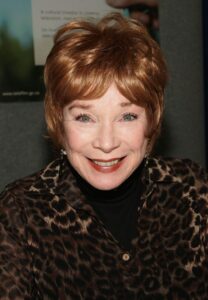
In an industry that often measures relevance by youth, reinvention, and fleeting attention, there are rare figures who quietly defy all of those expectations simply by continuing to exist on their own terms. Shirley MacLaine is one of those rare figures. At 91, she stands not as a relic of a bygone Hollywood era, but as a living, evolving example of what it means to sustain a meaningful life and career far beyond the boundaries most people assume are fixed. Her presence today is not rooted in nostalgia alone—it is grounded in authenticity, experience, and an unwavering commitment to self-definition.
For many, aging in the public eye is a delicate balancing act, often accompanied by pressure to maintain a certain image or to disappear gracefully when the spotlight begins to dim. MacLaine has done neither. Instead, she has chosen a path that embraces visibility without dependency on validation. She has spoken candidly about her life, her decisions, and even her insecurities, offering a rare glimpse into the internal world of someone who has spent decades under scrutiny but never fully surrendered to it.
Born in 1934 in Richmond, Virginia, Shirley MacLaine’s early life was shaped by creativity and discipline. Her mother, a drama teacher, fostered an environment where expression was not just encouraged but expected. From a very young age, MacLaine was immersed in performance, beginning ballet training at just three years old. Ballet, with its demanding structure and relentless pursuit of perfection, instilled in her a sense of discipline that would later define her approach to acting and life.
But ballet also taught her something else—resilience. The physical toll, the constant evaluation, and the need to push through discomfort became foundational experiences. When she eventually transitioned from dance to acting, she carried with her not just technical skill but a mindset that allowed her to navigate rejection, uncertainty, and the unpredictability of the entertainment industry.
Her move to New York City after high school was not a leap into the unknown so much as a continuation of a path she had already been walking. Independence came naturally to her, and so did risk-taking. These traits would prove invaluable when opportunity finally arrived in an unexpected way.
While working as an understudy in a Broadway production, MacLaine was suddenly thrust into the spotlight when the lead performer was injured. It was a moment that could have overwhelmed someone less prepared, but she stepped into it with confidence. That performance caught the attention of a major film producer, leading to her first contract and a swift transition into Hollywood.
Her film debut marked the beginning of a career that would span more than six decades. But what made MacLaine stand out was not just her talent—it was her refusal to conform to traditional expectations. She did not fit neatly into the conventional mold of Hollywood glamour, and rather than trying to adapt herself to fit it, she allowed her uniqueness to define her.
Throughout the late 1950s and into the 1960s, her career gained remarkable momentum. She took on roles that demanded emotional depth and complexity, portraying characters who were flawed, human, and often ahead of their time. Her performances resonated because they felt real. There was no artificial polish masking vulnerability; instead, she embraced it.
Over the years, she accumulated numerous accolades, including multiple award nominations and wins that recognized not only individual performances but her broader contribution to cinema. Yet even as recognition grew, she maintained a perspective that kept her grounded. Success, for MacLaine, was never solely about awards or public approval. It was about freedom—the ability to choose roles, to explore ideas, and to live a life that extended beyond the boundaries of her profession.
One of the most striking aspects of her journey is her relationship with fame. While many actors become defined by it, MacLaine treated it as just one element of a much larger life. She traveled extensively, explored spiritual and philosophical ideas, and pursued personal growth with the same intensity she brought to her work. This balance allowed her to avoid the trap of becoming overly dependent on public perception.
As the decades passed and conversations about aging in Hollywood became more prominent, MacLaine’s approach stood out even more. She did not deny the realities of aging, nor did she attempt to hide them entirely. Instead, she engaged with them openly, including discussions about cosmetic procedures she had chosen earlier in her life.
Her decision to undergo a facelift is something she has addressed without hesitation. What makes her perspective compelling is not the decision itself, but the way she contextualizes it. She does not frame it as a mistake or a necessity, but as a choice made at a particular time, influenced by the mindset she had then. Over time, her views evolved, and she began to embrace natural aging more fully.
This evolution reflects a broader truth about human experience: perspectives are not fixed. What matters at one stage of life may become less important at another. MacLaine’s willingness to acknowledge that shift adds depth to her story. It shows that growth does not stop, even in later years.
Today, she often speaks about aging with a sense of acceptance that feels both refreshing and rare. She does not romanticize it, nor does she resist it. Instead, she approaches it with curiosity and honesty. Wrinkles, for her, are not flaws to be erased but markers of a life lived fully.
This mindset challenges one of the most persistent narratives in modern culture—the idea that youth is the ultimate measure of value. By continuing to work, to speak, and to engage with the world at 91, MacLaine offers an alternative perspective. She demonstrates that relevance is not tied to age but to presence.
Her continued involvement in creative projects further reinforces this point. While many would have stepped away from the demands of the entertainment industry long ago, she remains active. This is not driven by a need to prove anything, but by a genuine passion for storytelling and expression.
There is something powerful about seeing someone maintain that level of engagement well into their later years. It disrupts assumptions about what is possible and invites a reconsideration of how we define purpose. For MacLaine, purpose is not something that diminishes over time—it evolves.
Beyond her professional life, her personal philosophy has also contributed to her enduring appeal. She has always approached life with a sense of exploration, whether through travel, introspection, or creative work. This openness to experience has allowed her to remain adaptable in a world that is constantly changing.
It also contributes to her authenticity. In an industry where image is often carefully constructed, MacLaine’s willingness to be herself—unfiltered and unapologetic—sets her apart. She does not attempt to align with expectations; she simply exists as she is.
This authenticity resonates with audiences across generations. Younger fans may discover her through classic films or recent appearances, while older audiences have followed her journey for decades. What connects them is not just admiration for her work, but respect for her individuality.
Her story also highlights the importance of redefining success. In many ways, she has achieved everything traditionally associated with it—recognition, longevity, and influence. But what makes her journey meaningful is the way she has shaped her own definition of what success looks like.
For her, it is not about maintaining a perfect image or adhering to external standards. It is about living honestly, making choices that align with her values, and continuing to grow. This perspective offers a valuable lesson in a culture that often prioritizes appearance over substance.
The conversation around aging, particularly for women, remains complex. There are societal pressures, industry expectations, and personal insecurities that intersect in ways that can be difficult to navigate. MacLaine’s openness about her experiences contributes to a more nuanced dialogue.
By sharing her thoughts on beauty, aging, and self-acceptance, she helps to normalize conversations that are often avoided or oversimplified. She does not present a one-size-fits-all solution but rather an example of what it looks like to approach these topics with honesty.
Her influence extends beyond entertainment into broader cultural conversations. She represents a shift toward valuing experience, individuality, and authenticity over superficial measures of worth. In doing so, she challenges long-standing norms and encourages a more inclusive understanding of beauty and success.
At 91, she continues to inspire not because she has defied aging, but because she has embraced it. She has allowed it to shape her without defining her entirely. This balance is what makes her story so compelling.
It is easy to look at a long career and focus on the highlights—the awards, the iconic roles, the moments of recognition. But what truly defines MacLaine’s legacy is not any single achievement. It is the consistency with which she has lived according to her own principles.
That consistency is what allows her to remain relevant in a world that often moves quickly from one trend to the next. She is not chasing attention; she is simply continuing to exist in a way that feels true to her.
As audiences continue to engage with her work and her story, the impact of her example becomes increasingly clear. She offers a reminder that aging is not something to be feared or resisted, but something to be understood and integrated into the broader narrative of life.
Her journey encourages a shift in perspective—from seeing aging as a decline to viewing it as a continuation. It suggests that each stage of life brings its own opportunities for growth, expression, and meaning.
In a culture that often prioritizes what is new and immediate, Shirley MacLaine represents something enduring. She embodies the idea that true relevance comes not from constant reinvention, but from authenticity and presence.
At 91, she is not just reflecting on a remarkable past. She is actively participating in the present, shaping conversations, and continuing to inspire those who look beyond surface-level definitions of success.
Her story is not just about longevity—it is about living fully within that longevity. It is about making choices, learning from them, and allowing those experiences to inform the person you become.
And perhaps most importantly, it is about understanding that there is no single way to age well. There is only the way that feels right for you. For Shirley MacLaine, that way has been defined by honesty, independence, and an unwavering commitment to being herself.
In that sense, her legacy is not just something she leaves behind—it is something she continues to build, one authentic moment at a time.