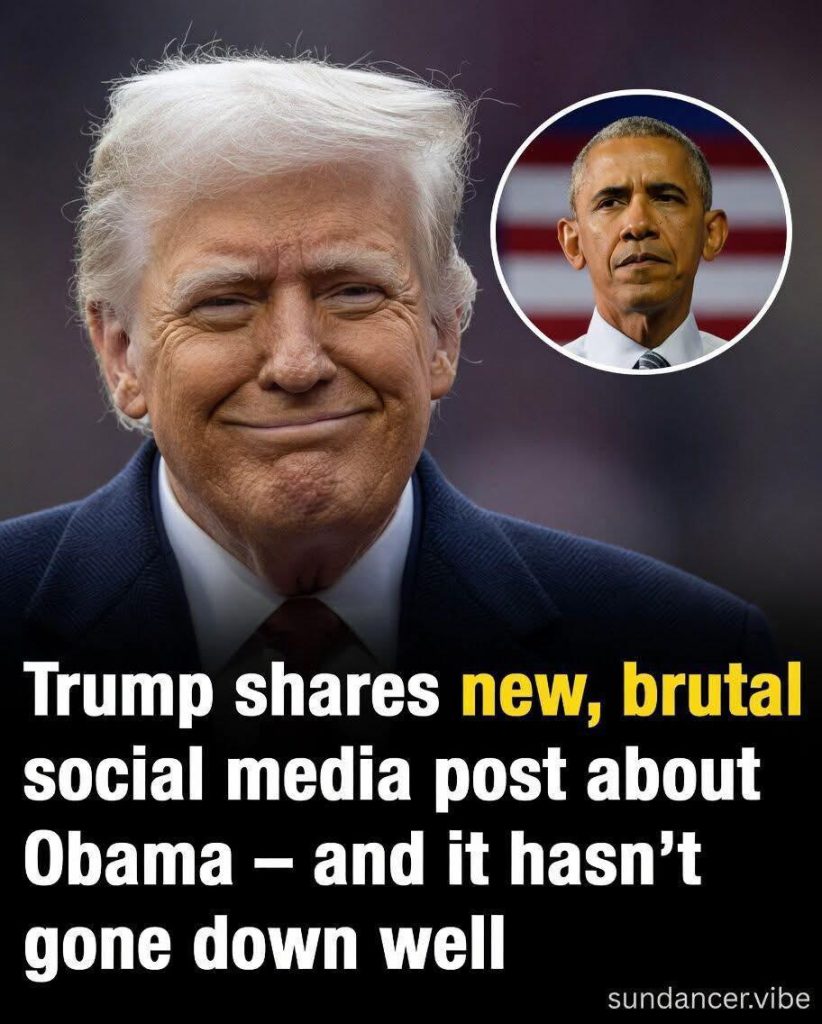
In today’s political landscape, influence isn’t shaped only by speeches, policies, or formal appearances—it’s increasingly driven by what happens online. A single post can dominate attention cycles, reshape narratives, and reignite years-old tensions within hours. That dynamic was on full display when Donald Trump shared a meme referencing Barack Obama, instantly drawing widespread reaction across social platforms.
At face value, the post was simple: a visual contrast between the two figures, paired with a message implying reversal of past skepticism. But the scale of engagement it generated says more about the environment it exists in than the content itself. In a media ecosystem built on speed and visibility, even a brief, symbolic gesture can become a major cultural moment.
A Rivalry That Still Resonates
The connection between Trump and Obama has long carried symbolic weight beyond standard political disagreement. They represent contrasting leadership styles, tones, and visions of public communication.
One frequently revisited moment in this narrative is the White House Correspondents’ Dinner, where Obama’s remarks about Trump became widely discussed and later reframed as a turning point in their dynamic. Whether or not that moment had lasting political consequences, it has become part of a broader storyline that continues to resurface.
By sharing content that references past skepticism, Trump reinforces a familiar theme: revisiting earlier doubts and reframing them as evidence of eventual success. It’s a pattern common in political storytelling—selecting moments from the past that support a current narrative.
The Power of the Meme Format
Memes have become one of the most effective—and ambiguous—tools in modern communication. They operate on multiple levels at once:
- Humor
- Commentary
- Criticism
- Self-promotion
When a public figure shares a meme, it doesn’t function like a traditional statement. Its meaning is flexible, shaped by the audience viewing it.
Supporters may interpret it as:
- A lighthearted jab
- A sign of confidence
- A relatable form of communication
Critics may see:
- A focus on personal rivalry
- A distraction from policy
- A lowering of political tone
That dual interpretation is part of what makes memes so powerful—they allow engagement without requiring clarity.
Social Media as a Political Stage
Platforms like Truth Social have become central to how political figures communicate. Unlike traditional media, they allow:
- Direct messaging to audiences
- Immediate feedback through reactions and shares
- Rapid amplification without editorial filtering
But that speed comes with trade-offs.
Nuance is often lost. Context can disappear. And emotionally charged content tends to travel farther than carefully explained ideas.
In this environment, visibility often outweighs depth.
The Role of Narrative Over Fact
One of the more complex aspects of viral political content is how easily it blends verified history with interpretation—or exaggeration.
References to past events may be:
- Accurate but selectively framed
- Simplified for impact
- Combined with unrelated or unclear claims
This doesn’t necessarily make them false—but it does make them incomplete.
For audiences, the challenge becomes not just understanding what was posted, but evaluating:
- What is confirmed
- What is implied
- What is being left out
That distinction is increasingly important in a fast-moving information space.
When Technology Adds Another Layer
The growing use of edited or AI-generated imagery adds further complexity. Visuals can now be:
- Altered for emphasis
- Created for satire
- Designed to provoke reaction
Even when intended as humor, such images can blur the line between reality and fabrication—especially when shared without clear context.
For viewers, that creates an additional layer of interpretation:
Is this symbolic?
Is it literal?
Is it meant to be taken seriously?
Often, the answer depends entirely on perspective.
Polarization and Amplification
Moments like this don’t exist in isolation—they feed into a broader cycle of political polarization.
When high-profile figures engage in public rivalry, even indirectly:
- Supporters rally around the message
- Critics respond with pushback
- Engagement increases on both sides
Social media algorithms tend to amplify this kind of interaction because it generates strong reactions.
Over time, this creates a feedback loop:
More reaction → more visibility → more division
The result is a shift in focus—from policy discussions to ongoing symbolic conflicts.
Why These Moments Spread So Quickly
Several factors explain why a single post can dominate conversation:
1. Familiar figures
Well-known individuals draw immediate attention.
2. Existing narratives
Long-standing rivalries provide built-in context.
3. Visual simplicity
Images are easier to process and share than detailed arguments.
4. Emotional engagement
Content that provokes reaction spreads faster.
5. Timing
Posts tied to major events gain additional visibility.
Together, these elements create ideal conditions for virality.
The Blurring Line Between Governance and Performance
One of the broader implications of this shift is how political communication is evolving.
Leaders are no longer just policymakers—they are also:
- Content creators
- Narrative builders
- Participants in ongoing digital conversation
This raises an important question:
Does this make politics more accessible—or more superficial?
On one hand, it allows direct engagement and relatability.
On the other, it can shift attention away from substantive issues.
The balance between those outcomes remains unclear.
A Changing Information Landscape
What moments like this ultimately reveal is not just something about individual figures—but about the environment itself.
Information today is:
- Faster
- More fragmented
- More emotionally driven
Audiences are no longer passive consumers—they are active participants, shaping which moments gain traction and which fade quickly.
That dynamic means influence is no longer determined solely by importance, but by engagement.
Final Reflection
The viral spread of a single meme involving Donald Trump and Barack Obama illustrates how modern political discourse operates.
It’s not just about what is said.
It’s about how it’s framed.
How it’s shared.
And how it’s interpreted.
In a digital environment where attention moves quickly and narratives evolve in real time, even small moments can take on outsized significance.
And increasingly, those moments don’t just reflect the political landscape—
They help define it.