Raising a teenager often feels like a constant balancing act—between trust and caution, between giving space and setting limits, between believing in what you’ve taught them and worrying about everything you can’t control.
Before that Sunday, I thought I had found that balance.
I wasn’t overly strict, but I wasn’t completely hands-off either. Still, there was always a quiet tension beneath the surface, especially as my daughter grew more independent. At fourteen, she wasn’t the little girl who shared everything anymore. Her world had expanded—new friendships, new thoughts, new boundaries. And naturally, some doors—both emotional and physical—began to close.
When Noah started visiting regularly, I told myself I trusted her. He was polite, respectful, never gave me a clear reason to worry.
But trust doesn’t silence imagination.
It just learns to live beside it.
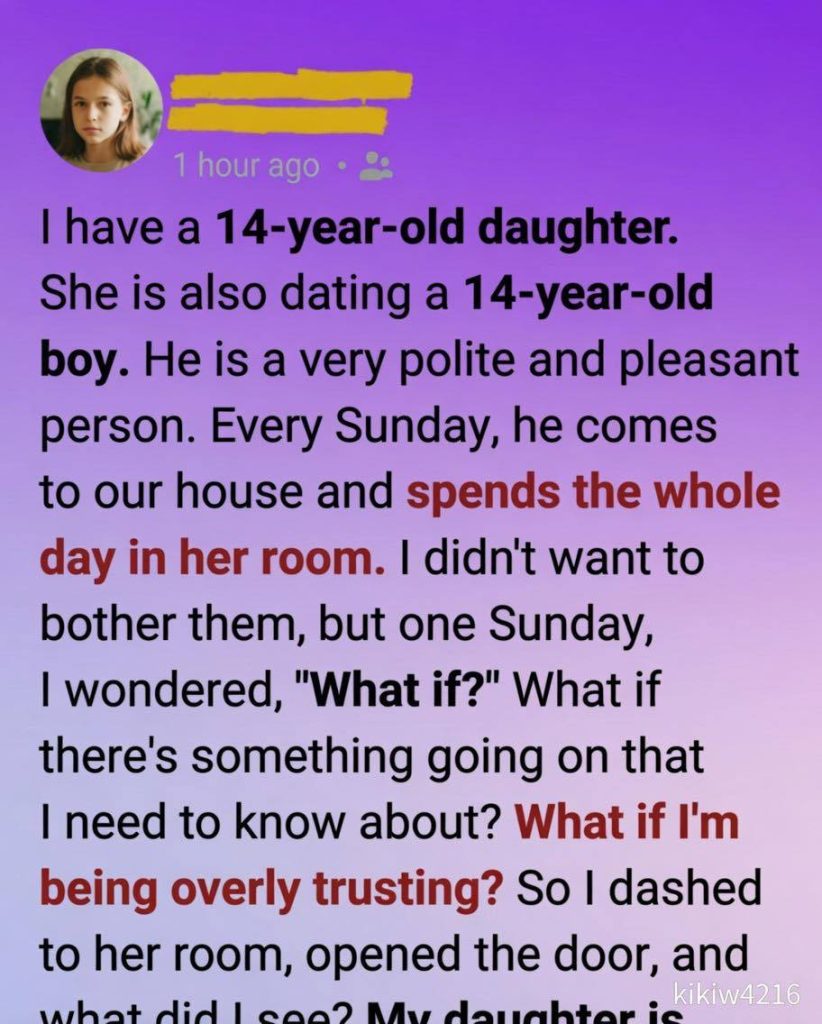
Every Sunday followed the same pattern: lunch, a quick greeting, then the sound of footsteps down the hallway and the soft click of her bedroom door closing.
And then… silence.
No music. No laughter. No obvious signs of teenage chaos.
At first, I appreciated it. Quiet meant calm. Calm meant everything was probably fine.
But over time, that same quiet began to feel different.
It became a blank space my mind insisted on filling.
Were they talking? Watching something? Hiding something?
The silence, ironically, made everything louder in my head.
I started noticing how long they stayed in there. How consistent the routine was. How determined they seemed not to be interrupted. I caught myself lingering in the hallway, pausing without reason, listening for something—anything—that might confirm or ease my growing unease.
It’s unsettling how quickly confidence can turn into doubt without a single piece of real evidence.
Just… “what if.”
That Sunday, the house felt especially still.
Sunlight stretched across the floor. The air felt heavy with quiet. I stood outside her door longer than I’d like to admit, a warm towel still in my hands, my thoughts louder than ever.
In that moment, I wasn’t just a parent.
I was someone caught between two choices:
Respect her privacy—or satisfy my fear.
Neither felt entirely right.
I told myself I was just checking in. That any responsible parent would do the same.
But the truth was, I was bracing myself.
Preparing for something I didn’t want to see—but felt I needed to be ready for.
I turned the handle slowly and opened the door.
And everything I expected… wasn’t there.
They were sitting on the floor.
Surrounded by notebooks, colored markers, printed photos, and a large piece of cardboard propped between them. A laptop sat open nearby, paused mid-slide.
They looked up—surprised, but not guilty.
No panic. No scrambling to hide anything.
Just a quiet interruption.
I stepped inside, taking it in piece by piece.
The board was detailed—headings, notes, arrows connecting ideas. It wasn’t random. It was thoughtful. Intentional.
Then I recognized something that made me pause.
Photos of my father.
The small park down the street.
The community center I’d passed a hundred times without thinking twice.
They explained it simply.
It had started as a school idea—but became something more.
They were creating a volunteer reading program for kids at the community center.
And my daughter wanted her grandfather to be part of it.
She had noticed how much he had changed since his illness—how quiet he’d become, how his sense of purpose seemed to fade.
This was her way of giving some of that back.
Noah had been helping her plan everything—the structure, the activities, even ways to make reading fun and engaging. The board wasn’t just an assignment.
It was a vision.
Carefully built.
Thoughtful.
Kind.
And in that moment, something inside me shifted.
All the imagined scenarios, the quiet suspicion, the hours of unnecessary worry—they dissolved almost instantly.
I had stood outside that door expecting to find a problem.
Instead, I found purpose.
I realized how easy it is to underestimate teenagers. To assume their silence hides something negative—when sometimes, it holds focus, care, and depth we don’t expect.
She wasn’t pulling away from me.
She was growing into herself.
And Noah—the boy I had quietly questioned—wasn’t a risk.
He was helping her build something meaningful.
I felt pride.
And, quietly, a little guilt.
When I closed the door later, it wasn’t with uncertainty—it was with calm.
That moment didn’t just change how I saw that afternoon.
It changed how I see parenting.
Trust isn’t just believing your child won’t make mistakes.
It’s allowing space for them to surprise you.
It’s understanding that growth often happens in rooms you’re not invited into—and that’s not distance.
That’s development.
Now, I still knock before entering. I still check in. I still care just as deeply.
But I carry less fear.
And more faith.
Because sometimes, behind a closed door, you don’t find what you’re afraid of.
Sometimes…
you find exactly what you hoped you raised.