The Quiet Call That Changed Everything
When my son finally arrived and saw what his silence had cost him, something shifted—not just in his expression, but in the fragile structure of assumptions that had quietly taken root over time.
But that moment didn’t come immediately.
It began earlier, with stillness.
I didn’t drive far after leaving the house. Just far enough that the laughter, the music, and the careless sense of occupation faded into something distant. The road curved along the cliffs, the ocean stretching endlessly beside me, steady and indifferent.
I pulled into a small overlook and turned off the engine.
For a while, I just sat there.
My hands rested on the steering wheel, unmoving, as if I were waiting for something—clarity, perhaps. Or calm. The kind of calm that doesn’t erase anger but reshapes it into something usable.
After my husband died, I had learned how to sit with emotion instead of reacting to it. Grief had taught me patience in ways nothing else ever could. It had also taught me something quieter, something more enduring:
Not everything requires a raised voice to be resolved.
I reached for my phone.
The first call was simple.
No dramatics. No long explanation.
Just clarity.
“Hello, Margaret,” my attorney answered.
“I need you to review something,” I said. “Right away.”
Within minutes, I sent everything: the property deed, the updated ownership documents, and most importantly, the clause I had added two years earlier.
At the time, it had felt unnecessary—almost overly cautious. Robert had asked to “borrow” the beach house for a weekend. That weekend had quietly stretched into three weeks.
Back then, I said nothing.
Back then, I still believed respect within a family didn’t need reinforcement.
Experience has a way of correcting beliefs like that.
“Give me ten minutes,” Margaret said.
I ended the call and looked out at the water.
The tide was shifting.
Waves moving forward without hesitation, reshaping the shore not through force, but through persistence. I had always admired that about the ocean. It didn’t argue. It didn’t explain. It simply moved, and the world adjusted around it.
My phone rang.
“They’re not authorized to be there,” Margaret said plainly. “Not your daughter-in-law. Not her family. And based on your clause, not even your son if he granted access without your permission.”
I let that settle.
“I thought so,” I said quietly.
“There’s also a liability provision,” he continued. “Any damage or disturbance falls entirely on whoever is occupying the property unlawfully.”
I closed my eyes briefly.
“Good.”
“Do you want to proceed?”
There was a time when I might have hesitated.
Wondered if I was overreacting. If I should give them time. If confrontation was worth the strain it would bring.
But that time had passed.
“Yes,” I said. “Let’s proceed.”
The second call was even shorter.
Property management.
They handled everything from maintenance to inspections—and when necessary, removal of unauthorized occupants.
“I need the house cleared,” I said.
A brief pause.
“Unauthorized occupancy?” the woman asked.
“Yes.”
“Understood.”
No judgment. No emotion.
Just process.
It was strangely comforting.
By the time I ended the call, things were already moving into place—quietly, efficiently, without the chaos that had filled my home just an hour earlier.
I didn’t go back immediately.
Instead, I checked into a small inn a few miles down the coast.
Not because I had nowhere to go.
But because I didn’t need to stand there and argue while something inevitable unfolded exactly as it should.
I made tea.
Sat by the window.
Watched the sky soften into late afternoon.
At 5:12 p.m., my phone buzzed.
“They’re resisting,” the property manager said. “But we’ve explained the situation. Authorities are present.”
In the background, I could hear raised voices. Not clear enough to understand, but sharp enough to recognize.
“Thank you,” I said.
The call ended.
At 6:03 p.m., Robert called.
I let it ring.
Once.
Twice.
Then I answered.
“Mom—what is happening?” he asked, panic edging into his voice. “Why are there people at the house? Megan is crying—she said—”
“Did you give her permission to be there?” I asked calmly.
A pause.
“That’s not the point—”
“It is exactly the point.”
Silence followed.
I could hear the shift—not in his words, but in his breathing. The realization beginning to form, slowly but undeniably.
“You told me I barely used the house,” I continued. “So I imagine you thought it wouldn’t matter.”
“Mom, it’s just family—”
“No,” I said gently but firmly. “Family doesn’t remove someone from their own home.”
That landed.
He didn’t respond right away.
And he didn’t argue.
Because deep down, he knew.
By the time I returned, the house was almost unrecognizable—not because it had changed, but because the illusion had been stripped away.
The driveway was clearing.
Cars were pulling out one by one.
Voices that had once been loud and careless were now sharp, defensive, restrained.
Two property officers stood near the porch, overseeing the process.
Inside, people moved quickly, gathering their belongings under quiet instruction.
And near the steps stood Megan.
No apron this time.
No casual ease.
Just tension—visible, undeniable.
“You did this?” she asked the moment she saw me.
I set my bag down.
“Yes.”
“You had no right—”
I looked at her fully.
And something shifted again.
Not in her.
In me.
“This is my home,” I said quietly. “That hasn’t changed.”
She opened her mouth to respond, but the words didn’t come as easily this time.
Because certainty had left her.
Behind her, her family continued packing, their earlier confidence replaced with urgency.
Reality has a way of doing that.
Robert arrived shortly after.
He stepped out of his car, taking in everything at once—the officers, the movement, the tension, and finally, me.
“What happened?” he asked.
But his voice already carried the answer.
I didn’t respond immediately.
I let him see it.
The house returning to itself.
The space reclaiming its boundaries.
The consequence of a decision made without thought.
“You gave away something that wasn’t yours,” I said finally.
His shoulders dropped slightly.
“I didn’t think it would go this far.”
I nodded.
“That’s exactly the problem.”
Megan stepped forward again, her frustration resurfacing.
“This is ridiculous,” she said. “We were just spending time together—”
“In my home,” I replied.
“You weren’t even using it!”
“And that gives you ownership?”
She didn’t answer.
Because there wasn’t one.
The last car left just as the sun dipped low over the horizon.
The noise faded.
The movement stopped.
And slowly, the house returned to quiet.
I walked inside.
The air felt different—heavier, disturbed. The scent of smoke, food, something slightly burnt in the kitchen.
But beneath it all, something remained unchanged.
It was still mine.
I moved through each room slowly, restoring small things. Straightening, opening windows, letting fresh air in.
Behind me, Robert stood silently.
“I didn’t realize,” he said eventually.
I paused.
“I know.”
And that was the truth.
He hadn’t realized.
But not realizing doesn’t erase responsibility.
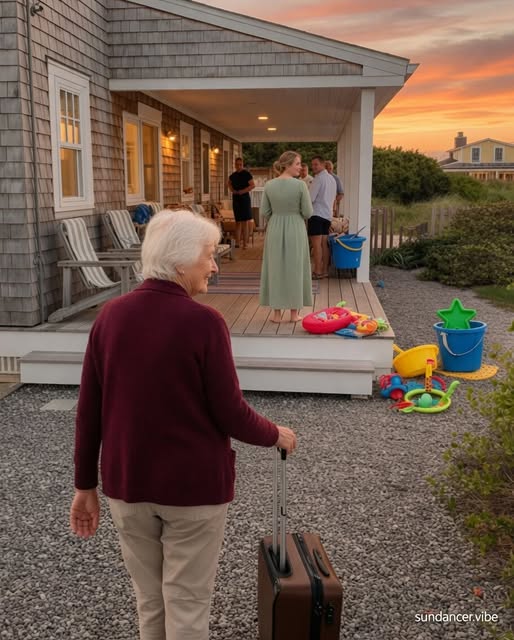
That evening, after everything had settled, I sat on the porch with a cup of tea.
The ocean stretched out before me, steady as ever.
Unchanged.
Waves rolling in, just as they had that morning.
Just as they would tomorrow.
The world hadn’t shifted.
Only the boundaries within it had been restored.
Megan thought the house was just a place.
Temporary. Replaceable. Available.
But it was never just a house.
It was time. Memory. Effort. Loss. Care.
And most importantly—
It was mine.
As the sky darkened and the first stars appeared, I pulled a blanket over my legs and took a slow sip of tea.
Peace isn’t something you stumble into.
It’s something you protect.
And sometimes, protecting it doesn’t require force.
Just clarity.
And one very calm call.