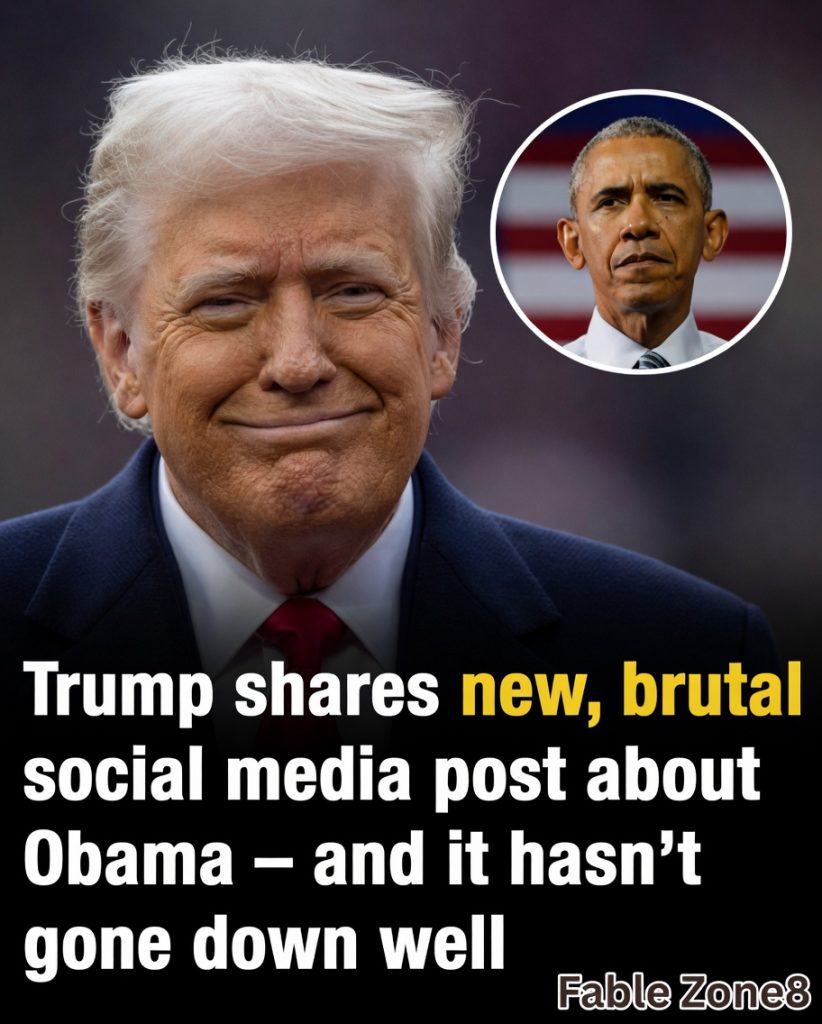
In today’s political environment, a single social media post can travel faster than traditional news cycles, generating debate, interpretation, and controversy within minutes. The boundaries between official communication, personal expression, and digital performance have become increasingly blurred. Political leaders now operate not only within institutions of governance but also within the fast-moving world of online platforms, where symbolism often carries as much weight as policy.
Recent attention surrounding Donald Trump’s reposted meme involving Barack Obama illustrates this shift clearly. While the content itself may appear simple at first glance—a stylized image paired with a provocative caption—the reaction it sparked reveals a much larger story about political communication in the digital age.
At the center of this moment is not just a meme, but the broader evolution of how political narratives are constructed, shared, and interpreted in real time.
The Rise of Political Social Media Culture
The transformation of political communication over the past decade has been dramatic. Platforms such as Truth Social, X (formerly Twitter), Facebook, and Instagram have become central arenas for political messaging.
Unlike traditional press releases or televised speeches, social media posts are:
- Immediate
- Unfiltered
- Emotionally charged
- Easily shareable
This creates an environment where messages are not only consumed but rapidly reshaped by audiences, commentators, and algorithms.
In this context, figures like Donald Trump have embraced direct-to-public communication strategies. Instead of relying on media intermediaries, messages are delivered instantly to followers, often bypassing traditional editorial scrutiny.
This shift has fundamentally changed how political narratives spread and evolve.
The Symbolism Behind Political Memes
Memes have become one of the most powerful tools in modern political communication. They condense complex ideas into simple visual formats that are easy to understand and emotionally impactful.
A political meme typically functions on multiple levels:
- As humor
- As criticism
- As identity signaling
- As ideological reinforcement
When a public figure shares a meme, it adds another layer of meaning. It is no longer just user-generated content—it becomes an extension of political messaging.
In the case of Trump and Obama, their long-standing symbolic opposition adds further weight. Each reference, whether direct or indirect, tends to revive past interpretations of their political relationship.
Historical Context of the Trump–Obama Dynamic
The relationship between Donald Trump and Barack Obama has been one of the most widely discussed political dynamics in recent U.S. history.
It is often framed less as a personal rivalry and more as a symbolic contrast between two different political eras and leadership styles.
Key moments that shaped public perception include:
- Obama’s 2011 remarks at the White House Correspondents’ Dinner, which were widely interpreted as mocking Trump’s political ambitions
- Trump’s emergence in national politics shortly after, including his promotion of the “birther” controversy
- The 2016 presidential election, where Trump ultimately succeeded in becoming president
- Ongoing references from both supporters and commentators linking their political narratives
Over time, these moments have become part of a broader cultural storyline, often revisited in media commentary, social discussions, and political analysis.
Whether or not any single moment directly influenced outcomes, the narrative itself has become politically significant.
The Role of Digital Amplification
One of the defining features of modern political communication is amplification.
A single post can be:
- Shared thousands of times within minutes
- Reinterpreted across multiple platforms
- Commented on by journalists, influencers, and analysts
- Repackaged into news segments
This creates a feedback loop where the original message becomes less important than its interpretation.
In many cases, audiences engage more with reactions to the content than with the content itself. This dynamic amplifies emotional responses and often intensifies political polarization.
AI Images and the Problem of Visual Manipulation
Another layer in today’s digital environment is the increasing use of AI-generated or digitally altered imagery.
These images can:
- Appear realistic but be entirely synthetic
- Reframe political figures in fictional scenarios
- Spread rapidly before verification occurs
- Influence emotional perception of events
When combined with political messaging, AI-generated content introduces ambiguity. It becomes harder for audiences to distinguish between satire, commentary, and misleading representation.
This raises important questions:
- Should political figures share manipulated imagery?
- Does context matter if audiences interpret it differently?
- How should platforms label synthetic content?
These questions remain unresolved, but they are becoming increasingly relevant as technology evolves.
The Power of Narrative Over Facts
Modern political discourse is increasingly shaped by narrative rather than isolated facts.
A narrative is not just what happened—it is how events are framed and remembered.
In the case of viral political posts, narratives often include:
- Personal vindication stories
- Long-running rivalries
- Symbolic victories or defeats
- Interpretations of past statements
This framing can overshadow factual accuracy. Even when specific claims are disputed or exaggerated, the narrative may still persist because it resonates emotionally with audiences.
Polarization and Emotional Engagement
One of the most significant consequences of social media-driven politics is increased polarization.
When political content is shared online, it tends to:
- Reinforce existing beliefs
- Trigger emotional responses
- Encourage group identity formation
- Reduce exposure to opposing viewpoints
Memes and viral posts are especially effective in this regard because they are designed for quick emotional impact rather than nuanced analysis.
As a result, audiences may become more divided, even when engaging with the same content.
The Blurring Line Between Politics and Entertainment
Another important development is the blending of political communication with entertainment culture.
Modern political messaging often includes:
- Humor
- Irony
- Visual storytelling
- Viral-friendly formats
This creates a hybrid space where political figures are also media personalities, and political events are consumed similarly to entertainment content.
Critics argue that this can reduce the seriousness of governance, while supporters suggest it makes politics more accessible and relatable.
The tension between these perspectives continues to shape debates about modern leadership.
Media Interpretation and Secondary Narratives
When a political post goes viral, it rarely remains in its original form. Instead, it is:
- Reported by news outlets
- Analyzed by commentators
- Debated on social platforms
- Contextualized within broader political trends
Each layer adds interpretation, which can shift the meaning of the original post.
Over time, secondary narratives may become more influential than the original content itself.
The Role of Public Perception
Public perception plays a crucial role in how political communication is received.
Two individuals can view the same post and interpret it differently based on:
- Political affiliation
- Media consumption habits
- Cultural background
- Prior beliefs
This subjectivity means that political messaging is rarely universally understood in the same way.
Instead, it becomes fragmented across different audience groups.
The Strategic Use of Digital Messaging
For political figures, social media offers strategic advantages:
- Direct communication without intermediaries
- Immediate response capability
- Control over messaging tone
- Ability to test public reaction in real time
However, it also carries risks:
- Misinterpretation
- Viral backlash
- Loss of context
- Permanent digital record of informal statements
These risks are amplified when content is provocative or symbolic in nature.
Broader Implications for Democracy
The evolution of political communication raises broader questions about democratic discourse.
Key concerns include:
- Whether emotional content crowds out policy discussion
- Whether misinformation spreads faster than corrections
- Whether audiences are becoming more fragmented
- Whether political trust is affected by constant online conflict
At the same time, there are potential benefits:
- Increased public engagement
- Greater accessibility to political messaging
- Faster dissemination of information
- Opportunities for diverse voices to participate
The overall impact remains complex and still unfolding.
Conclusion: A New Era of Political Communication
The viral attention surrounding Trump’s shared meme about Obama is not just about two political figures or a single piece of content. It reflects a broader transformation in how politics is communicated, consumed, and interpreted in the digital age.
Social media has changed the rhythm of political life. Messages are now immediate, visual, and highly shareable. Symbolism often travels further than substance, and narratives evolve faster than verification processes can keep up.
In this environment, political figures are no longer just policymakers—they are also content creators operating in a constantly active digital arena.
Whether this shift strengthens public engagement or deepens division remains an open question. What is clear, however, is that political communication will continue to evolve alongside technology, and moments like this will remain central to understanding how modern political narratives are formed and sustained.