In a world fascinated by self-discovery and personality insights, even the smallest physical details can spark curiosity about what makes us who we are. From handwriting analysis to facial features, people have long searched for clues hidden in the body that might reveal deeper truths about personality. One of the most intriguing modern theories centers on something surprisingly simple: the length of your fingers.
Specifically, researchers and enthusiasts alike have explored the relationship between the index finger (known as the second digit or 2D) and the ring finger (the fourth digit or 4D). This comparison, known as the 2D:4D ratio, has gained popularity both in scientific circles and across social media, where it is often presented as a quick way to “decode” personality traits.
At first glance, the idea seems almost too simple to be meaningful. Could something as basic as finger length really provide insight into behavior, preferences, or even life choices? While the answer is not entirely straightforward, the theory does have roots in scientific research—though it is often oversimplified or exaggerated in popular interpretations.
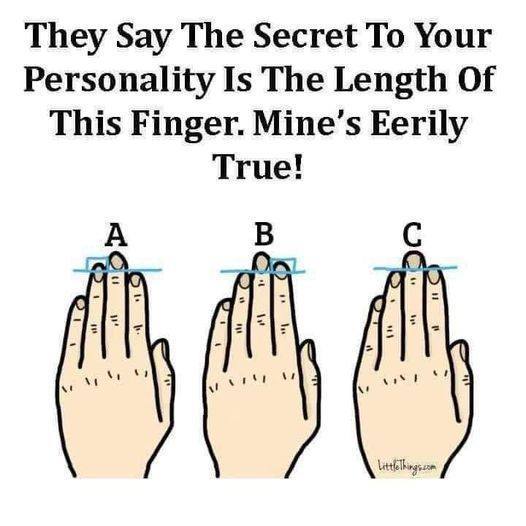
The 2D:4D ratio refers to the proportional difference in length between the index finger and the ring finger. To determine your ratio, you simply compare the two fingers: if your ring finger is longer, shorter, or roughly the same length as your index finger. This seemingly small detail has been linked to hormonal exposure during early development in the womb.
Scientists believe that this ratio may reflect the balance of two key hormones—testosterone and estrogen—during prenatal development. Higher exposure to testosterone is thought to result in a longer ring finger relative to the index finger, while higher exposure to estrogen may lead to a longer index finger. These hormonal influences occur before birth and are believed to play a role in shaping both physical traits and certain tendencies in behavior.
This connection between prenatal hormones and later-life characteristics is what makes the 2D:4D ratio so fascinating. Hormones like testosterone are known to influence traits such as aggression, competitiveness, and risk-taking, while estrogen is often associated with communication, empathy, and social bonding. If finger length reflects early hormonal exposure, it raises the possibility that it could also correlate with personality patterns.
However, it is important to emphasize that this is where the science becomes more complex—and less definitive. While some studies have found correlations between finger ratios and certain behaviors, the results are often inconsistent. Not all research agrees, and even when patterns are observed, they tend to be weak and influenced by many other factors.
Still, the theory has captured widespread interest, in part because it offers an accessible and visual way to think about personality differences. Let’s explore the commonly discussed interpretations associated with different finger ratios, keeping in mind that these are general trends rather than fixed rules.
One of the most frequently mentioned patterns is when the ring finger is longer than the index finger. This configuration is often associated with higher prenatal testosterone exposure. People with this ratio are commonly described as confident, assertive, and comfortable taking risks.
They may be drawn to competitive environments where performance and results are highly valued. Careers in business, sports, entrepreneurship, or entertainment are often cited as examples where such traits could be advantageous. These individuals may enjoy challenges, thrive under pressure, and feel motivated by opportunities to stand out.
Some studies have even suggested links between this finger ratio and higher performance in certain physical or strategic activities. For example, researchers have explored correlations with athletic ability or spatial reasoning. However, these findings are not universal and should be interpreted cautiously.
It is easy to see how such descriptions can be appealing, but they can also be misleading if taken too literally. Not everyone with a longer ring finger is naturally competitive or risk-oriented. Personality is shaped by a wide range of influences, and physical traits alone cannot determine behavior.
On the other hand, individuals whose index finger is longer than their ring finger are often associated with lower prenatal testosterone exposure. This group is typically described as more cautious, analytical, and thoughtful in their approach to decision-making.
They may prefer stability over risk and excel in environments that reward careful planning and attention to detail. Roles in leadership, education, research, or communication are often highlighted as areas where these traits can shine. These individuals may also be more inclined toward collaboration and long-term thinking.
Again, while these descriptions may resonate with some people, they are not universal truths. Human behavior is far too complex to be reduced to a single biological factor. Cultural background, upbringing, personal experiences, and individual choices all play significant roles in shaping personality.
A third category includes those whose index and ring fingers are roughly the same length. This balanced ratio is often interpreted as reflecting a more even hormonal influence during development. People in this group are commonly described as adaptable, empathetic, and socially skilled.
They may find it easier to connect with others and work effectively in team settings. Communication, cooperation, and emotional intelligence are often highlighted as strengths. Such individuals may thrive in roles that require understanding different perspectives and building relationships.
While these interpretations are widely shared, it is essential to approach them with a healthy level of skepticism. The human brain and personality are influenced by countless variables, many of which cannot be measured through physical traits alone.
Scientific research into the 2D:4D ratio has explored a wide range of potential connections, from behavior and cognition to health and disease. Some studies have examined links to conditions such as anxiety, depression, or even certain medical risks. Others have investigated associations with career preferences, academic performance, or social behavior.
However, one consistent theme emerges from the research: correlations, when they exist, are typically small and not predictive on an individual level. This means that while trends may appear in large groups, they cannot reliably determine the personality or future of a single person.
Another important consideration is the role of environmental factors. From childhood experiences to education, relationships, and cultural influences, the environment plays a powerful role in shaping who we become. Even if prenatal hormones have some influence, they are only one piece of a much larger puzzle.
The popularity of the 2D:4D ratio in popular culture highlights a broader human tendency to seek simple explanations for complex phenomena. It is comforting to believe that personality can be decoded quickly and easily, but reality is rarely so straightforward.
That said, there is nothing wrong with exploring such ideas in a lighthearted and curious way. Looking at your finger lengths and considering what they might suggest can be a fun exercise, as long as it is not taken too seriously or used to make rigid judgments about yourself or others.
In fact, one of the most valuable aspects of theories like the 2D:4D ratio is that they encourage reflection. They invite people to think about their own traits, preferences, and behaviors, and to consider how different factors might have shaped them.
Ultimately, self-awareness is not about finding a single answer but about exploring multiple perspectives. Whether through science, psychology, or personal experience, the journey of understanding oneself is ongoing and deeply individual.
It is also worth noting that relying too heavily on physical traits to define personality can lead to stereotypes or misunderstandings. Just as appearance does not determine intelligence or character, finger length cannot define someone’s identity or potential.
In a world where individuality is increasingly valued, it is important to embrace the complexity of human nature. Each person is a unique combination of biology, experience, and choice. While patterns and tendencies can offer insights, they should never limit our understanding of what is possible.
In conclusion, the idea that your finger length reveals your personality is both fascinating and thought-provoking. The 2D:4D ratio provides an interesting glimpse into how prenatal development might influence certain tendencies, but it is far from a definitive measure of who you are.
Rather than viewing it as a strict rule, it is better to see it as a small piece of a much larger picture. Your personality is shaped by countless factors, many of which are within your control. Your actions, decisions, and experiences play a far greater role in defining your life than the length of your fingers.
So the next time you look at your hands, you can appreciate them not just as tools, but as reminders of the intricate and fascinating ways in which biology and life intersect. And while they may hint at certain possibilities, the story of who you are is ultimately yours to write.