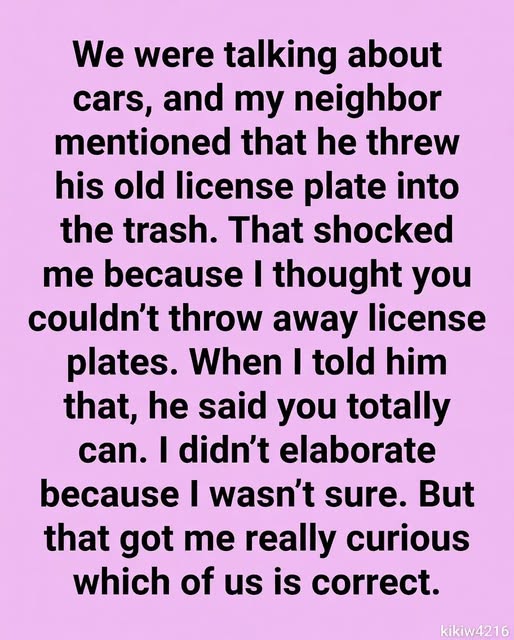
It started with a casual comment that refused to stay casual.
One evening, while chatting with my neighbor in his driveway, the conversation drifted—as it often does—toward cars, repairs, and the endless quirks of ownership. Somewhere between complaints about fuel prices and a story about a stubborn transmission, he casually mentioned tossing his old license plate straight into the trash.
Just like that.
No hesitation. No second thought.
I remember pausing, unsure whether I had heard him correctly. To me, a license plate wasn’t just scrap metal. It felt official—almost like a document. Something tied to identity, registration, and the invisible system that keeps track of who owns what on the road.
“Is that even legal?” I asked.
He shrugged.
“Of course it is. It’s just a piece of metal.”
But the more I thought about it later that night, the less convinced I felt. Something about that answer didn’t sit right. It felt too simple for something connected to government records and vehicle ownership.
So I did what curiosity demanded.
I started digging.
The First Discovery: There’s No One-Size-Fits-All Answer
The first thing I learned surprised me immediately: there is no universal rule.
Unlike many aspects of driving—like speed limits or insurance requirements—license plate disposal is not standardized across the country. Each state sets its own rules, and those rules vary more than most people expect.
In some places, yes—throwing away a plate might not cause any immediate issue.
In others, it could technically violate regulations.
And in a few, it could even create problems down the line if that plate is somehow reused, reported, or linked back to you.
That realization alone changed everything.
This wasn’t a simple yes-or-no question.
It was a patchwork of policies, expectations, and gray areas.
Why License Plates Matter More Than You Think
At first glance, a license plate seems trivial.
It’s just a stamped piece of metal with numbers and letters.
But in reality, it’s tied to a much larger system.
A plate connects to:
- Vehicle registration records
- Ownership history
- Insurance data
- Law enforcement databases
In many ways, it acts like an external ID for your vehicle.
That’s why improper disposal can sometimes create unexpected complications.
For example:
- A discarded plate could be picked up and misused
- It might be attached to another vehicle illegally
- It could appear in traffic violations or criminal activity
While these situations are rare, they’re not unheard of.
And that’s exactly why some states take plate disposal seriously.
The Three Most Common Legal Approaches
After researching dozens of state guidelines and speaking with officials and drivers, I found that most rules fall into three main categories.
1. Return to the DMV (Strict States)
Some states require you to return your plates to the Department of Motor Vehicles when they are no longer in use.
This is especially common when:
- You cancel registration
- You move out of state
- You no longer insure the vehicle
In these cases, the plate must be officially surrendered.
Why?
Because it closes the loop in the system. It confirms that the plate is no longer active and prevents future confusion or misuse.
Failing to return it in these states can sometimes lead to:
- Fines
- Registration issues
- Delays in future transactions
2. Destroy Before Disposal (Moderate Rules)
Other states allow you to dispose of plates—but only after making them unusable.
This usually involves:
- Bending the plate
- Cutting it into pieces
- Drilling holes through key areas
The goal is simple: ensure the plate can’t be reused.
Once destroyed, it can often be:
- Recycled as scrap metal
- Disposed of in regular waste
This approach balances convenience with security.
3. No Specific Requirement (Relaxed States)
In some areas, there are no strict rules at all.
Once a plate is no longer registered, it’s effectively just metal.
People in these states often:
- Throw plates away
- Keep them as souvenirs
- Repurpose them as decorations
This is likely where my neighbor got his confidence.
And to be fair—he’s not entirely wrong depending on where he lives.
The Hidden Risk: Identity and Misuse
One of the most eye-opening parts of my research came from conversations with people in law enforcement and vehicle administration.
They explained something I hadn’t fully considered.
License plates can be misused.
If someone retrieves a plate from the trash, they might:
- Attach it to a similar vehicle
- Avoid detection for tolls or tickets
- Create confusion in tracking systems
Even if the plate is technically inactive, it can still cause headaches.
In some cases, the original owner might need to prove:
- They no longer had the plate
- They weren’t responsible for certain violations
It doesn’t happen often—but when it does, it’s frustrating.
And preventable.
Environmental Impact: The Overlooked Angle
Another surprising layer to this story is environmental.
License plates are typically made of aluminum, which is highly recyclable.
Throwing them in regular trash means:
- Wasted material
- Unnecessary landfill use
Many recycling centers accept old plates—but often recommend:
- Removing identifying features
- Ensuring they’re no longer valid
Some states even encourage recycling as the preferred option.
It’s a small step, but multiplied across millions of vehicles, it matters.
What People Actually Do (Real-World Behavior)
Despite the rules, real-world behavior varies widely.
Through conversations and online forums, I found examples like:
- A driver who mailed plates back in an envelope with a formal letter
- Someone who drilled holes and turned theirs into garage décor
- A person who unknowingly tossed plates and later had to explain a toll violation
- Others who kept them as souvenirs from road trips or old cars
The gap between official rules and everyday habits is real.
And it explains why confusion is so common.
So… Was My Neighbor Right?
After weeks of research, I returned to the original question.
Was my neighbor wrong to throw his plate in the trash?
The honest answer:
Maybe.
It depends entirely on:
- His state’s rules
- Whether the plate was still registered
- Whether proper steps were required beforehand
In some places, he likely got away with it because enforcement is minimal.
In others, the same action could have caused issues.
That’s what makes this topic so tricky.
The Smartest Approach (No Matter Where You Live)
If there’s one clear takeaway from all of this, it’s this:
Don’t assume.
Instead, take a few minutes to check your local requirements.
In most cases, the safest options are:
- Return the plate to the appropriate authority
- Or destroy it before disposal
- Or recycle it properly
These steps take very little effort—but eliminate potential risks entirely.
A Small Lesson in a Bigger System
What fascinated me most about this journey wasn’t just the answer.
It was what the question revealed.
A simple object—a license plate—turned out to be part of a much larger system involving:
- Regulation
- Accountability
- Public safety
- Environmental responsibility
It reminded me how many everyday actions are quietly connected to systems we rarely think about.
And how easy it is to overlook them.
Back to the Driveway
When I finally shared everything with my neighbor, he laughed.
“Okay,” he admitted, “maybe I should’ve checked first.”
But he also made a fair point.
“If it’s this confusing,” he said, “no wonder people just throw them away.”
He wasn’t wrong.
The rules aren’t always clear.
And that’s part of the problem.
Final Thought
In the end, this wasn’t about proving who was right.
It was about understanding something most people never question.
So if you ever find yourself holding an old license plate, wondering what to do with it, remember this:
It might look like scrap metal.
But it carries more meaning—and responsibility—than it seems.
And sometimes, taking a moment to check the rules can save you from a problem you never saw coming.