In the early months of 1981, the world became captivated by what seemed like the beginning of a modern royal fairytale. At the center of it all stood Princess Diana—young, graceful, and seemingly stepping into a life of romance that millions could only imagine. Her engagement to Prince Charles was met with fascination and hope, a union that appeared to promise both continuity and renewal for the British monarchy. Newspapers celebrated her innocence, her charm, and her natural warmth, painting a picture of a love story destined for greatness.
Yet even as the public embraced this narrative, the reality unfolding behind palace walls was far more complex—and far more fragile.
Diana was just nineteen years old when she became engaged, thrust almost overnight into a world governed by tradition, expectation, and constant scrutiny. Every gesture she made, every expression she wore, became subject to interpretation. What might have been ordinary moments in another life were magnified into symbols, analyzed and discussed by millions who believed they were witnessing a perfect romance.
But perfection, as it often does, existed more in appearance than in truth.
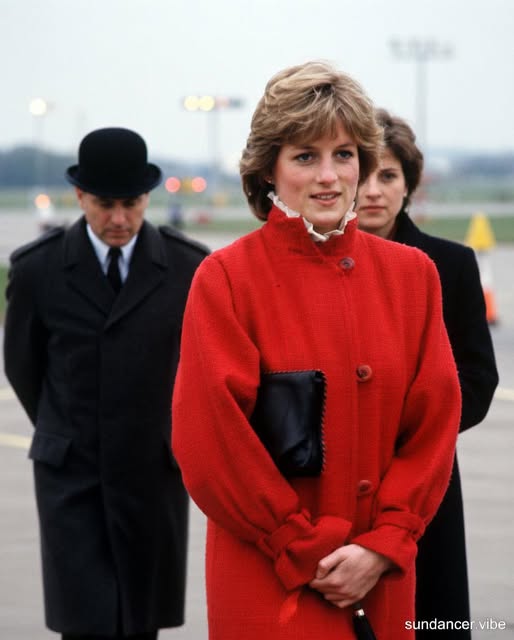
One of the most memorable early images from that period was captured in March 1981, at an airport where Diana stood saying goodbye to Charles as he prepared to leave for a five-week royal tour. She wore a striking red coat, her face marked by visible emotion as cameras clicked relentlessly around her. To the public, it was a moment of pure relatability—a young woman deeply in love, struggling with the temporary separation from the man she was about to marry.
Charles, in contrast, appeared composed, offering a brief, formal farewell before departing. The contrast between them only seemed to deepen the narrative: she was the emotionally open, devoted partner; he, the reserved and duty-bound royal. Together, they fit into a story the world was eager to believe.
But what the cameras captured was only the surface.
Years later, through recordings revealed in the documentary Diana: In Her Own Words, a different truth emerged—one that would fundamentally reshape how that moment was understood. Diana herself explained that her tears that day were not simply about missing Charles. They were not the result of overwhelming love or romantic longing.
They were born from something far more painful.
Shortly before Charles’s departure, Diana found herself confronted with a reality she had sensed but not fully accepted: his ongoing emotional connection with Camilla Parker Bowles.
According to her own account, the realization came quietly, almost casually. A phone call came through—from Camilla. It was not the existence of the call alone that affected Diana, but the tone, the familiarity, the unspoken intimacy that lingered in the exchange. It was enough to confirm what she had begun to fear: that her relationship with Charles was not as singular as she had believed.
In that moment, she faced a choice—stay and listen, or step away.
She chose politeness. She left the room.
But that decision did not shield her from the emotional impact. If anything, it intensified it. What she had sensed became something undeniable, something she could no longer dismiss as imagination or insecurity. It was no longer a vague concern—it was a reality.
And it hurt.
By the time she stood at the airport later that day, surrounded by cameras and public attention, that quiet realization had already taken root. The tears the world saw were not just about a temporary goodbye. They carried the weight of confusion, heartbreak, and a dawning awareness that the life she was stepping into was far more complicated than she had been led to believe.
The symbolism of that moment becomes even more striking in hindsight. At the time, it reinforced the fairytale narrative. Today, it represents something else entirely—a turning point, a moment of clarity hidden in plain sight.
The days that followed did little to ease Diana’s concerns.
During Charles’s absence, she came across something that would deepen her sense of unease: a bracelet intended for Camilla. It was not simply a gift—it was a gesture that suggested thoughtfulness, planning, and emotional investment. For Diana, it was a tangible confirmation that the connection she had sensed was real and ongoing.
Her reaction, as she later described, was intense.
There was anger—sharp and immediate. But beneath it lay something deeper: a sense of betrayal, not just in action, but in omission. She questioned why she had not been told the full truth, why she had been allowed to step into an engagement without understanding the emotional landscape she was entering.
For a young woman navigating her first serious relationship—under the scrutiny of the entire world—this realization was overwhelming.
And yet, there was no easy way out.
The momentum of the engagement, the expectations of the monarchy, and the weight of public anticipation created a situation where stepping back felt almost impossible. Diana found herself moving forward, even as her instincts urged caution.
That tension—between what she felt and what she was expected to do—would become a defining feature of her experience.
One particularly revealing moment came during a lunch meeting between Diana and Camilla. On the surface, it appeared to be a cordial interaction, a polite engagement between two women connected through circumstance. But beneath that surface, there was an undercurrent of meaning that Diana could not ignore.
Camilla’s remarks, subtle as they were, seemed to carry implications—suggestions of familiarity, of established presence. It was not confrontation, but it was not neutral either. It reinforced the idea that Camilla occupied a space in Charles’s life that predated Diana and had not fully disappeared.
For Diana, this was not just uncomfortable—it was destabilizing.
It challenged her understanding of her role, of her relationship, and of the future she had envisioned. The fairytale image, so carefully constructed and widely believed, began to fracture under the weight of these realizations.
What makes this period so significant is not just what happened, but how early it happened.
Long before the wedding at St Paul’s Cathedral, long before the global celebration that would captivate millions, Diana was already grappling with doubts. The iconic ceremony—watched by an estimated 750 million people worldwide—was framed as the culmination of a love story.
But for Diana, it was also the continuation of a question she had not been able to answer.
Could a relationship built on uncertainty become something secure?
In later years, Diana would reflect on this time with a clarity that only distance can provide. Her now-famous words—“there were three of us in this marriage”—would come to define public understanding of her relationship with Charles. But that awareness did not suddenly appear years into the marriage.
It was there from the beginning.
It was present in that quiet moment before the airport goodbye.
It was present in the discovery of the bracelet.
It was present in the subtle exchanges that revealed more than words ever could.
Looking back, the airport scene stands as one of the most powerful examples of how public perception can differ from private reality. The world saw a young woman in love, overcome with emotion at a temporary separation. What they did not see was the emotional complexity beneath that moment—the realization that the relationship she was entering was not as simple as it appeared.
This contrast between image and experience became a central theme in Diana’s life.
She was, in many ways, a figure defined by duality. Publicly, she was confident, radiant, and deeply admired. Privately, she navigated uncertainty, emotional strain, and a constant search for authenticity within a system that often prioritized appearance over truth.
And yet, despite these challenges, Diana’s story is not solely one of heartbreak.
It is also a story of awareness.
That night before the airport goodbye marked a shift—not just in how she saw Charles, but in how she understood her own instincts. The feeling that something was not right, the subtle awareness that had been easy to ignore at first, became something she could no longer dismiss.
In that sense, the moment carries a broader meaning.
It speaks to the idea that intuition often precedes clarity.
That we sometimes sense the truth of a situation before we can articulate it.
And that those quiet signals, however uncomfortable, are often worth listening to.
Diana’s experience resonates not because it is unique to royalty, but because it reflects something deeply human. The tension between expectation and reality, the challenge of trusting one’s instincts, the difficulty of navigating relationships that are not as they seem—these are experiences that extend far beyond the walls of any palace.
What makes her story particularly powerful is the way it unfolded in public view, even when its most important moments remained unseen.
Today, the image of Diana at that airport carries a different weight. It is no longer just a symbol of romantic devotion. It is a reminder of the complexity behind appearances, of the emotions that can exist beneath even the most carefully constructed narratives.
It reminds us that what we see is not always the full story.
And that sometimes, the most significant moments are the ones that happen quietly—away from cameras, away from attention, but deeply felt nonetheless.
In the end, that goodbye was more than just a farewell.
It was a moment of realization.
A point at which illusion gave way to awareness.
And a quiet beginning to a story that the world would come to understand only much later—not as a fairytale, but as something far more real.