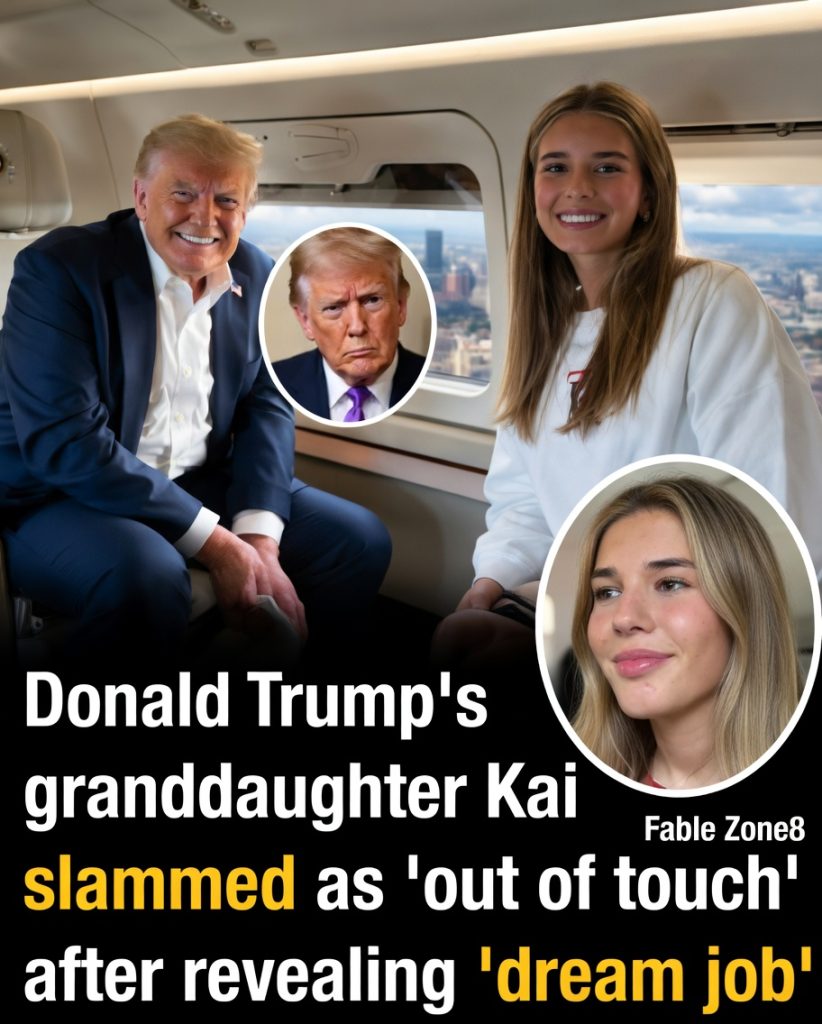
When Kai Trump spoke openly about her “dream job,” it seemed like a fairly typical moment—one young person sharing ambitions about the future. But because of who she is, that simple statement didn’t stay simple for long.
As the granddaughter of Donald Trump, her words quickly spread across social media, where they were analyzed, criticized, defended, and debated. What might have been a casual interview comment for someone else turned into a broader conversation about privilege, expectations, and what it means to dream publicly when your last name already carries weight.
A Dream That Sparked Debate
In her remarks, Kai described wanting a career that blends business, media, and influence—something creative, impactful, and engaging. It wasn’t a rigid job title so much as a direction: a role where she could make decisions, connect with people, and build something meaningful.
On its own, that kind of aspiration isn’t unusual. Many young people today are drawn to flexible, high-impact careers that combine multiple interests.
But the reaction wasn’t focused on the dream itself.
It was focused on who was dreaming it.
The Backlash: “Out of Touch”
Critics online were quick to push back.
Some argued that her vision of a “dream job” felt disconnected from the realities many young people face—student debt, job insecurity, rising living costs, and limited access to opportunity. To them, her words sounded less like ambition and more like something already within reach due to family influence.
Comments framed her perspective as “out of touch,” reflecting a broader frustration with economic inequality and the perception that some paths are easier for those born into wealth and visibility.
In this view, the issue wasn’t that she had dreams—it was that her starting point looked very different from that of most people.
The Defense: Let Her Be Young
At the same time, many came to her defense.
Supporters pointed out that Kai is still young, still figuring things out, and should be allowed to explore her ambitions without being harshly judged. They argued that having access to opportunities doesn’t invalidate personal goals or effort.
Some emphasized a simple point: everyone, regardless of background, deserves the space to imagine their future.
Others also noted the pressure that comes with being part of a high-profile family. Growing up in the public eye means even ordinary milestones—like talking about career goals—can become amplified and scrutinized.
The Bigger Conversation: Privilege vs. Aspiration
What made this moment resonate wasn’t just Kai’s comment—it was what people projected onto it.
The reaction tapped into ongoing cultural conversations about:
- Economic inequality
- Access to elite networks
- The role of family legacy in success
- The difference between opportunity and effort
For some, her statement highlighted how differently life can look depending on where you start. For others, it raised the question of whether privilege should limit how openly someone can talk about ambition.
Is it fair to criticize someone for having advantages they didn’t choose?
Or is it reasonable to question how those advantages shape their perspective?
There’s no simple answer—and that’s why the conversation continues.
The Reality of Growing Up Visible
For members of well-known families, there’s often a double standard at play.
On one hand, they benefit from visibility, connections, and access.
On the other, they face constant scrutiny, where even neutral statements can be interpreted through political, social, or economic lenses.
Kai’s situation reflects that tension.
Her ambitions are being evaluated not just on their own terms, but in the context of her family’s influence in business and politics. That makes it harder to separate her identity from the legacy she was born into.
Identity Beyond a Last Name
One of the most challenging aspects for young people in high-profile families is building an identity that feels independent.
Every choice—career, education, public statements—can be seen as either an extension of the family legacy or a reaction against it.
Kai appears to be navigating that space by expressing her goals in personal terms, focusing on what interests her rather than what is expected of her.
Whether people accept that distinction often depends less on her words and more on their own views about privilege and power.
A Reflection of the Times
The intensity of the reaction also says something about the current moment.
Social media has created an environment where:
- Personal statements become public debates
- Individual stories become symbols of larger issues
- Nuance is often replaced by quick judgments
Kai’s “dream job” became more than a personal aspiration—it became a lens through which people discussed fairness, opportunity, and generational challenges.
What Happens Next
For now, Kai has remained composed, continuing to express her goals without escalating the controversy. That approach suggests an awareness of the environment she’s navigating—one where every word can be amplified.
How she continues to shape her path will likely influence how people see her—not just as a member of a famous family, but as an individual.
Final Thought
At its core, this story isn’t just about one young woman’s career aspirations.
It’s about how society reacts to ambition when it comes from a place of privilege.
It’s about the tension between opportunity and perception.
And it’s about the challenge of being seen clearly when the world is already looking at you through a lens shaped by history, wealth, and expectation.
In the end, Kai Trump’s “dream job” didn’t just start a conversation about her future.
It revealed how complicated the idea of dreaming has become—especially when the world is watching.