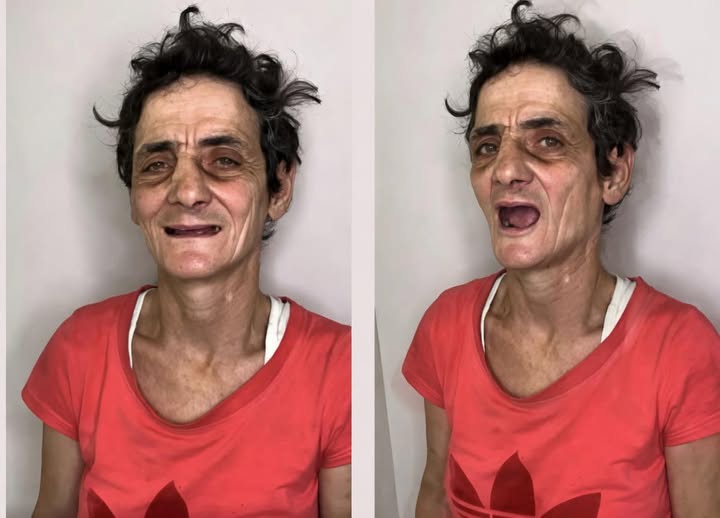
Rita’s life was not always defined by the streets, though that is where most people came to know her—if they noticed her at all. For years, she existed on the edges of a world that moved too quickly to care, navigating crowded sidewalks with quiet determination and a plastic bag filled with bottles others had thrown away. To strangers, she was just another figure blending into the background, someone whose presence required no acknowledgment. But behind her tired eyes lived a story shaped by loss, endurance, and a longing that never fully disappeared, no matter how deeply it was buried.
Each day followed a similar rhythm. Rita would wake early, often before the city had fully stirred, and begin her routine of collecting discarded items. It was not just about survival—though survival was always at the center—it was also about maintaining some sense of purpose. Every bottle she picked up, every coin she earned, represented a small victory in a life where victories had become rare. Yet even as she moved forward, step by step, there was a quiet heaviness she carried with her, a sense that life had once held more than this.
That feeling was not imagined. There had been a time when Rita’s life looked very different. She had dreams, responsibilities, and a place where she belonged. But those pieces did not disappear overnight. Instead, they unraveled slowly, pulled apart by circumstances she could not control. The turning point came with a loss so profound that it reshaped everything she knew about herself and the world around her.
The death of her only son was not just a tragedy—it was a rupture. It tore through the structure of her life, leaving behind a void that nothing seemed capable of filling. Grief consumed her in ways she had never anticipated. It was not only sadness; it was disorientation, isolation, and a deep sense of disconnection from everything that had once grounded her. Without a strong support system to guide her through that pain, she found herself drifting further away from stability.
In the months and years that followed, the effects of that loss became increasingly visible. Relationships faded as she withdrew into herself, unable to find the words or the energy to maintain them. Opportunities slipped away, not because she lacked ability, but because grief had clouded her focus and diminished her confidence. Slowly, almost imperceptibly at first, her life shifted from one of possibility to one of survival.
The streets did not welcome her—they simply became the place where she ended up. And once she was there, leaving proved far more difficult than anyone might imagine. Without consistent income, stable housing, or a network of support, each attempt to rebuild felt like trying to climb a hill that never stopped rising. Employers saw only her worn appearance, not the capable person beneath it. Strangers avoided eye contact, reinforcing a painful message: she was no longer someone worth noticing.
Over time, Rita adapted. She learned how to navigate a world that often overlooked her, developing routines that allowed her to get by. But adaptation came at a cost. The longer she remained in that environment, the harder it became to remember who she had been before. Hope, once a natural part of her life, began to feel distant—something she could no longer afford to hold onto.
And yet, even in that diminished state, something within her endured.
It was not always visible, even to herself, but it was there—a quiet resilience that refused to disappear completely. It showed itself in small ways: in the consistency of her daily efforts, in the care she still took with the few belongings she had, and in the moments when she allowed herself to imagine, however briefly, that life could be different.
That possibility might have remained hidden indefinitely if not for a single, unexpected encounter.
It happened on an ordinary day, one that began like so many others. Rita was moving through the streets, focused on her routine, when she crossed paths with someone who saw her differently. Instead of looking past her, this person paused. Instead of assuming, they observed. And in that moment, something shifted—not in the world at large, but in the way Rita was being seen.
What followed was not immediate or dramatic. There was no sudden transformation, no instant change that erased years of hardship. Instead, there was a conversation. A simple exchange that carried a depth of attention Rita had not experienced in a long time. She was asked questions—not out of curiosity, but out of genuine interest. And for the first time in years, she answered without feeling invisible.
That interaction led to something more: an offer of help.
At first, Rita was hesitant. Life had taught her to be cautious, to expect disappointment rather than support. But there was something different about this situation—something grounded in respect rather than pity. The help being offered was not about fixing her; it was about supporting her.
The transformation began in a place many would not expect: care.
Before any visible changes were made, her immediate needs were addressed. A visit to the dentist restored her smile, but more importantly, it restored a part of her confidence that had been missing for years. For someone who had spent so long feeling overlooked, this act of care carried profound meaning. It was a signal that she mattered, that she was worthy of attention and effort.
From there, the process continued with intention and patience. Each step was approached thoughtfully, focusing not just on appearance but on comfort and dignity. A simple manicure became more than a cosmetic change—it became a reminder of self-care. A new hairstyle was not about following trends; it was about framing her face in a way that reflected her individuality.
These changes, while visible, were not the most significant part of her transformation.
The real shift occurred within.
As the days passed, Rita began to see herself differently. It started subtly, in the way she held her posture, in the way she responded to conversation. The heaviness that had once defined her presence began to lift, replaced by a quiet sense of awareness. She was no longer just surviving; she was beginning to reconnect with herself.
Seeing her reflection became a powerful moment. For years, mirrors had not been a source of recognition—they had been reminders of loss. But now, as she looked at herself, she saw something unexpected: possibility.
The emotion that followed was overwhelming. Tears came, not from sadness, but from the realization that she had not been lost entirely. Beneath the layers of hardship, the person she had once been was still there.
This emotional awakening marked a turning point.
Confidence, though fragile at first, began to grow. With it came the courage to consider new opportunities. The idea of rebuilding no longer felt impossible—it felt challenging, yes, but achievable. For the first time in a long time, the future was not something to fear.
Rita’s story is not one of instant success or complete resolution. The challenges she faces do not disappear overnight, nor does her past lose its significance. But what has changed is her relationship to those challenges. She no longer sees herself as defined by them.
Instead, she sees herself as someone capable of moving forward.
Her journey highlights an important truth about human experience: that circumstances, no matter how difficult, do not determine a person’s worth. Homelessness is often misunderstood, reduced to simple explanations that fail to capture its complexity. Rita’s life reflects a reality that is shaped by loss, resilience, and the absence of support systems that many take for granted.
What makes her story powerful is not just the transformation itself, but the way it began.
It started with recognition.
With one person choosing to see her, not as a problem to be solved, but as a person with a story worth understanding. That choice created a ripple effect, setting in motion a series of changes that extended far beyond the surface.
Compassion, in this context, was not a fleeting emotion—it was an action. It required time, attention, and a willingness to engage. And in doing so, it demonstrated the profound impact that even a single act of kindness can have.
As Rita continues her journey, she carries with her more than the results of her transformation. She carries a renewed sense of identity, a belief in her own value, and a reminder that change is possible, even after years of hardship.
Her story serves as an invitation to look more closely at the world around us.
To notice the people who are often overlooked.
To recognize that behind every face is a story, and behind every story is a person who deserves dignity and respect.
In a society that often moves too quickly to pause, Rita’s transformation reminds us of something essential: that human connection has the power to restore what has been lost, to rebuild what has been broken, and to illuminate paths that once seemed unreachable.
She is no longer invisible.
And perhaps more importantly, she no longer sees herself that way either.