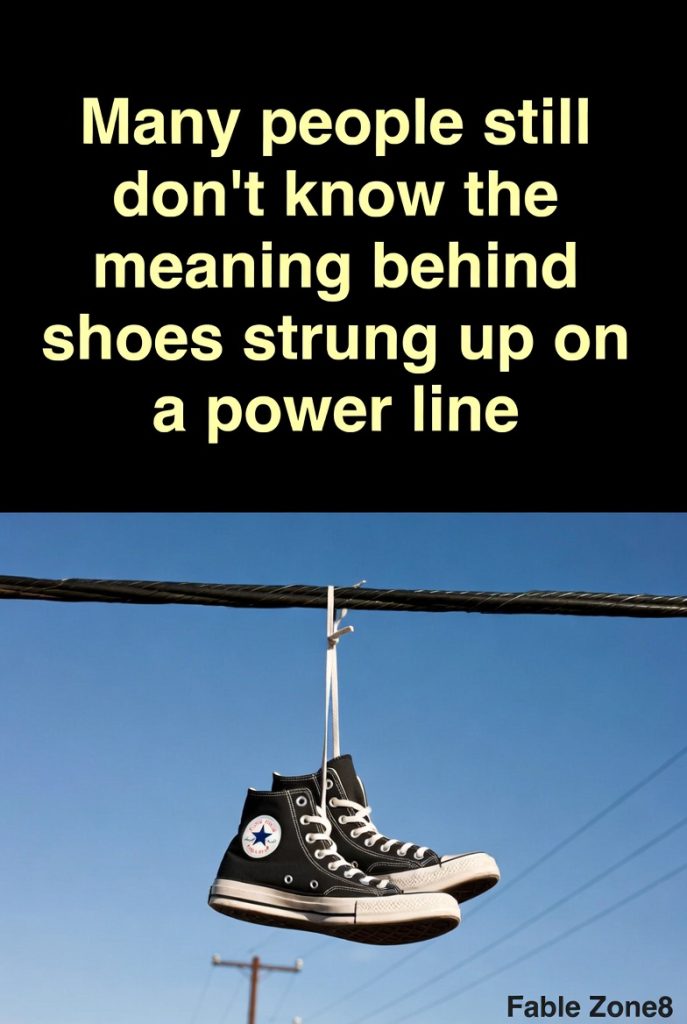
At some point, nearly everyone has looked up while walking down a street or driving through a neighborhood and noticed a pair of shoes dangling from a power line. Suspended high above the ground, tied together by their laces and tossed over electrical wires, these abandoned sneakers often appear out of place—almost like a deliberate interruption in an otherwise ordinary scene. For many, the sight sparks curiosity or even unease. Why are they there? Who put them there? And what do they mean? While it may seem like a random or meaningless act, the truth is far more layered. Shoes hanging from power lines, often referred to as “shoefiti,” carry a wide range of meanings that vary depending on geography, culture, and context. What began as a simple act of play or personal expression has evolved over decades into a phenomenon rich with symbolism, rumor, and interpretation. From celebratory rituals to coded messages, from urban myths to artistic statements, these dangling shoes tell stories—some real, some imagined—that continue to intrigue people around the world.
The origins of this peculiar practice can be traced back to the mid-20th century, particularly in urban areas where tight-knit communities created their own forms of expression and tradition. One of the earliest and most widely accepted explanations is that throwing shoes onto power lines was a way to mark a milestone. Young people would toss their worn-out sneakers after graduating from school, finishing a sports season, or reaching another important life transition. In this sense, the act symbolized letting go of the past and stepping into a new phase of life. In some communities, it became a shared ritual—something done collectively, turning individual moments into visible, public markers of change. Soldiers, too, were sometimes said to participate in similar acts, discarding their boots after completing training or returning home from service. Over time, the practice gained popularity among children and teenagers, who turned it into a kind of game or challenge. The goal was simple: throw your shoes as high as possible and get them stuck on the wire. Success meant recognition, bragging rights, and a lasting mark on the neighborhood skyline. What began as a playful activity gradually took on deeper meaning as it spread across different regions and social groups.
As the phenomenon became more widespread, it began to acquire more complex and sometimes controversial interpretations. In certain areas, particularly in large cities, shoes hanging from power lines have been associated with territorial markers used by gangs. According to this interpretation, the presence of shoes could signal that a particular street or block is controlled by a specific group. The type of shoes, their color, or even the number of pairs might carry coded meanings understood only by those within that community. Similarly, there have been claims that the shoes indicate locations where illegal activities, such as drug sales, take place. While these ideas are frequently discussed in media and by local residents, law enforcement agencies have often stated that there is little consistent evidence to support a universal code. In reality, the meaning—if any—tends to vary from place to place. Nevertheless, the association with crime and danger has contributed to the mysterious and sometimes ominous reputation of shoefiti. In other contexts, particularly in rural or less densely populated areas, the act has been used in more practical ways. Hunters, fishermen, or locals might use the visual marker to indicate a meeting point, a hidden trail, or a location known only to a select few. This quiet, low-tech method of communication demonstrates how something as simple as a pair of shoes can serve as a tool for conveying information without words.
Alongside these real-world uses, a rich collection of urban legends has emerged to explain the presence of shoes on power lines. These stories often lean toward the dramatic or unsettling, adding an element of intrigue that captures the imagination. One common myth suggests that the shoes mark the site of a tragic event, such as a murder or fatal accident. According to this version, the shoes belong to a victim and were placed there as a memorial or warning. Another variation claims that they honor someone who has passed away, symbolizing their final journey or the steps they will never take again. More fantastical interpretations link the practice to secret societies, initiation rituals, or even supernatural beliefs. Some stories suggest that the shoes act as a kind of spiritual marker, warding off evil or signaling the presence of unseen forces. While there is little to no factual evidence supporting these claims, they persist because they offer compelling narratives that transform an ordinary object into something meaningful. Humans have a natural tendency to seek patterns and explanations, especially when faced with something unusual. The sight of shoes hanging in the sky, defying both gravity and expectation, invites speculation. Over time, these stories become part of local folklore, passed down through generations and adapted to fit new contexts. Even in the digital age, where information is readily available, these myths continue to circulate, fueled by social media and online discussions.
Beyond folklore and speculation, shoes on power lines have also found a place in art and popular culture. Filmmakers often use the imagery to establish a sense of place, particularly in stories set in urban environments. A quick shot of dangling sneakers can instantly convey a neighborhood’s character, hinting at themes of struggle, resilience, or community. In music, references to shoefiti appear in lyrics that reflect on street life, memory, and identity. The image resonates because it is both familiar and symbolic, representing a blend of personal history and shared experience. Photographers are drawn to the visual contrast created by the shoes—soft, worn fabric suspended against hard, industrial lines and open sky. The result is often striking, turning a simple object into a powerful composition. Street artists and contemporary creators have embraced the motif as well, incorporating it into installations and visual projects that explore themes such as consumer culture, waste, and the passage of time. The shoes themselves, often old and discarded, take on new meaning when placed in such an unexpected context. They become more than just footwear; they become artifacts, reminders of the people who once wore them and the stories they carry. This artistic reinterpretation has helped keep the tradition alive, even as its original meanings evolve or fade.
In recent years, the practice has continued, but its significance has shifted in response to modern influences and concerns. With the rise of social media, what was once a local or community-based activity has become a global phenomenon. People now share images of shoes on power lines from cities around the world, often accompanied by captions that offer personal interpretations or humorous explanations. In some cases, individuals deliberately create shoefiti as part of online challenges or trends, adding a new layer of intention to the act. At the same time, practical concerns have led to increased efforts to remove hanging shoes. Utility companies warn that the presence of foreign objects on power lines can interfere with equipment, cause outages, or even pose fire hazards if metal components are involved. Local governments in some areas have launched campaigns to discourage the practice, citing both safety and aesthetic reasons. Environmental considerations also come into play, as discarded shoes contribute to visual clutter and waste. Despite these efforts, the tradition persists, adapting to new contexts and meanings. In some communities, shoes on power lines have been used as forms of protest or remembrance, symbolizing broader social issues and giving voice to collective experiences. This ability to evolve ensures that the phenomenon remains relevant, even as the world around it changes.
Ultimately, the enduring appeal of shoes hanging from power lines lies in their ambiguity. They do not come with a clear explanation or a single, universally accepted meaning. Instead, they exist as open-ended symbols, inviting interpretation and curiosity. For some, they represent milestones and memories; for others, they hint at hidden messages or untold stories. They can be playful or serious, artistic or accidental, meaningful or meaningless—all at once. This duality is what makes them so fascinating. In a world where so much is explained, categorized, and understood, the presence of something mysterious can be refreshing. It encourages people to pause, to look up, and to wonder. Each pair of shoes has its own origin, its own story, even if that story is never fully known. As long as people continue to seek ways to express themselves, mark their experiences, or simply have fun, the tradition of tossing shoes onto power lines is likely to continue. It may change in form or meaning, but its essence will remain the same—a small, curious act that leaves a lasting impression. The next time you notice a pair of sneakers swaying gently overhead, consider the possibilities. Behind that simple image could be a celebration, a message, a memory, or nothing more than a moment of spontaneity. And perhaps it is that very uncertainty that makes the sight so enduringly compelling.