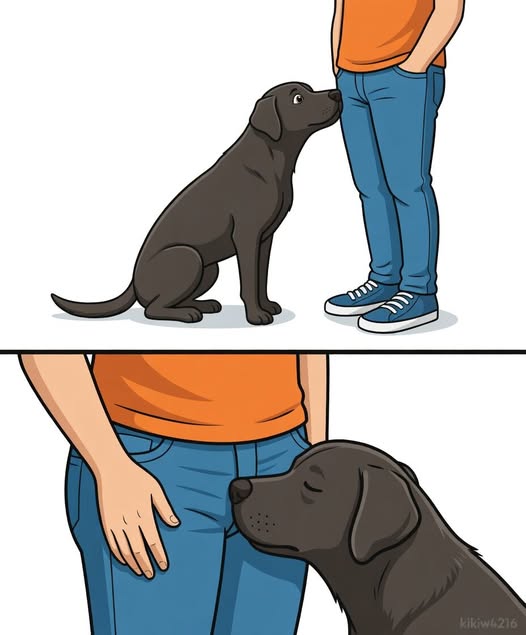
It’s one of those awkward moments most people have experienced but rarely talk about openly: a dog suddenly approaching and sniffing a very personal area of the body. The instinctive human reaction is embarrassment, confusion, or even the assumption that the dog is behaving inappropriately. Yet beneath that seemingly uncomfortable interaction lies something far more fascinating than social awkwardness. Dogs are not bound by human etiquette; they operate within a sensory world dominated by smell, a world so detailed and information-rich that it surpasses human perception in ways we are only beginning to understand. What feels intrusive to us is, to a dog, a completely natural way of gathering information—an instinctive process rooted deeply in biology, evolution, and communication. At the center of this behavior is the dog’s extraordinary olfactory system, capable of detecting subtle chemical signals that humans cannot perceive. When a dog sniffs a person’s private area, it is not acting out of mischief or lack of training. Instead, it is accessing one of the richest sources of biological data the human body produces, interpreting a complex combination of scents that reveal identity, emotional state, and even underlying physiological changes. What appears to be a simple sniff is, in reality, a highly advanced sensory investigation.
To understand this behavior, it is essential to appreciate just how powerful a dog’s sense of smell truly is. Humans rely primarily on sight, with smell playing a relatively minor role in daily life. Dogs, however, experience the world through scent as their dominant sense. Their noses contain hundreds of millions of olfactory receptors—far more than humans—and a significant portion of their brain is dedicated to processing smells. This allows them to detect incredibly faint odors and distinguish between layers of scent that would be indistinguishable to us. But their abilities go even further. Dogs possess a specialized structure known as the vomeronasal organ, which is specifically designed to detect pheromones—chemical signals released by the body that convey biological and emotional information. These signals are not consciously detectable by humans, yet they play a powerful role in communication among animals. When a dog approaches a person and focuses on areas rich in sweat glands, it is essentially analyzing these pheromones. The groin and armpit regions, in particular, contain apocrine glands that produce a type of sweat rich in chemical compounds. These compounds interact with bacteria on the skin, creating a unique scent signature for each individual. For a dog, this signature is like a detailed profile, offering insights that go far beyond simple recognition.
One of the most intriguing aspects of this behavior is the type of information dogs can extract through scent alone. When a dog sniffs a person, it is capable of identifying characteristics such as biological sex, age range, and hormonal fluctuations. Changes related to puberty, menstruation, pregnancy, or even stress can subtly alter the body’s chemical output, and dogs can detect these variations instantly. In addition, emotional states influence scent in measurable ways. When a person feels anxious, frightened, or excited, the body releases hormones such as cortisol and adrenaline, which in turn affect body odor. Dogs are highly sensitive to these changes and often adjust their behavior accordingly. This is one reason why dogs can appear comforting when their owners are distressed—they are responding to chemical cues rather than visible signs alone. Furthermore, there is growing evidence that dogs can detect certain health conditions through scent. Variations in metabolism, infection, or disease can produce unique chemical markers that dogs are capable of identifying. While not every dog is trained to recognize such changes, the underlying ability exists, making their curiosity about human scent both logical and purposeful. What might feel like an embarrassing moment is, in fact, a demonstration of a remarkable biological skill.
Another important factor in understanding this behavior is the role of evolution. Dogs are descendants of animals that relied heavily on scent for survival, navigation, and social interaction. In the wild, scent provides critical information about territory, reproductive status, and group hierarchy. Animals communicate through chemical signals in ways that humans have largely replaced with language and visual cues. However, the biological mechanisms for producing these signals still exist in humans, even if we are less aware of them. When dogs interact with each other, they commonly engage in scent-based greetings, often focusing on areas where pheromones are most concentrated. This is a normal and essential part of their social structure. When a dog applies this same behavior to humans, it is not making a distinction between species—it is simply using the most effective method it knows to gather information. From the dog’s perspective, sniffing is equivalent to a handshake, a conversation, and an introduction all at once. The misunderstanding arises because humans interpret the action through the lens of social norms, while dogs interpret it through instinct. Recognizing this difference helps shift the perception of the behavior from inappropriate to entirely natural.
Despite its biological basis, the behavior can still be uncomfortable for people, especially in social situations. Fortunately, dogs are highly adaptable and capable of learning alternative ways to interact with humans. Training plays a crucial role in shaping how a dog expresses its natural instincts. Rather than punishing the behavior, which can create confusion or anxiety, gentle redirection is far more effective. Teaching a dog to greet people by sniffing hands or sitting calmly can satisfy its curiosity while respecting human boundaries. Consistency is key, as dogs learn through repetition and positive reinforcement. Providing them with other opportunities to engage their sense of smell—such as scent-based games or exploratory walks—can also reduce the intensity of their curiosity in social settings. It is important to remember that the goal is not to eliminate the instinct, but to guide it in a way that aligns with human comfort. When approached with patience and understanding, dogs quickly learn the difference between interacting with other dogs and interacting with people. This balance allows both species to coexist harmoniously, each respecting the other’s natural tendencies and social expectations.
Ultimately, this behavior reveals something profound about the relationship between humans and dogs. It highlights the vast differences in how each species experiences the world, while also emphasizing the deep connection that has developed over thousands of years of companionship. Dogs are uniquely attuned to humans, capable of sensing changes that we ourselves may not notice. Their reliance on scent allows them to perceive layers of information that remain invisible to us, creating a form of awareness that is both practical and deeply intuitive. When a dog sniffs a person, it is not merely acting on impulse—it is engaging in a form of communication that reflects curiosity, recognition, and connection. By understanding the science behind this behavior, we can move beyond embarrassment and appreciate it for what it truly is: a glimpse into a sensory world far richer than our own. It serves as a reminder that our bodies are constantly communicating, even in ways we cannot perceive, and that our canine companions are listening to those signals with remarkable precision. In that sense, what feels awkward on the surface becomes something far more meaningful—a quiet, instinctive interaction that speaks to the extraordinary bond between humans and dogs.