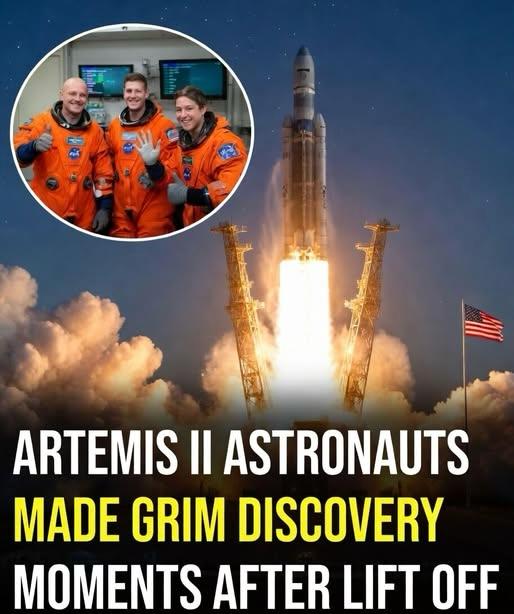
When NASA launched the Artemis II mission, it wasn’t just another milestone—it was a symbolic return to deep space, echoing the legacy of the Apollo program while stepping firmly into the future. For the first time in over 50 years, humans were once again on a path toward the Moon, carrying with them not only cutting-edge technology but also the collective anticipation of a world eager to witness a new era of exploration. Aboard the Orion spacecraft were four astronauts—Reid Wiseman, Victor Glover, Christina Koch, and Jeremy Hansen—each representing not just their respective countries, but the collaborative spirit that defines modern space travel.
Everything about the mission reflected precision, ambition, and decades of preparation. The launch from Kennedy Space Center was a carefully orchestrated event, the result of years of engineering, testing, and planning. Yet, just hours after liftoff, the mission encountered an unexpected issue—one that had nothing to do with propulsion, navigation, or communication systems. Instead, it revolved around something far more ordinary: the spacecraft’s toilet system.
At first glance, it might seem almost ironic that such a groundbreaking mission could be challenged by something so basic. But in reality, waste management is one of the most critical aspects of human spaceflight. In microgravity, even the simplest bodily functions require highly specialized systems. Without gravity, airflow, suction, and precise engineering take over roles we rarely think about on Earth. When something in that system doesn’t work as expected, it quickly becomes more than a minor inconvenience—it becomes a matter of health, hygiene, and mission stability.
The issue aboard Orion served as a reminder that space exploration, no matter how advanced, is still deeply human at its core. While the public imagination often focuses on rockets, lunar orbits, and distant horizons, astronauts must also manage the same fundamental needs as anyone else—just in an environment where every detail is magnified. A malfunction that might be trivial on Earth can become complex and urgent in space, where repair options are limited and conditions are unforgiving.
As soon as the problem was identified, teams on the ground coordinated closely with the crew. This dynamic—astronauts working in tandem with engineers back on Earth—is one of the defining features of missions like Artemis II. It reflects a system built not just on technology, but on trust, communication, and adaptability. In this case, Christina Koch played a central role in addressing the issue, carefully following instructions and applying her training to troubleshoot the system step by step.
The process required patience and precision. In space, even small adjustments can have significant consequences, and every action must be deliberate. The crew worked methodically, guided by real-time analysis from mission control. Eventually, the system was restored, bringing relief and allowing the mission to continue as planned. While the situation was resolved successfully, the moment left a lasting impression—not because of its scale, but because of what it revealed.
It highlighted a truth that often goes unnoticed: the success of a space mission depends just as much on solving everyday problems as it does on achieving extraordinary goals. The grandeur of traveling to the Moon can sometimes overshadow the reality that astronauts are living in a confined, complex environment where comfort and functionality are tightly interconnected. Systems like waste management, temperature control, and food preparation may not capture headlines, but they are essential to sustaining life beyond Earth.
Historically, this challenge is not new. During the Apollo era, astronauts relied on far more rudimentary solutions, often described as uncomfortable and inefficient. Over time, advancements have led to more sophisticated designs, improving both usability and reliability. The system aboard Orion represents decades of innovation, yet the Artemis II incident shows that even the most refined technology can encounter unexpected issues once exposed to the realities of space.
In many ways, moments like this are invaluable. They provide real-world data that cannot be fully replicated in simulations on Earth. Every challenge encountered—and resolved—adds to a growing body of knowledge that will shape future missions. As plans for longer journeys, including potential missions to Mars, continue to develop, these insights become increasingly important. A small issue today can lead to significant improvements tomorrow, ensuring that future crews are better equipped for extended time in space.
Beyond the technical lessons, the incident also humanizes the mission. It reminds us that astronauts are not just explorers or symbols of progress—they are individuals navigating an environment that demands both resilience and adaptability. The image of highly trained professionals working together to fix a practical problem in the middle of a historic journey offers a different perspective on space exploration. It shifts the focus from spectacle to experience, from achievement to process.
The Artemis II mission itself represents a turning point. It is not merely a return to the Moon, but a step toward a sustained presence beyond Earth. The program reflects a broader vision—one that includes international collaboration, technological innovation, and the long-term goal of expanding human exploration deeper into the solar system. Each mission builds upon the last, creating a foundation for what comes next.
At the same time, the realities revealed by incidents like this ensure that the narrative remains grounded. They remind us that progress is not just about reaching new destinations, but about learning how to live and work in environments that challenge every aspect of human capability. The journey is not defined solely by its milestones, but by the countless adjustments, solutions, and adaptations that make those milestones possible.
As Artemis II continues its path around the Moon, the story it tells is richer than any single achievement. It is a story of ambition and preparation, but also of humility and learning. It shows that even in the most advanced missions, success often depends on the ability to respond to the unexpected. And sometimes, those unexpected moments come from the simplest aspects of being human.
In the vastness of space, where distances are measured in thousands of miles and technology operates at the edge of possibility, it is easy to lose sight of the everyday realities that sustain life. Yet it is precisely those realities that keep astronauts grounded—both physically and mentally—as they venture beyond our planet.
The Artemis II mission captures this balance perfectly. It represents the extraordinary potential of human exploration, while also reminding us that no matter how far we travel, we carry our humanity with us. And in that sense, even the smallest challenges become meaningful, offering insight into what it truly takes to live beyond Earth—not just as explorers, but as people.