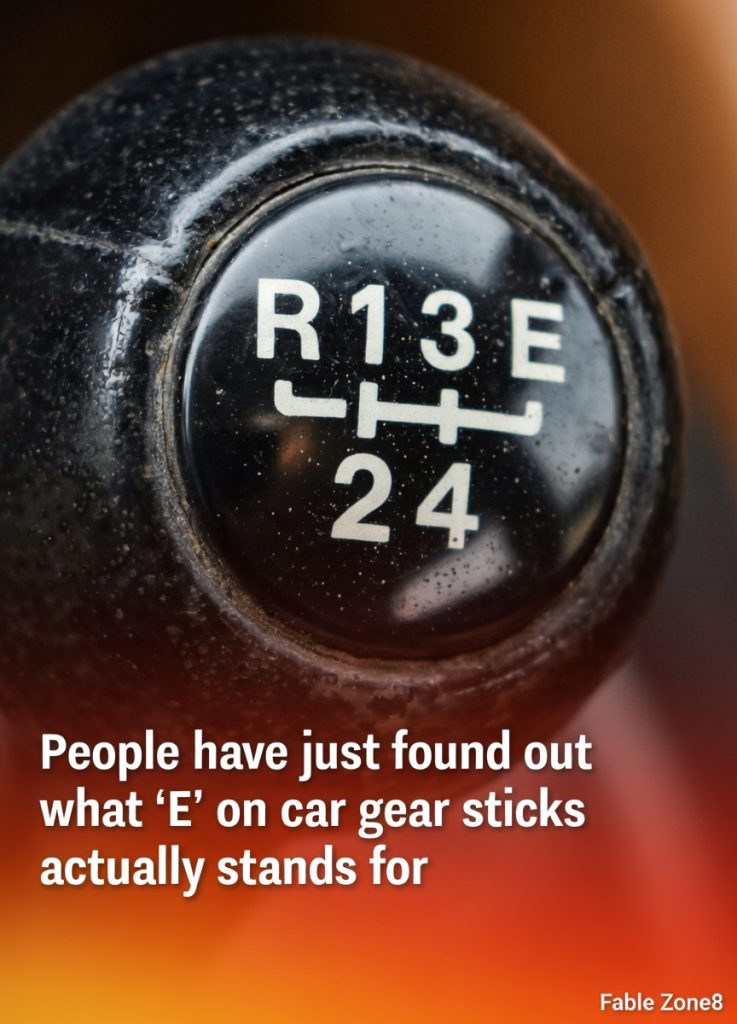
For decades, driving has followed a universal language. Whether someone learned to drive in Europe, the United States, or elsewhere, the basic layout of gear sticks felt familiar. Manual cars came with numbered gears and a reverse, while automatic transmissions simplified everything into a few letters: Park, Neutral, Drive, and Reverse. This consistency made it easy for drivers to switch between vehicles without confusion. But occasionally, something unusual appeared—something that broke that familiar pattern. That’s exactly what happened when drivers noticed a mysterious “E” on certain older gear sticks. To many, especially younger drivers, it seemed out of place—almost like a mistake. Naturally, curiosity sparked questions: what does “E” really mean?
The confusion didn’t stay contained. Online discussions soon turned into debates. Some guessed it meant “extra,” others thought “emergency,” and a few assumed it hinted at electric functionality. The mystery gained traction on social media, where drivers shared photos and stories of the elusive letter. Then experienced drivers, particularly those familiar with older European cars, clarified that “E” stood for Economy. Suddenly, what seemed like a strange, unexplained symbol became a surprisingly practical feature. It wasn’t random—it was a deliberate design choice aimed at improving fuel efficiency at a time when vehicles required more hands-on attention.
The Economy mode worked subtly but effectively. Selecting “E” encouraged the car to operate at lower engine speeds, prioritizing smoother, more efficient performance. Rather than pushing the engine to higher revolutions—which burns more fuel—the system functioned almost like an additional gear, keeping the engine relaxed during steady driving, such as highway cruising. The result was reduced fuel consumption without requiring constant driver intervention. In an era when efficiency depended heavily on driving habits, this feature gave motorists more control over fuel use. Over long trips, the savings could add up significantly.
As automotive technology advanced, however, the “E” gear gradually disappeared. Smarter systems, fuel injection, and onboard computers made manual efficiency adjustments largely unnecessary. Modern vehicles now optimize gear shifts, engine performance, and fuel delivery automatically. What once required a dedicated gear selection became something the car managed in the background. The Economy gear didn’t vanish; it simply became invisible. Efficiency persisted, but the driver no longer needed to micromanage it.
For those who remember it, the “E” gear represents a different era of driving—one that required a more hands-on relationship with the machine. Drivers once needed to know when to shift, how to manage fuel, and how to respond to road conditions. Economy mode was part of that tactile, engaged experience. Today, automation has replaced much of that mechanical awareness, offering convenience but removing the sense of intimate control that older drivers once valued.
Interestingly, the letter “E” has returned with an entirely new meaning in the modern automotive world. Today, it is far more likely to indicate Electric than Economy. Electric vehicles often use single-speed transmissions, delivering power instantly and eliminating traditional gear-shifting. Gear sticks themselves are sometimes replaced with buttons, dials, or digital controls. The “E” that once signaled fuel-saving behavior in combustion engines now symbolizes a full transition to a new era of transportation.
In the end, the story of the “E” gear is more than a curious piece of automotive trivia. It is a reflection of technological evolution. A practical solution to a specific problem can become obsolete, only to return in a completely different context. The letter “E” has traveled that path: from fuel-saving innovation to historical footnote, to emblem of the electric future. For older drivers, it recalls a time when every gear shift mattered. For younger drivers, it is a reminder that even the smallest car details can carry a story. And for the industry, it quietly illustrates progress—how past solutions can find new life in unexpected ways.