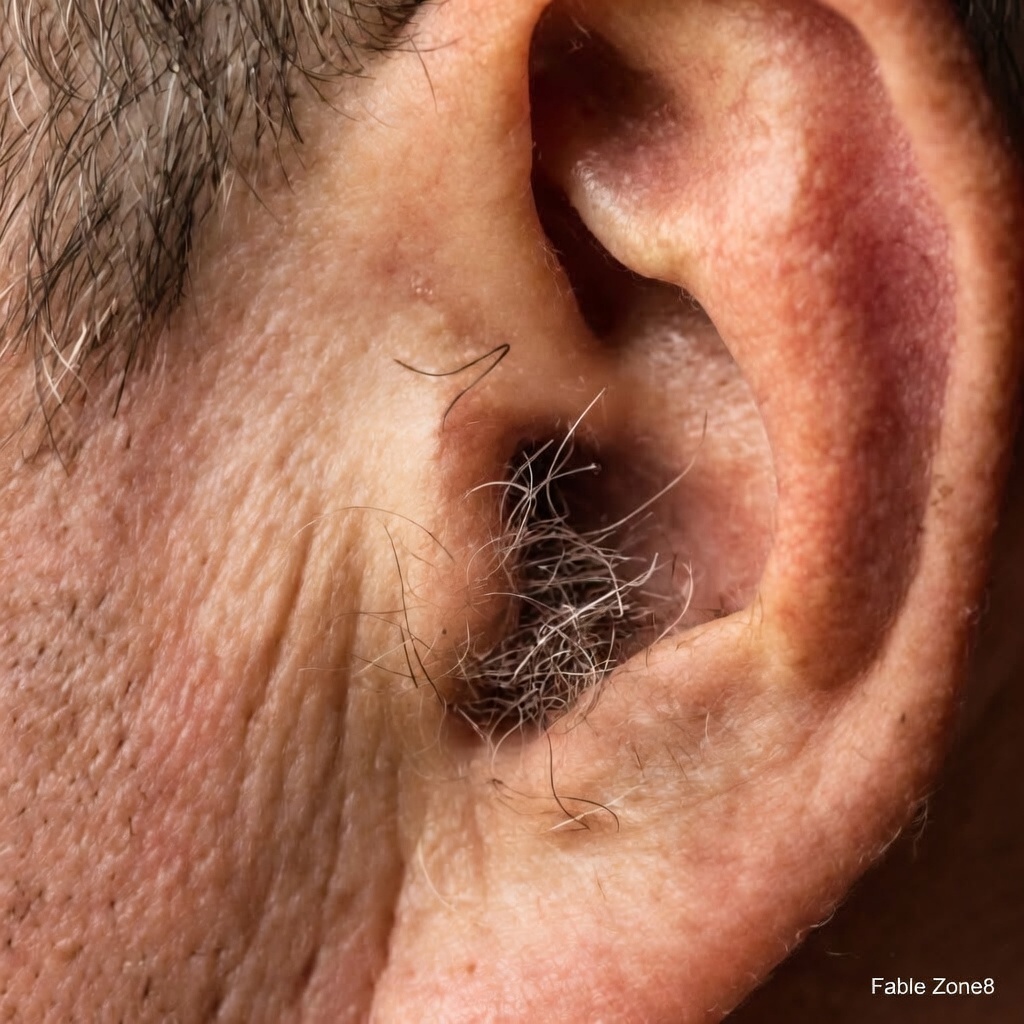
Did you know? If hair begins to grow on your ears, it is not a warning sign, not a mystery, and certainly not a disease. It is simply your body doing what it has always done—adapting to time. While it may come as a surprise when first noticed, especially later in life, ear hair growth is one of the most ordinary and natural expressions of aging. Yet despite its simplicity, it often carries unnecessary confusion, discomfort, or even embarrassment. Understanding why it happens replaces uncertainty with clarity and helps shift perspective from concern to acceptance.
The human body is not designed to remain static. It evolves continuously, responding to internal chemistry, environmental influences, and the passage of time. Aging is not a sudden event but a gradual transformation that touches every system differently. Some changes are subtle, almost invisible, while others become more noticeable because they affect outward appearance. Hair growth patterns fall into this second category. They provide visible evidence of internal shifts, particularly hormonal changes that occur over decades.
One of the most common misconceptions about aging is the belief that all systems decline in the same direction. In reality, aging is uneven and often paradoxical. While scalp hair may thin or recede, hair in other areas—such as the ears, nose, and eyebrows—may become thicker, longer, or more prominent. This contrast can feel confusing, even contradictory. How can the same body lose hair in one place and gain it in another? The answer lies in how hair follicles respond differently to hormones depending on their location.
Hair follicles are present across most of the body, but they are not identical. Each group of follicles has its own sensitivity to hormones, particularly androgens—male-associated hormones such as testosterone and its derivative, dihydrotestosterone (DHT). Over time, the balance of these hormones shifts. Levels may decrease overall, but the responsiveness of certain follicles can increase. This means that even with less circulating hormone, some areas become more reactive, producing thicker or longer hair.
The ears are among these areas. As sensitivity increases, hair that was once fine and barely visible begins to grow more noticeably. This change does not happen overnight. It unfolds gradually, often becoming apparent in middle age or later. For many, it appears suddenly only because it crosses a threshold of visibility—not because it began suddenly.
Although this process is most commonly associated with men, it is not exclusive to them. Women experience similar changes, particularly after menopause. As estrogen levels decline, the relative influence of androgens becomes more pronounced. This shift can lead to subtle increases in hair growth in areas that were previously less active, including the ears. While the extent may differ, the underlying mechanism is the same: hormonal balance changing with time.
Genetics also plays a decisive role. If ear hair was prominent in older family members, it is more likely to appear in future generations. This is not coincidence but inheritance. Genes determine how many follicles are present, how sensitive they are to hormones, and how long each hair remains in its growth phase. Some people will notice only minimal changes, while others may see more pronounced growth. Both outcomes fall within the range of normal human variation.
From an evolutionary perspective, ear hair is not without purpose. Though it may seem unnecessary in modern life, it serves protective functions that date back to earlier stages of human development. Fine hairs at the entrance of the ear canal help trap dust, debris, and small particles before they can enter deeper structures. They also provide a barrier against insects and environmental irritants. In youth, this hair is subtle and often invisible. With age, as growth cycles lengthen and thickness increases, its presence becomes more noticeable.
This shift in visibility often leads to misunderstanding. Because ear hair becomes apparent later in life, it is sometimes interpreted as something abnormal. In truth, it has always been there. What changes is not its existence, but its expression. The body is not introducing something new—it is simply continuing a process that has been quietly ongoing.
Despite this, myths persist. Some believe that ear hair is linked to poor circulation, organ dysfunction, or serious health conditions. Others assume it signals hormonal imbalance in a pathological sense. These ideas are not supported by medical evidence. Ear hair growth is not used as a diagnostic marker for disease. It is not an indicator of liver problems, kidney issues, or systemic failure. It reflects normal biological aging, nothing more.
Another common misconception is that removing ear hair causes it to grow back thicker. This belief is widespread but incorrect. When hair is cut or shaved, the tip becomes blunt rather than tapered, which can make it appear thicker as it regrows. However, the structure of the follicle—and therefore the actual thickness of the hair—does not change. Growth rate and density remain the same.
The persistence of these myths highlights how easily natural changes can be misunderstood when they are not discussed openly. Because ear hair is rarely talked about in everyday conversation, it becomes something people notice privately and interpret without context. This lack of information often leads to unnecessary concern.
Beyond the physical explanation, there is also a psychological dimension to consider. Modern culture places a strong emphasis on youth, often equating aging with decline or loss of value. Visible signs of aging, including ear hair, can therefore carry emotional weight that goes far beyond their biological significance. People may feel self-conscious, not because the change is harmful, but because it conflicts with societal expectations.
This response is understandable, but it is important to recognize its source. The discomfort does not come from the body itself—it comes from the meaning assigned to it. When aging is viewed negatively, natural changes are interpreted as flaws. When aging is understood as a normal and inevitable process, those same changes can be seen as neutral or even meaningful.
Grooming practices reflect this balance between personal preference and social influence. Some individuals choose to trim ear hair regularly, finding it more comfortable or aesthetically pleasing. Others choose not to, seeing no need to alter something that is natural. Both approaches are valid. Grooming is not a medical requirement; it is a personal decision.
For those who do choose to manage ear hair, safety is important. Small electric trimmers designed specifically for this purpose are widely available and easy to use. Rounded-tip scissors can also be effective when used carefully. What should be avoided is any method that risks injury to the ear canal, such as inserting sharp tools without clear visibility or attempting to remove deeply rooted hairs through force. The goal, if grooming is desired, is simple maintenance—not aggressive removal.
It is also worth noting that gradual ear hair growth over time is entirely normal. However, if hair growth appears suddenly and extensively across multiple areas of the body, it may be influenced by external factors such as medications or rare medical conditions. These cases are uncommon and typically accompanied by other noticeable symptoms. In the absence of such signs, ear hair alone does not warrant concern.
Ultimately, what ear hair represents is not change gone wrong, but change unfolding as expected. The body is not trying to preserve a youthful appearance indefinitely. Its priority is function, not aesthetics. Hair growth patterns shift because the body’s internal priorities shift. These changes may not align with cultural ideals, but they align perfectly with biology.
There is a broader lesson in this. Many aspects of aging are misunderstood because they are viewed through the lens of comparison—how the body used to be versus how it is now. This perspective can create a sense of loss. But if aging is viewed instead as a process of transformation, each change becomes part of a larger narrative. Ear hair, like gray hair or wrinkles, is simply one chapter in that story.
In earlier generations and in many cultures around the world, visible signs of age were associated with wisdom, experience, and authority. They were markers of time lived and knowledge gained. While modern perspectives have shifted, the underlying truth remains: aging reflects continuity, not failure.
The presence of ear hair does not diminish a person’s vitality, intelligence, or worth. It does not signal decline in the way it is often assumed to. It is, in the simplest terms, a reminder that the body continues to adapt as life progresses.
So the next time you notice it—whether in yourself or someone else—it can be seen differently. Not as something to question or hide, but as something to understand. A quiet, visible sign that the body is still doing exactly what it was designed to do.
No alarm.
No mystery.
No hidden meaning.
Just time, expressed in one of its many forms.
And time, lived fully, is never something to be ashamed of.