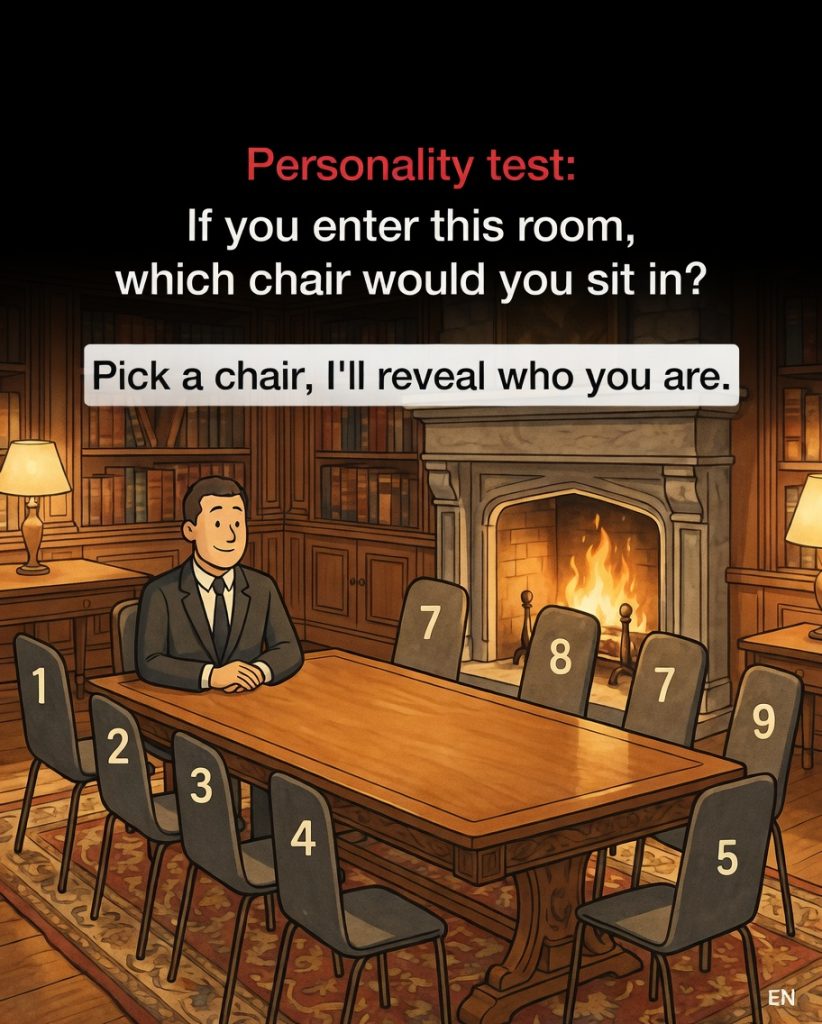
There is something quietly revealing about the choices we make when no one is watching closely—when there are no rules, no expectations, and no clear “right” answer. Sometimes, it is in these simple, instinctive decisions that we expose the most honest version of ourselves. Imagine, for a moment, stepping into a warmly lit, wood-paneled room. The glow of a crackling fireplace fills the space with soft, flickering light. Shelves lined with old books rise along the walls, and the faint scent of polished oak lingers in the air. At the center of the room stands a long table, surrounded by nine distinct chairs, each one offering a slightly different perspective of the space. At the head of the table sits a composed figure, quietly observing. You are invited to sit—but where?
It sounds like a simple choice, yet it carries surprising depth.
Without overthinking, most people feel drawn to a specific seat almost immediately. That instinct is not random. It is shaped by personality, past experiences, social tendencies, and subconscious preferences. This is what makes the exercise so compelling. Rather than answering a series of structured questions, you are simply responding to an environment—allowing your natural inclinations to guide you. And in doing so, you reveal patterns that often go unnoticed in everyday life.
This personality test has gained popularity not because it is scientifically rigid, but because it feels accurate in a deeply intuitive way. People recognize themselves in the descriptions. They see their habits reflected in their choices. They begin to understand why they behave the way they do in group settings, relationships, and moments of decision.
The room itself plays an important role in this process. It is not cold or clinical. It is warm, inviting, slightly formal but not intimidating. This balance encourages honesty. You are not trying to impress anyone—you are simply choosing where you feel most comfortable. And comfort, in this context, is incredibly revealing.
Each chair represents a different relationship to power, connection, independence, and emotional space.
Chair 1, positioned closest to the head of the table, naturally attracts those who are drawn to leadership. These individuals often feel comfortable taking initiative and being seen. They are decisive, confident, and willing to step forward when others hesitate. Sitting here suggests a personality that does not shy away from responsibility. You likely enjoy influencing outcomes and being part of important conversations. However, this strength can sometimes come with a subtle challenge—a tendency to take on too much control or to assume that others expect you to lead at all times. Growth for this type often involves learning when to step back and allow others to contribute equally.
Chair 2, just beside the most prominent position, reflects a slightly different dynamic. Those who choose it are often strong, capable individuals who prefer influence without full exposure. You are likely strategic, thoughtful, and highly aware of group dynamics. You support leadership while still maintaining your own voice. People often rely on you because you are dependable and perceptive. However, you may occasionally hesitate to claim recognition for your contributions. Your path forward lies in embracing your ability to lead when the moment calls for it, rather than always remaining in a supporting role.
Chair 3 represents balance. If this seat feels right to you, it suggests that you value connection without losing your independence. You are adaptable, easy to talk to, and often serve as a bridge between different personalities. People feel comfortable around you because you neither dominate nor withdraw. This makes you socially effective, but it can also lead to over-accommodation. You may find yourself prioritizing harmony over your own needs. Learning to set boundaries while maintaining your natural warmth is key to your growth.
Moving toward the center, Chair 4 attracts those who are grounded and practical. You are likely someone who values stability, logic, and thoughtful decision-making. You do not rush into situations—you observe, analyze, and act with intention. Others see you as reliable and steady, someone who can be trusted to handle responsibilities without drama. However, this preference for stability can sometimes limit your willingness to embrace change. Growth for you comes from allowing a bit more flexibility and openness to new experiences.
Chair 5, positioned further away from the center of attention, often appeals to independent thinkers. If you chose this seat, you likely value autonomy and personal space. You are comfortable forming your own opinions and do not feel the need to follow group expectations. Creativity and introspection are often strong traits here. You may prefer depth over constant interaction. While this independence is a strength, it can sometimes create distance from others. Building connections without sacrificing your individuality is an important balance to maintain.
On the right side of the table, Chair 6 introduces a more dynamic and energetic personality. This choice suggests someone who enjoys variety, movement, and social interaction. You are likely outgoing, curious, and quick to adapt to new situations. People are drawn to your energy and sense of humor. You bring life into conversations and help create a positive atmosphere. However, you may occasionally struggle with consistency or long-term focus. Developing structure while maintaining your spontaneity can help you achieve greater stability.
Chair 7, closer to the warmth of the fireplace, reflects emotional depth and empathy. If this is your choice, you are likely someone who values connection on a meaningful level. You are intuitive, caring, and deeply attuned to the emotions of others. People trust you because you listen and understand without judgment. You create safe spaces for others, often becoming the person people turn to in times of need. The challenge here is avoiding emotional exhaustion. Learning to protect your own energy while continuing to care for others is essential.
Chair 8 blends ambition with a desire for comfort. Those who choose this seat often have strong goals but also appreciate stability and security. You are driven, focused, and capable of building something lasting. At the same time, you value meaningful relationships and personal well-being. This balance makes you both practical and passionate. However, you may sometimes place too much pressure on yourself to succeed. Allowing room for rest and imperfection can lead to a healthier, more sustainable path.
Finally, Chair 9, closest to the fire’s intensity, represents vision and inspiration. If you felt drawn here, you likely think in big ideas. You are imaginative, forward-thinking, and motivated by purpose rather than routine. You see possibilities where others see limits. This makes you a natural innovator and, at times, an inspiring leader. However, your challenge may lie in grounding your ideas into practical action. Turning vision into reality requires patience and structure—skills that complement your natural creativity.
What makes this test so powerful is not the labels themselves, but the patterns they reveal. Each chair highlights a different way of interacting with the world—how you approach power, how you connect with others, and how you balance independence with belonging.
It is also important to recognize that no single choice defines you completely.
You may see yourself in multiple descriptions. Your choice might even change depending on your mood, your experiences, or the stage of life you are in. This flexibility is part of what makes personality so complex and fascinating. The test is not meant to confine you—it is meant to illuminate tendencies you may not have fully recognized.
In real life, we are constantly choosing “chairs” in a metaphorical sense. We decide when to step forward and when to observe, when to lead and when to support, when to connect and when to withdraw. These decisions shape our relationships, our careers, and our personal growth.
By becoming aware of your natural inclinations, you gain the ability to make more intentional choices.
If you tend to choose positions of control, you can practice collaboration. If you prefer distance, you can explore deeper connection. If you are naturally empathetic, you can strengthen your boundaries. Each insight becomes an opportunity—not a limitation.
This is why such a simple exercise continues to resonate with so many people. It transforms an ordinary moment into a mirror, reflecting not just who you are, but who you are becoming.
So if you find yourself imagining that room again—the fire softly crackling, the chairs quietly waiting—consider not only where you would sit, but why.
Because sometimes, the smallest choices reveal the biggest truths.