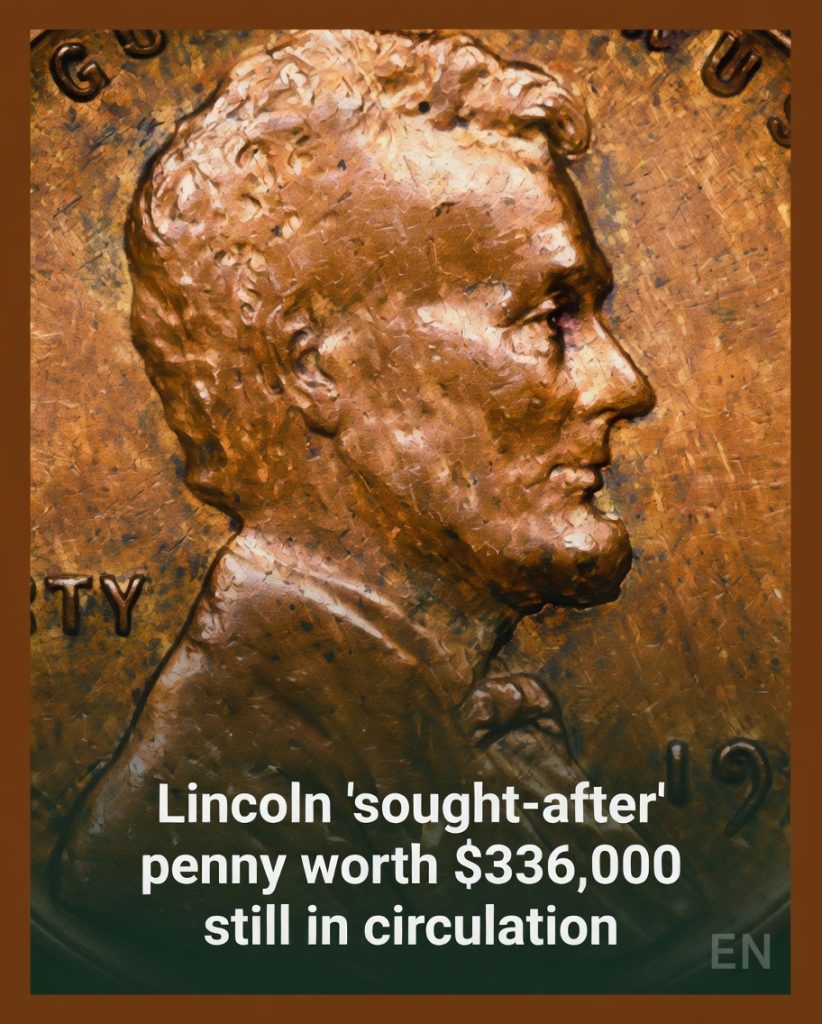
Most people rarely think twice about the coins they carry. Pennies, in particular, are often dismissed as the least valuable form of currency—small, copper-toned reminders of transactions that feel almost insignificant in modern life. They collect in jars, disappear into couch cushions, and pile up in forgotten drawers without ever drawing attention. Yet hidden among these ordinary coins, there exists a rare and extraordinary possibility—one that has fascinated collectors, historians, and everyday people for decades. A single penny, struck under unusual circumstances during one of the most turbulent periods in modern history, could be worth more than a luxury home, a lifetime of savings, or even generations of financial security.
That coin is the 1943 Bronze Lincoln penny, and its story begins in a time when the world was at war and even the smallest resources were considered critical to survival.
In 1943, the United States was deeply engaged in World War II. The war effort required enormous amounts of raw materials, and copper was among the most valuable. It was used extensively in ammunition, wiring, communications equipment, and countless other military applications. To support the war, the U.S. Mint made a significant decision: it would temporarily stop using copper to produce pennies. Instead, that year’s pennies would be made from zinc-coated steel—a practical but visually striking change that gave the coins a silvery appearance unlike anything Americans had seen before.
This shift was efficient and necessary, but like many large-scale changes implemented under pressure, it was not entirely flawless.
Before the transition, billions of bronze planchets—metal discs used to strike coins—had been produced for the 1942 pennies. When production switched to steel in 1943, a few of these leftover bronze blanks remained inside the minting machinery. They were not meant to be used again, but in the complexity and urgency of wartime production, a handful slipped through unnoticed. When the presses began striking the new 1943 pennies, these leftover bronze planchets were accidentally stamped with the new date.
The result was something no one had intended: a 1943 penny made of bronze.
At the time, no one realized the significance of this mistake. The coins entered circulation quietly, indistinguishable to most people who handled them. They passed from hand to hand, used in everyday purchases, lost, saved, or forgotten entirely. It wasn’t until a few years later that their existence began to attract attention.
In 1947, reports started to surface of unusual 1943 pennies that did not match the steel versions everyone recognized. These coins were darker, warmer in color, and notably different in texture. At first, many assumed they were fakes or altered coins. The idea that such an error could have occurred seemed unlikely, even implausible.
The U.S. Mint initially denied their authenticity, suggesting that any copper-colored 1943 pennies were the result of tampering or misidentification. However, as more examples appeared and experts began to examine them closely, the truth became undeniable. Metallurgical tests confirmed that these coins were made of the same bronze alloy used before the war—approximately 95 percent copper, with small amounts of tin and zinc.
What had once been dismissed as rumor was now recognized as one of the most remarkable minting errors in American history.
The rarity of these coins is almost unimaginable. Experts estimate that fewer than twenty genuine 1943 bronze pennies exist across all mints. Some were struck in Philadelphia, which did not use a mintmark, while others came from Denver and San Francisco, marked with a small “D” or “S.” Each coin has been carefully studied, cataloged, and tracked over the years, making every known example a documented piece of history.
This extreme scarcity is what gives the coin its extraordinary value.
Over the decades, these pennies have sold for staggering amounts. One example reached $1.7 million at auction, while others have consistently sold for hundreds of thousands of dollars. Even coins in less-than-perfect condition can command prices that most people would never associate with a single cent.
But what truly fuels the fascination is not just the money—it is the possibility.
Unlike rare paintings locked away in galleries or jewels kept in vaults, these coins were once part of everyday circulation. They were used to buy groceries, pay for bus fare, or sit unnoticed in a handful of change. This means that, at least in theory, one could still be out there, waiting to be discovered by someone who simply takes the time to look.
This idea has transformed the 1943 bronze penny into something more than a collector’s item. It has become a symbol of hidden opportunity—a reminder that extraordinary value can exist in the most ordinary places.
Over the years, countless people have searched for one. Children have examined their pocket change with curiosity, collectors have scoured coin rolls from banks, and families have poured out jars of old coins onto kitchen tables, hoping to uncover something remarkable. The search itself has become part of the story, blending hope, curiosity, and a touch of imagination.
Of course, not every 1943 penny is valuable.
The vast majority of pennies produced that year were made of steel, and they are relatively common. These coins can be easily identified by their silver color and their magnetic properties. A simple magnet test can quickly distinguish them from bronze coins, which are not magnetic. However, even this test is not foolproof, as counterfeit versions have been created over the years.
Some fakes involve copper-plated steel pennies designed to mimic the appearance of the real thing. Others are altered coins, such as 1948 pennies where the “8” has been modified to look like a “3.” These imitations can be convincing at first glance, which is why authentication by professionals is essential for any coin believed to be genuine.
Despite the presence of counterfeits, the allure of the real coin remains as strong as ever.
Part of what makes the 1943 bronze penny so captivating is its connection to history. It is not just a rare object; it is a physical reminder of a time when the world was undergoing profound change. Every detail of the coin reflects that moment—the decision to conserve copper, the challenges of wartime production, and the human element that allowed a small mistake to slip through.
It is, in many ways, a perfect intersection of necessity and chance.
Beyond its historical significance, the coin also represents something deeply human: the idea that value is not always obvious. A coin that looks like any other penny could, under the right circumstances, be worth a fortune. This challenges the way we think about everyday objects and encourages us to look more closely at the world around us.
There are also stories—real, documented stories—that keep this legend alive.
One of the most famous involves a teenager who discovered a 1943 bronze penny in his school cafeteria change. At the time, he had no idea of its significance. He simply kept it, perhaps out of curiosity or a vague sense that it was unusual. Decades later, that same coin would be authenticated and sold for a substantial sum, transforming what had once been a simple find into a remarkable piece of history.
Stories like this resonate because they feel accessible. They suggest that discovery is not limited to experts or professionals. Sometimes, it belongs to ordinary people who happen to notice something others overlook.
Today, many of these rare coins are held in private collections or displayed in museums, where they are carefully preserved and studied. They are treated not just as valuable objects, but as historical artifacts—evidence of a unique moment when global events influenced even the smallest details of daily life.
And yet, the possibility remains that not all of them have been found.
It is entirely plausible that one could still exist, tucked away in an old coin jar, hidden in a drawer, or passed down unknowingly through generations. Perhaps it sits among dozens of other pennies, indistinguishable to anyone who has not taken the time to examine it closely.
That possibility is what keeps the story alive.
In a world where so much feels predictable and controlled, the idea that something so valuable could still be waiting to be discovered offers a sense of wonder. It invites people to slow down, to pay attention, and to consider that even the most familiar objects might hold unexpected significance.
So the next time you come across a handful of change, take a moment before you set it aside.
Look closely at the pennies. Check the date. Notice the color. Try a magnet if you have one nearby.
It may seem like a small effort, almost trivial.
But sometimes, the smallest actions lead to the most extraordinary discoveries.