I never expected that cleaning out my grandmother’s closet would feel like stepping into another century.
At first, I approached the task with quiet practicality. The plan was simple—sort through her clothes, set aside donations, fold what remained, and bring some sense of order to a space that had been untouched for months. Her sweaters still carried the faint scent of lavender. Her scarves, many of them hand-knitted, held the softness of winters that seemed harsher, slower, more meaningful than those we know now.
But practicality dissolves quickly in places like that.
Every object begins to carry weight. Memory settles into your hands, slowing you down, asking you to notice.
My grandmother had been gone for six months, yet the room still felt inhabited. The hangers were aligned perfectly, just as she liked them. The curtains held their careful folds. Even the air felt warm, touched by the ghost of her presence. I had delayed this task for weeks, convincing myself I simply wasn’t ready. The truth was simpler—there is no right moment to dismantle the physical traces of someone who shaped your life.
Eventually, you begin anyway.
It was in the far corner of the closet, behind winter coats and a stack of aging books, that I found it—a small, plain cardboard box, tucked away with quiet intention. It wasn’t something I recognized. Its placement suggested care, not neglect. My grandmother had never kept anything without purpose.
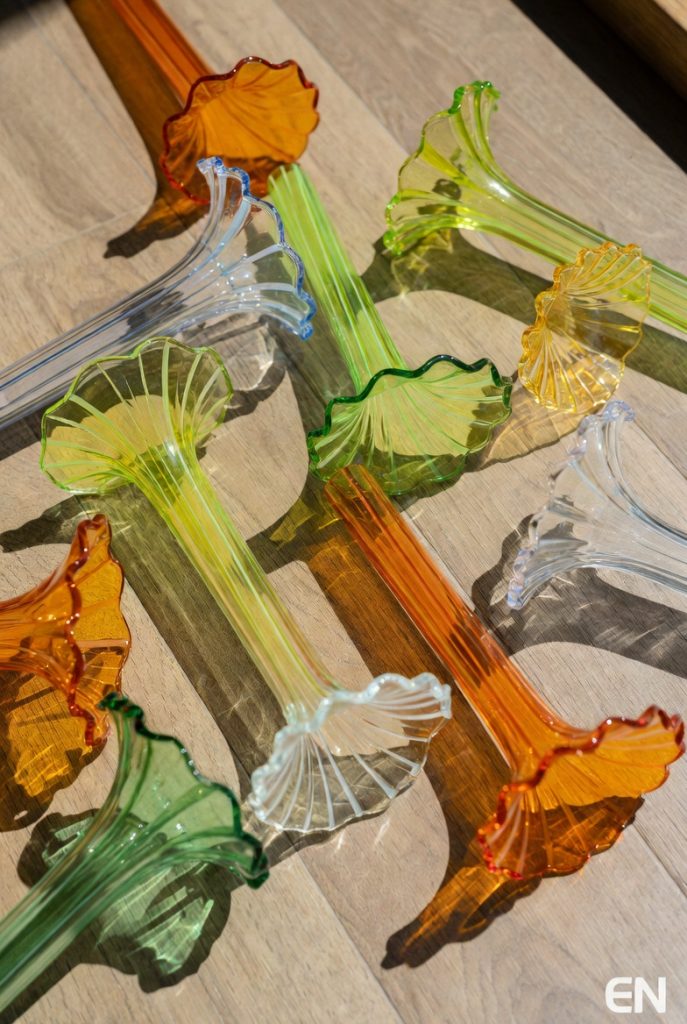
When I lifted the lid, I expected something familiar—old jewelry, letters, photographs. Instead, I found a collection of delicate glass tubes.
They were exquisite.
Each one was slightly different—some long and slender like drops of rain, others gently curved, almost organic in shape. Soft colors swirled through the glass: pale blue, muted green, faint pink. At the top of each tube was a tiny metal hook, worn with time. They looked fragile, almost impossibly so, like something that belonged to another era.
I held one in my hand, turning it carefully. It was light, smooth, clearly handmade. Beautiful—but puzzling.
They resembled miniature vases, yet too small to make sense. What could they have been used for? Why the hooks? Why so many of them, all preserved so carefully?
I brought the box into the living room and sat with it for a long time, the silence of the house pressing gently around me. Something about them felt important, even if I didn’t yet understand why.
That afternoon, I visited my great-aunt—my grandmother’s sister—hoping she might recognize them.
The moment she saw one, her expression changed.
Recognition softened her face, and for a brief moment, time seemed to fold inward.
“Oh my,” she whispered, holding it with reverence. “I haven’t seen these in decades.”
“What are they?” I asked.
She smiled, as if amused by how distant the past had become.
“They’re miniature vases,” she said. “Men used to carry them in their jacket pockets.”
I stared at her, unsure whether I had heard correctly.
She laughed gently at my confusion.
“It was a different time,” she explained. “A single flower, carried like a gesture. These held just one bloom—something small, but meaningful. Men wore them when they went out. Some did it for style. Some for romance. And some because they believed beauty, even in small forms, mattered.”
The idea felt almost foreign—and yet, strangely moving.
“And my grandmother kept them because…?”
Her expression shifted, softening further.
“They were your grandfather’s.”
The words settled heavily between us.
I had never met him. To me, he had always existed only in photographs and passing stories—a distant figure, more legend than person. But suddenly, he became real.
“He wore them?” I asked quietly.
“Every Sunday,” she said. “One fresh flower when he took your grandmother for a walk. It became his signature. People remembered him for it.”
I imagined him then—not as an abstract memory, but as a man: careful, attentive, quietly expressive. A man who carried a single flower not for display, but for meaning.
My great-aunt went on, her voice filled with memory. He had been observant, she said. Gentle. The kind of person who noticed small details—the way light shifted through a room, the subtle beauty in ordinary things. The vases weren’t just accessories; they were part of how he moved through the world.
“And your grandmother,” she added softly, “kept them because she couldn’t let go of him.”
Everything changed in that moment.
The box I had found was no longer a curiosity—it was a love story, preserved in glass.
When I returned home, the house felt different. Fuller, somehow. As if something unspoken had finally been revealed.
I began to see my grandmother differently.
The small rituals I had overlooked—the fresh flower she placed on the kitchen table every Sunday, the books she kept beside her bed, the quiet way she watched the sunset—were no longer habits. They were continuations. Echoes of a love she had carried silently for decades.
I had always thought of her as reserved, practical, composed.
I had been wrong.
She had loved deeply. She had simply chosen to keep that love private, protecting it in small, sacred ways.
As I continued sorting through her things, I found a notebook filled with pressed flowers. Each one dated. Some tied to family milestones, others to moments only she would have understood. It read like a diary without words—a life documented through petals and memory.
The more I discovered, the more I understood: we inherit more than we realize.
Perhaps my own fondness for fresh flowers wasn’t random. Perhaps it was something passed down quietly, an echo traveling through generations.
In the end, I kept the vases.
I placed them in my home, not hidden, but visible. I chose one—a pale pink glass tube—and placed a single fresh flower inside it.
A small gesture.
A continuation.
And in that moment, I realized that what I had found in my grandmother’s closet was not just an object, or even a tradition.
It was a bridge—between past and present, between memory and understanding, between the people we think we know and the lives they quietly lived beyond our view.